

Water Leaking Into Your Meter Box: What It Actually Means
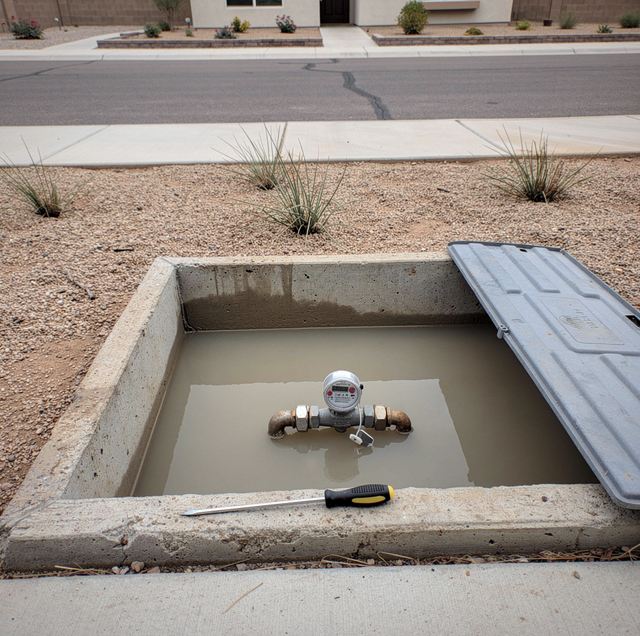
Quick Answer: Water standing in a meter box is a starting observation, not a diagnosis. Rain, groundwater, and irrigation overspray account for most wet vaults, and sorting those out first is what makes a real leak stand out from ordinary weather.
You crouch at the curb, wedge a flathead screwdriver under the lip of the meter box lid, and pry it free. Instead of the dry meter and coiled wire you expected, the vault is half full of water, the dial barely visible under a couple inches of cloudy liquid. The instinct is to assume the worst, but water sitting in that box on its own doesn't automatically mean a plumbing leak. It means something is putting water there, and figuring out what is a process of elimination, not a guess.
What a Wet Meter Box Usually Means
A meter box is a buried vault set into the ground, usually with only a thin lid separating it from the surface. That makes it one of the lowest, most exposed points along the entire water line, so it collects whatever is moving through the soil around it long before it collects anything from a genuine leak. Expansive, dense soil common in the region holds moisture against the box walls for days after it rains, which is why a box can still be wet well after a storm has passed, even when the yard looks dry again. None of that rules out a leak. It just means the box being wet is the starting observation, not the conclusion.
Rainwater, Groundwater or Irrigation Overspray
Three ordinary sources account for many wet meter boxes with nothing wrong at the pipe. Heavy rain can run straight through a lid that doesn't seat flush, filling the vault just as it would fill a shallow depression elsewhere in the yard. Groundwater can seep in from the surrounding soil after sustained wet weather even with a tight lid, since the box is set below grade and concrete isn't watertight. Sprinkler or drip irrigation aimed too close to the box can overspray into the same gap the lid leaves for the meter reader's key. Neither cause is seasonal in one direction only: storm runoff shows up during storm season, while overspray and groundwater from routine watering occur the rest of the year, so a wet box in any month deserves the same look rather than being written off as "just the season."
[NOTE: A box that dries out completely between watering cycles and only reappears wet after rain or a sprinkler run points toward runoff, not a leak. One that refills within a day or two of being emptied points the other way.]
Water Before the Meter or Water After It
The pipe has two segments on either side of the meter: the run that comes in from the main toward the box, and the line that continues out of the box toward the house. Water pooling near the fitting on the street-facing side of the meter points to the segment before the meter; water pooling near the fitting that feeds toward the house points to the segment after it. Neither location tells you who will address it, only which stretch of pipe is worth a closer look.
A technician sorts through several details before treating standing water as confirmation of either one. Where the wet fitting sits relative to the meter body carries the most weight: upstream toward the street versus downstream toward the house changes which segment gets attention first. How high the water stands relative to the pipe entering the vault matters as well, along with whether the ground around the box is saturated in a wide ring or damp only at the rim of the lid.
None of this is a homeowner project. The point of gathering these details is to hand a technician a clearer starting picture, not to diagnose the pipe from the curb.
When the Lid Itself Is Part of the Problem
Sometimes the box has been sitting under drifted soil, gravel, or grass clippings for so long that the lid is essentially buried. That creates two separate problems that get mistaken for one. First, a caked-over lid traps whatever water lands on it instead of letting it run off, so the vault holds moisture longer than a clear box would, even from an ordinary rain. Second, the same buildup can hide the register face entirely, which means nobody, not the utility's meter reader and not you, has actually seen a current reading in a while. A packed lid is worth clearing on its own, separate from whatever the water turns out to mean, simply so the box can be read and inspected instead of guessed at, and so that if the water does turn out to be a leak, the detection specialist who traces it and the plumbing contractor who repairs what gets marked are both working from a vault they can actually see into.
What Happens After You Find Water in the Box
The most useful thing to do with a wet box is turn one observation into a short record. Sponge or bail the vault dry, note the date, then look again after the next irrigation cycle and again after the next rain. A box still dry through both was catching runoff. A box that has refilled by the following morning with no rain and no watering in between has answered a question a single glance never could.
Two other details are worth writing down while you are at the curb. The first is whether the lid seats flush on its rim or rocks when you set it back down, since a lid that no longer sits square keeps letting surface water in no matter how many times the vault is emptied. The second is whether the soil immediately around the box has slumped or settled relative to the rest of the yard. A shallow depression forming over a buried line is one of the few surface clues a below-grade loss ever gives, and it is easy to walk past while looking down into the box rather than at the ground around it.
Frequently Asked Questions
Yes, and grade matters as much as soil does. Dense clay-heavy soil common in this region holds water against a buried vault's walls after a storm even once the surrounding ground looks dry on the surface. On top of that, a box sitting at the low point of a graded lot collects runoff from the entire slope above it, so two boxes on the same street can behave completely differently after the same rain, one dry by morning and the other still holding water.
Clear water actively welling up near a specific fitting behaves differently than cloudy, sediment-heavy water sitting flat at the bottom of the vault; the first pattern is more consistent with an active source at that fitting, while the second is more consistent with runoff or seepage that has simply pooled and settled. A dry box can be read the same way: a fine rust bloom or orange staining part of the way up the vault wall marks the high-water line from an earlier episode, so a box holding nothing today may still have filled repeatedly before.
Over months or years, a lid packed under soil and moisture keeps standing water against the meter body itself. On many residential meters, the register sits under a lens sealed only well enough to shed splash and rain, not to be submerged for weeks at a time, and a seal that degrades that way lets moisture under the lens, fogging or staining the face until the numbers cannot be read at all.
Municipal supply water typically carries a faint chlorine odor, while groundwater seeping in from the surrounding soil generally doesn't, so a chlorine smell coming from the box is one more detail that points toward supply water rather than rain or groundwater.
On some meter models, water deep enough to submerge the register can fog the glass face or corrode the internal read-out contacts over time, which is a separate concern from whatever put the water there in the first place.
Indirectly, and not in the way most people expect. A register sitting underwater or buried in silt cannot be read, and a meter reader who cannot see the numbers submits an estimate instead of an actual reading. That estimate gets reconciled against a real reading on some later visit, which can produce a catch-up jump or a credit on a bill weeks or months afterward, entirely separate from whatever put the water in the box.
Get a professional read on what's in your meter box — a plumbing contractor can help sort what's happening in your line from what's just weather. American Discount Plumbing serves Phoenix and the Valley. ROC #150707. Call (602) 883-2787.
