

How Plumbers Find Hidden Leaks Before Anything Is Cut
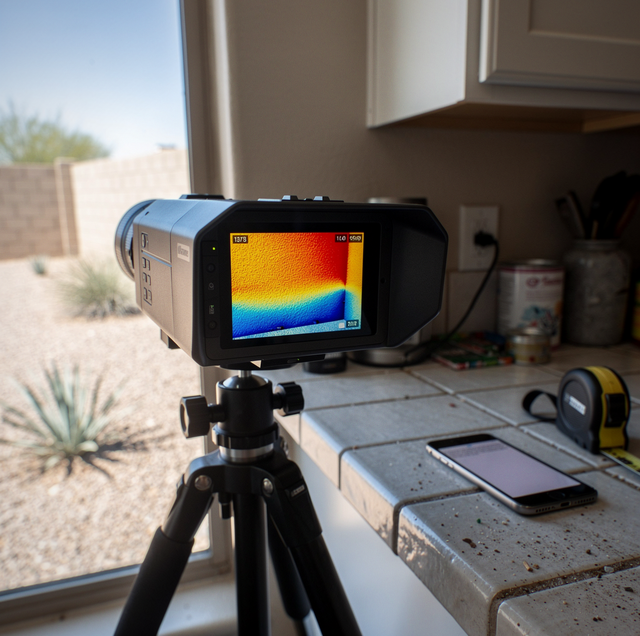
Quick Answer: A hidden leak must be located before any wall, floor, or slab is opened. A dedicated detection specialist narrows the source with specialist equipment, and the plumbing contractor then cuts once, at the marked spot.
The sentence arrives early in the phone call, and it sounds reasonable enough. We will need to open the wall before we can tell you where the leak is. You are standing over a dark patch spreading out from under the baseboard; you want somebody to do something, and opening a wall is unmistakably that.
It is worth hearing what that sentence commits you to. It buys a hole in a finished surface, positioned by a guess, in exchange for information that may not be behind it. A wall opened at the stain and dry inside is what a guess looks like after it has already been tried once, and the water showed itself there for reasons that have little to do with where it left the pipe. The question worth asking before anyone picks up a saw is not where the stain is, but where the leak is. Those are two different addresses.
What Opening the Wall First Actually Destroys
Exploratory demolition feels like progress. What is actually happening is that a permanent decision is being made on temporary information.
Every opening is one-way: Drywall can be patched, but tile, stone, engineered flooring, and poured concrete cannot be put back the way they were. An opening in a tiled shower wall is not a patch job; it is a matching problem, and the tile installed eight years ago is usually out of production. A cut in a slab is the extreme version of the same trade: fast to make, slow and disruptive to close.
Each new hole widens the damaged area: While the search continues, the pipe is still leaking. Every hour spent looking is another hour of water moving into framing, insulation, and flooring that a separate trade will later have to dry out. Searching does not pause the leak.
Demolition destroys the evidence you were reading: The pattern of water flow is itself a clue, and it survives only while the assembly is intact. Once three walls are open and everything inside them is wet, that pattern is gone, and the next guess has less to work with than the first one did.
There is also the case nobody plans for, where the search causes the damage: a blade run into a cavity at an unknown depth can find a live wire, a gas line, or the supply pipe being chased.
Why Water Rarely Surfaces Where It Escapes
The reason guessing fails so reliably is mechanical, not bad luck. A pressurized supply line does not politely drip. Water leaves the break under pressure, gets pushed sideways into whatever sits next to the pipe, and only then does gravity take over. By then it has already traveled.
Within a wall or floor assembly, water takes the easiest path rather than the shortest. It runs down a stud face, spreads along the top of the subfloor, wicks under flooring adhesive, and surfaces at the first opening it reaches: a gap at the baseboard, a seam between two planks, the underside of a cabinet toe kick in the next room.
Under a slab, it is stranger still. Slab-on-grade construction sits on fill and, in many soils, on hard caliche layers that water does not readily drain through. A leak under the floor spreads laterally across that dense layer instead of soaking straight down, then rises through the concrete at cracks, at penetrations where pipe or conduit passes through, and at cold joints between pours. The damp patch can end up a long way from the break. If the answer turns out to be a line under the foundation, that carries its own repair choices, and they deserve to be decided on evidence rather than on where the floor felt wet.
This is where most leak advice stops short. Plenty of guidance covers how to confirm that water is escaping somewhere in the house, and that step is valuable. But confirmation answers only whether a leak exists. It says nothing about where, and the second question is the consequential one. That gap is why locating is a separate step rather than being folded into the repair.
The Right Order Puts the Locate Before the Cut
In practice, plumbers find hidden leaks by handing the first half of the job to someone whose whole occupation is narrowing a field. The narrowing belongs to a dedicated detection specialist, along with the equipment it takes to do it. What follows the mark, the opening and the repair, belongs to the plumbing contractor. Two roles, in that order.
The principle underneath the equipment matters more than the equipment does. The work proceeds by elimination: establish what the whole system is doing, isolate a section and see whether the behavior changes, narrow to a single run, then narrow to a point on that run. Each step removes territory from consideration. A guess does the opposite: it adds a hole and hopes the hole was right.
Isolation carries a lot of that weight. A house is not one pipe; it is a tree of branches that close off at valves, fixture stops, and appliance connections. Shutting a branch and watching what the system does afterward says something true about whether the leak sits upstream or downstream of that valve, before any surface is touched.
The target is a mark, not a hole. The specialist's aim is to pinpoint the source to within inches, and the result of that visit is a marked location on an intact surface. That is where the locate ends. The opening comes after, once, at a known spot.
What Locating First Protects
It protects the finish you already have, because one opening in known drywall beats four openings and a tile order. It protects the clock, since a crew that knows where to work starts repairing the moment it arrives instead of searching, and the water stops sooner for it. It protects the rest of the plumbing too: cutting at a located point means cutting where the pipe is expected, at a known depth and orientation, rather than blind into a cavity.
It also protects the diagnosis itself, which matters more than it sounds. A located leak can be verified. When the surface opens at the marked spot and the pipe there is wet, the theory is confirmed by physical evidence you can see. A leak found by demolition can never be checked against anything, because the search and the evidence were the same act. And once the source is a specific point, the work stops being open-ended. There is a defined thing to be done in a defined place.
The Locate Comes First, Then the Opening
The order is the whole argument. Locating happens on an intact house, by elimination rather than excavation, and it ends with a mark. Opening happens after that mark exists, once, in a place chosen by evidence. Reversed, the same two steps still get done, except the search is carried out with a saw, and the house absorbs the difference in drywall, tile, concrete, and time.
If someone proposes opening a wall or a floor before the source has been narrowed, the reasonable response is to ask for the locate first. It is the smaller job, and it decides how big the larger one has to be.
Frequently Asked Questions
Generally yes, and this surprises people who have already turned the water off to limit the damage. Escaping water under pressure is what makes a hidden leak detectable in the first place, so a system that has been fully shut down goes quiet, leaving the specialist with much less to work with. If a branch was closed at a fixture stop before the visit, expect it to be briefly reopened during the locate.
Accessible plumbing shortens the job considerably. A supply line that passes through an attic run, a plumbing chase, or the removable access panel behind a tub valve can sometimes be checked visually and either cleared or confirmed on the spot. The specialist normally works through accessible sections first for exactly this reason: eliminating them for free narrows what must be located in the concealed construction.
Yes, and the household can stay put throughout, because nothing is opened during a locate. What the visit asks for is quiet, not an empty house. Listening for water moving inside a pipe means the air conditioning gets switched off for stretches, the ice maker and any recirculation pump are stopped, and nobody runs a fixture or an appliance while the specialist is working a section. That is the reason a locate is sometimes booked at the start or the end of the day, when a house is at its stillest, and there is less to switch off.
Not always. When suspicion is confined to a single fixture, the technician's first move on arrival is usually to close the angle stop under that fixture and watch what the rest of the system does afterward, which can settle the question before any locating equipment leaves the van. A locate earns its place when the water is coming from somewhere between fixtures, inside a wall cavity, or beneath concrete, where there is nothing to isolate and nothing to look at.
The goal is identical: a marked point on an intact surface, but the approach follows the pipe. A run inside a wall cavity is accessible from two sides and can be narrowed against framing that is itself measurable, so the answer is a position relative to a stud, a corner, or a fixture. A run cast into or beneath a floor slab is worked from the floor above it, and the answer arrives as a position on the tile, the wood, or the carpet instead. The other difference is what the result hands off to. A wall result leads straight into an ordinary access-and-repair conversation. A slab result leads into a different conversation with the plumbing contractor about how that particular line gets reached, which is a decision to make once the location is known rather than before.
An inconclusive locate is still a result because it rules out a pressurized supply leak and redirects attention to sources that only intermittently wet things. That list includes a failed shower pan, water entering through a roof or window penetration, or condensation forming on a cold line running through hot attic space, which can produce a real puddle with no plumbing failure at all. Knowing what it is not makes the next step narrower.
Schedule leak detection before anyone opens a wall — get the source pinpointed first so the repair stays small. American Discount Plumbing serves Phoenix and the Valley. ROC #150707. Call (602) 883-2787.
