

The Water Leak Repair Process: From Marked Spot to Water On
Quick Answer: Once the leak is located, the repair visit follows a fixed order: isolate and drain the line, open access to the pipe, cut out the failed section, make the connection, then refill, purge the air, and pressure-test the repair.
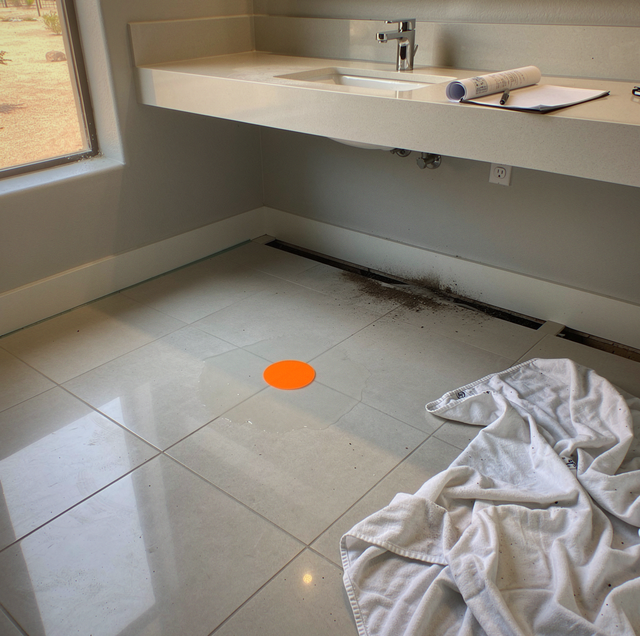
There is a small orange mark on the guest bathroom floor, on the tile just short of the vanity, about the size of a coaster, and the specialist who put it there has already packed the cases back into the van. The house is quiet again. Nothing has been opened, nothing is wet, and the only evidence that anything is wrong is that painted circle and a page of notes on a work order.
That is the handover point, and where most people stop having any picture of what comes next. A dedicated detection specialist brings the equipment and identifies where water is escaping. The plumbing contractor takes it from there, a separate piece of work with an order of operations that barely changes from job to job.
The First Thing That Happens Is Nothing Gets Opened
The mark shows where water is leaving the pipe. It does not show which way the pipe runs, which fixtures sit downstream, or what else is behind that surface. The opening minutes go on confirming those things rather than cutting, while drop cloths go down and the room gets taped off against the dust a wall or floor cut throws far beyond the opening.
The plumber traces the run back to its source and forward to whatever it feeds, determining whether the failure is on a hot or cold line and which fixtures lose water when that section comes down. That also places the opening, which is not always centered on the mark. From there, the isolation point gets chosen, and the goal is the smallest valve that stops water reaching the failure so the rest of the house stays in service. Many older homes lack an intermediate valve on that run, which is why a small repair can sometimes take the whole house offline.
With the supply closed, the lowest fixture on the run is opened to let standing water drain. Working into a full line turns a contained repair into a wet one, and it tests the isolation: a pipe still trickling after several minutes means water is getting past the valve, and the plumber closes further upstream before a blade touches anything.
Access Gets Cut Bigger than the Mark for a Reason
The size of the opening surprises people, and the reason is mechanical rather than careless. You cannot repair a pipe you can only see the front of. A sound repair requires the failed section to be cut out entirely and the clean pipe exposed on both sides, with clearance for two hands and a tool. An opening cut tight to the mark becomes a larger opening ten minutes later.
The cut is made in passes rather than one stroke, because a wall cavity can hold framing, wiring, and other lines in an arrangement nobody can predict from outside.
What actually drives the length of the appointment: The joint is not the long part. Reaching the pipe and getting back out again is. A line in an open wall behind a laundry area is one kind of day. A line above a finished ceiling, behind cabinetry, or under the concrete foundation is another, and a leak under the slab is a category of its own.
Some repairs span two appointments: the first stops the water, opens access, and leaves the system safe; the second completes the connection once a part arrives or the exposed area is dry enough to work in. That shape is normal, not a sign something went wrong.
The System Has to Come Back Up Under Pressure Before Anyone Leaves
A joint that looks dry with the water off proves nothing. Pressure is what drives water through a gap too small to see, and a repair that has never been loaded has never been tested. That is why the water goes back on while the access is still open.
There is a second reason worth knowing before the valve turns. A pipe that has been leaking has been running below its normal working load, sometimes for months. Restoring full pressure puts that load back on every other joint in the run, and an aging fitting that had been holding quietly at reduced pressure can start to weep. That is not the repair failing. It is the rest of the run telling the truth for the first time since the leak started, and far better found with the access still open.
While the line is loaded, the plumber watches for movement rather than for a puddle. A bead that forms, gets wiped and forms again in the same place is the signal. So is a joint that stays dry under static pressure and starts to weep only once a fixture is opened, and water is actually moving through the run.
Refilling Is Slower than Shutting Off
Turning the supply back on is done gradually. Snapping a valve fully open sends a slug of water into an air-filled line: the air compresses, the water slams, and scale sitting undisturbed on the pipe wall is driven downstream into faucet cartridges and toilet fill valves.
So the valve opens partway, the line fills against air being let out ahead of it, and each fixture is run until what comes out is clear and steady. Everything is then closed again, and the repair sits under static pressure while the plumber watches it. The last check is the water meter with every fixture shut: the low-flow indicator should be motionless. A meter still creeping means water is going somewhere, and the visit is not finished.
What Changes Once the Water Is Back On
The pipe is sound, but the house does not immediately look repaired, and that is the part that catches people out.
Wet material stays wet: A ceiling stain, a damp patch of carpet or a musty cabinet base will still be there when the van pulls away.
The direct signals are the useful ones: The running-water sound with every fixture off should be gone, and pressure should be steady. Those respond immediately because they belong to the system rather than to the surrounding wet material.
Before anyone leaves, there is a short handover, and it is worth treating as more than a formality. You should be shown the section of pipe that came out, with the failure visible on it, and told where the new joint sits relative to the mark. You should be told which valve was used to isolate the run, and whether that valve was left in service or replaced during the visit. Above all, you should be clear which state the system was left in: fully back in service, with every fixture run and the meter static, or with that one run still capped and closed off because a part is on order or the exposed area needs to dry before the connection can be finished. Those two outcomes look identical from the doorway and are completely different to live with over a weekend.
The access opening itself is left open on purpose. Nobody closes a wall or a ceiling over a joint made an hour earlier, partly because that joint should stay visible while it settles into normal service, and partly because the cavity behind it is not the plumbing contractor's to close.
The plumbing work ends at a tested pipe and an open access point: Closing that surface back up and drying anything that got soaked belong to different trades.
What warrants a callback is a symptom that persists after things have had time to dry: dampness spreading into new material, the sound returning, or a fresh drop in pressure. Anything static is drying. Anything growing is not.
The mark on the bathroom tile was never the end of anything. It was the point where a search stopped, and a piece of work started, and that work has a shape you can follow from the doorway.
Frequently Asked Questions
Someone able to approve opening a wall, ceiling, or floor should be there at the start and reachable afterward, because the decisions needing your consent come early. In a condo or townhome where the run is shared, or the wall is common property, many associations require approval before an opening is cut in a common wall, and getting that approval beforehand saves a wasted trip.
An old gate valve that hasn't been turned in years can refuse to reseat when moved, so it closes during the repair and then weeps afterward. Replacing that valve is done on the same visit, a common reason a repair runs longer than the leak alone suggests.
That is trapped air working its way out. The plumber generally removes the aerator screens before the refill so grit flushes clear rather than packing into the mesh, and purges from the lowest fixture in the house upward so the air has somewhere to go before the water. A single fixture that still sputters once the others have cleared usually has debris caught in its aerator or cartridge.
The failure and the story around it. Green or blue-green staining on copper, and a chalky white mineral crust on the pipe and the material behind it, mean water has been escaping long enough to leave deposits, so the leak is older than the symptom that got it noticed. A bright, clean failure with no deposit points to something recent. A hard edge, a rebar tie, or sharp fill pressed against the pipe wall at the failure says it was wearing rather than corroding through.
If the work required draining the system, the heater refilled with cold and has to heat a full tank from scratch before hot water reaches the taps. That recovery lag is expected, not a fault. A drained tank also gets checked before power comes back, because an electric element that is not fully submerged when it energizes can burn out almost immediately, and trapped air at the top of a refilled tank is how that happens.
Often, when access is easy and the fittings are standard, an actively running leak gets same-day priority. The limit is the schedule rather than the work: appointments run Monday through Saturday, seven in the morning to seven in the evening, with no Sunday service. A leak discovered late on a Saturday usually requires a Monday repair, with the affected run left isolated over the weekend.
Book the repair on a leak that has already been located — access opened, the failed section replaced, and the line verified under pressure before anyone leaves. American Discount Plumbing serves Phoenix and Scottsdale. ROC #150707. Call (602) 883-2787.
