

Irrigation Leak Fixed, Water Bill Still High: 4 Places Left
The invoice from the irrigation repair is still sitting on the counter, the total circled where you paid it, next to an envelope from the water utility that arrived this week. You already did the thing you were told would fix this: a technician found the break, repaired it, and the sprinklers haven't run since without you watching them do exactly what they're supposed to. The new bill doesn't reflect any of that. It's close to where it was before the leak was found, maybe a little lower, but nowhere near what a fixed break should look like on paper.
Quick Answer: An irrigation repair confirms the irrigation branch and nothing else. The pool's fill line, the buried service run to the house, the indoor fixtures, and any treatment equipment on the property were never part of that job and remain untested.
The Repair Ruled Out More Than the Sprinklers
Whatever else is still drawing water, the sprinkler system itself is now a settled question rather than an open one, and going back over it a second time is unlikely to turn up what the first visit did not. That is worth accepting rather than relitigating, because it is what makes the remaining list short. What is left is everything that was never part of that job: the pool's fill line, the buried run of pipe feeding the house, the fixtures indoors, and any water treatment equipment on the property. A sprinkler repair neither touches nor clears any of them.
A Pool's Autofill Valve Doing Its Job Too Well
If the property has a pool, its autofill, a float-operated valve that keeps adding water once its seat stops sealing fully, is the candidate here most likely to have survived an irrigation repair untouched. The reason is a plumbing distinction rather than a pool one. An autofill sits on the potable side of the property, fed from the house supply ahead of the pool and downstream of the meter, so every gallon it adds is measured and billed exactly like a gallon from a kitchen tap. The pool's own circulation is the opposite: the pump pulls water out through the skimmer and main drain, sends it through the filter and heater, and returns it to the same body of water it came from. That loop is closed. Nothing in it passes the meter, however many hours the pump runs.
That single distinction explains both halves of the puzzle. It is why the fill line survives an irrigation repair: a sprinkler technician works the zone valves and laterals and has no reason to touch a branch that leaves the house supply for somewhere else entirely. And it is why the pump never comes up in the question, no matter how long its timer runs or how much electricity it uses, because a closed loop cannot show up on a water bill. It also explains why a visit from the pool company does not close this out: the pad, the filter, and the pump are that trade's turf, while the supply line and the valve feeding the pool are plumbing.
The Line Between the Meter and the House
If the irrigation system tapped into the supply out in the yard rather than inside the house, ruling out the zones does not rule out the buried run feeding the house itself. A loss on that stretch keeps the meter moving long after the sprinklers are sound, and nothing about the sprinkler repair would have touched it in either direction. This is also the point where looking stops being useful: narrowing a loss to a buried run is work for a dedicated detection specialist, who brings the equipment, and the plumbing contractor makes the repair once the point is marked.
Fixtures That Run Without Making Noise
Indoors, the fixture category names itself quickly enough: a toilet fill valve that never shuts completely passes water into the overflow tube rather than into the bowl, which is why it makes no sound worth noticing. What deserves more attention here are the two appliance connections almost nobody thinks of as plumbing at all.
A dishwasher's inlet valve is a solenoid held closed against supply pressure while the machine sits idle, which is most of its life. Grit or scale on that seat causes it to pass a small amount into the tub between cycles, and because the tub drains to the same line the machine uses anyway, the water leaves without ever reaching the floor. The tell is standing water in the bottom of a machine that has not been run since yesterday.
The refrigerator's ice maker line is the other one. It is usually small-diameter tubing tapped off a nearby cold line and run behind the cabinet to a valve at the back of the appliance, sometimes through a saddle fitting left over from an earlier installation. Two things go wrong there. The valve at the fridge fails to close fully after a fill and keeps trickling into the mold, which simply overfills and drains, or the tubing weeps at a compression nut that got pushed against the wall when the appliance was last slid back into place. Both sit behind something heavy that nobody moves casually, which is exactly why they run for months.
Treatment Equipment That Regenerates More Often Than It Needs To
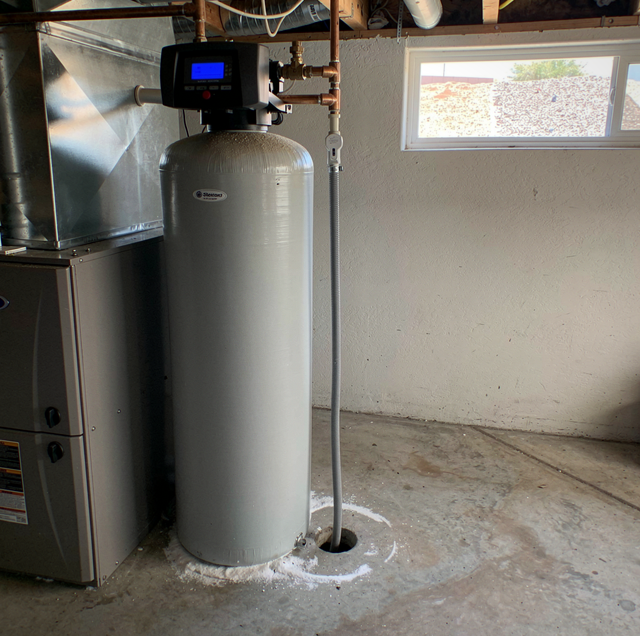
Water treatment equipment is built to use water, which is what makes it awkward to judge by watching. A softener draws water on purpose every time it backwashes and rinses its resin bed, and an under-sink reverse-osmosis unit sends water to drain on purpose every time it refills its storage tank. Neither draw is a fault in itself. The only real question is how often each one happens, and that is set by numbers somebody entered into the equipment rather than by anything visible from the garage floor.
The softener's setting is the first of those numbers. A hardness figure that reads the water as harder than it actually is, or a clock that has drifted out of step, triggers a regeneration cycle more often than the resin bed needs, and every cycle draws water whether the bed was exhausted or not. That setting is worth checking against the hardness figure your water utility publishes, rather than a value carried over from a previous service visit or from a previous house on a different supply.
The reverse-osmosis unit fails the other way, not too often but without stopping. A fouled automatic shutoff or a failing check valve can leave the membrane producing even when the storage tank is already full, so the drain line runs continuously rather than only during a fill. A unit in that state is doing exactly what it legitimately does several times a day, just never finishing.
Where the Next Call Should Start
Four candidates, and the paperwork already on the counter narrows them faster than another billing cycle will. Bring the irrigation invoice, the bill from before the repair alongside the one that arrived after it, and a plain written account of what has been checked and what has not. That last part carries the most weight: a technician who arrives with a list of what is already ruled out picks up where the previous visit left off, rather than covering the same ground a second time and charging for it. Written down while it is fresh, that account is worth more to the visit than another month spent watching the number.
Frequently Asked Questions
Ask whether the technician left a written report naming the zone that was isolated and what was observed once it was closed, since a note on paper is evidence in a way an assurance given at the truck is not. It also covers a specific case worth knowing about: a repair that fixed a visible break but left a smaller loss on the same lateral would still show real improvement without full resolution, and a single observation made at the moment of the repair cannot speak to a second break that opened afterward.
Not if the level stays inside a working autofill's range, since the valve exists specifically to mask evaporation and splash-out by replacing it before the level visibly drops. A more reliable sign is at the float itself, in the skimmer throat, or in the deck-mounted leveler box, where a frequently cycling valve can be seen and heard.
Adding salt to a brine tank doesn't, by itself, trigger a regeneration cycle. But a technician resetting the hardness dial during a service visit can push the unit into more frequent cycles afterward if the new setting overstates how hard the water actually is, which is a separate issue from anything the irrigation repair would have touched.
Not reliably. A stuck-open drain-to-waste line runs to the drain, not to the faucet, so the tap performs normally while the system wastes water in the background the whole time. The more reliable sign is at the drain line itself: water still flowing well after the tank should have finished filling and the tap has been closed.
Usually not, and where the confirmation gets made is the reason. An irrigation repair is normally proved against the irrigation branch's own isolation, closing that leg and watching what happens on that side, rather than against the house meter, with everything else in the property still live. That is a narrow test and a reliable one, which means the sprinklers were answered before the technician left. A second opinion re-answers a closed question while the categories nobody has isolated yet stay exactly as untested as they were.
Not much you can safely narrow on your own without opening equipment you're not familiar with, but noting whether the softener's control panel shows a recent regeneration time out of its usual pattern, or whether the pool company's own service notes mention the autofill running more than usual, gives whoever answers the call a real head start instead of a blank slate.
Get what the sprinkler repair was never going to cover checked: the indoor fixtures, the supply line and valve feeding the pool, and the buried run to the house. American Discount Plumbing serves Phoenix and the Valley. ROC #150707. Call (602) 883-2787.
