

Second Opinion on a Plumbing Quote: 5 Questions to Ask
Quick Answer: A second opinion is only useful if it tests the diagnosis. Ask what was located, how the line was isolated, what gets opened, what was ruled out, and what happens if the pipe is dry.
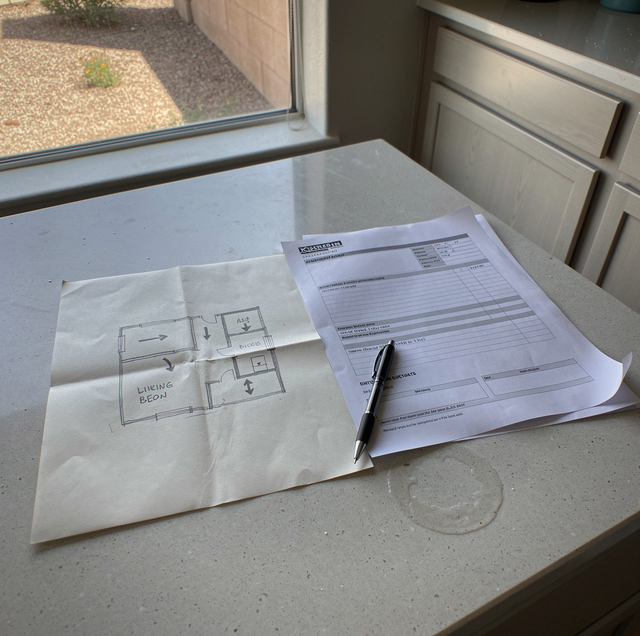
Two pages sit on the kitchen counter. One is a folded work order with a hand-drawn rectangle and an X marked near the hallway. The other arrived by email, describes the same house and the same faint running-water sound, and puts the problem in a different room entirely. Both were written by licensed plumbers who stood in those rooms the same week. Neither is trying to mislead you.
What you are holding is not two prices. It is two accounts of the same problem, and until you know which account rests on evidence, nothing about them can be compared. That is the real value of a second opinion on a plumbing quote: a chance to test whether the leak was diagnosed or merely described.
A Quote Describes Work, a Diagnosis Describes a Problem
An estimate is a description of work someone is willing to perform. By itself, it is not a claim about what is wrong. The two get written on the same page, in the same tone, which is why they blur together in a homeowner's hands.
This article is not about what either page says at the bottom. That is a separate exercise, and it cannot be attempted while the two pages describe different problems in different rooms. The five questions below aim at one seam: what a plumber observed versus what a plumber assumed.
Question 1: Has the Leak Been Located, or Only Confirmed to Exist?
These are two different findings, and they get reported in the same sentence. Evidence that water is escaping somewhere is not evidence of where. In a house with hidden or under-slab piping, the first finding is often quick and the second is the actual work. That second finding is usually not made by the plumber repairing at all. Locating goes to a dedicated detection specialist, whose van carries the equipment, while the repair stays with the plumbing contractor. So the question has a factual answer: either yes or no.
A diagnostic answer sounds like: The position was marked on the floor or wall by the specialist, the mark is still there, and here is the photograph of it.
A vague answer sounds like: It is in that wall somewhere, and it will turn up once things are open.
You do not need the full reasoning behind locating first. You need the yes or the no, clearly given, and you need it before anything gets cut.
Question 2: Which Line Is Leaking, and How Was That Determined?
Supply piping is under pressure every minute of the day. A drain line carries water only when a fixture is running. That distinction is the most useful branch in any plumbing diagnosis, because each side leaks differently and is checked differently. A supply-side leak can be detected with the system held static and all fixtures closed; if water continues to disappear when nothing is running, the leak is on the pressurized side. A drain-side leak has to be reproduced rather than inspected because it only wets things while a fixture is actually draining.
A diagnostic answer sounds like: The system was isolated and held with nothing running, and the loss continued, so it is on the supply side.
A vague answer sounds like: You have a leak.
If the answer points toward a drain line, that is a different repair conversation entirely. It is still a real answer, and better than an unnamed one.
Question 3: What Gets Opened, and Where Exactly?
The proposed access point is the most checkable claim on either page. Ask which surface, in which room, and from which side. Ask what else runs through that space, because an opening rarely reaches only pipe: a drain arm, a framing member, or a gas line may share the cavity.
A diagnostic answer sounds like: the opening goes in the hallway ceiling from below, because the run is reachable there without disturbing the tiled surface on the other side.
A placeholder sounds like: the wall gets opened and it goes from there.
This is the question worth asking twice. If the two write-ups in your hand propose openings in different rooms, at least one of them has not located anything. That is not a matter of preference. Both accounts cannot be describing the same escaping water.
Question 4: What Else Could Explain the Same Evidence?
A diagnosis is a comparison, not a verdict. The evidence that sends a plumber toward a hidden supply leak, a warm patch of floor, a moving meter, a spreading ceiling stain, is produced by several ordinary things as well.
A fixture supply connection weeping behind a cabinet base will soak a floor without ever showing a drip. A toilet's failed wax seal can wet a subfloor while the bowl and the visible connections stay dry. An irrigation valve outside the house, sharing the same meter, will move that meter exactly the way a house leak does. A slab leak may still be the answer, and it is a much stronger answer once the alternatives have names attached to them.
A diagnostic answer sounds like: The fixtures and the outside valves were checked first, all were dry, and the meter still moved, which is what points under the slab.
A vague answer sounds like: it is definitely the slab.
Question 5: What Happens if the Pipe Is Dry Where You Open It?
Every locate carries some uncertainty, and an honest one says so. The answer you are listening for is a plan, not a reassurance.
A worked-out answer sounds like: If the exposed section is dry, work stops there; the finding is reported to you before anything else is cut; and the next step is decided with you.
A vague answer sounds like: That will not happen.
Ask it before work is scheduled, not while someone is holding a saw. A contractor who has answered it before has run into the situation and built a way through it.
What a Diagnostic Answer Sounds Like
Read back through the answers and look for three habits rather than three facts. The first is specificity about position: a room, a surface, a side, a mark someone can walk you to. The second is that the method gets named alongside the conclusion, so you hear what was checked, in what order, and what each check actually showed. The third is the hardest to imitate: a boundary drawn at the edge of what is known. A plumber willing to say that one part is not confirmed yet, and to describe how they would confirm it, is giving you better information than one who is certain about everything.
Confidence is not evidence, and neither is speed. A written scope that names the access point, the section of piping to be reached, and the plumber's ROC license number gives you something to hold the work against later. Anything vaguer is a description of a transaction, not of your house.
Frequently Asked Questions
Let them work the problem cold first, so their read is independent. Then hand over the earlier write-up before they leave, and hand over the document rather than paraphrasing it. A paraphrase omits the detail most likely to change the second answer, and the document lets them respond to specific points rather than to a conclusion.
An existing locate travels with the job, so a repairing contractor can work from it rather than starting over. Ask the firm that performed the locate to release the report to whoever is doing the repair; if another contractor engaged the specialist, that release usually has to come from them rather than from you. Settle that before the repair is booked, because a contractor who turns up holding only a mark is starting the diagnosis again.
Not meaningfully. The five questions take about as long as the walk back to the truck, and asking them takes far less time than a second opening in the wrong room. Scheduling runs Monday through Saturday, 7:00 AM to 7:00 PM, with same-day priority for active leaks.
Licensed contractors carry an ROC number, and it should appear on the estimate, the truck, and the website. Look the license up by its number rather than by the company name. Trade names and DBAs change over time while the number stays attached to the license itself, so a number search returns a cleaner match than a name search does.
Ask each one which fitting or joint they expect to find failed, in writing, before work starts. A compression fitting at a stop valve, a soldered elbow, a pinhole in a horizontal run and a failed threaded joint all leave different evidence on the pipe. Then ask to be shown the failure once the section is exposed.
Keep both with the house records rather than discarding the one you did not use. Years later, a plumber inherits the history of which sections of piping have already been reached and replaced, and that history shortens the next diagnosis. A photograph of the exposed repair before the access is closed is worth filing with them.
Ask for a second read on a leak diagnosis before anything gets opened — a licensed technician will walk you through what was found and how it was determined. American Discount Plumbing serves Phoenix and Scottsdale. ROC #150707. Call (602) 883-2787.
