

How Can Tree Roots Get Into and Damage Underground Pipes?
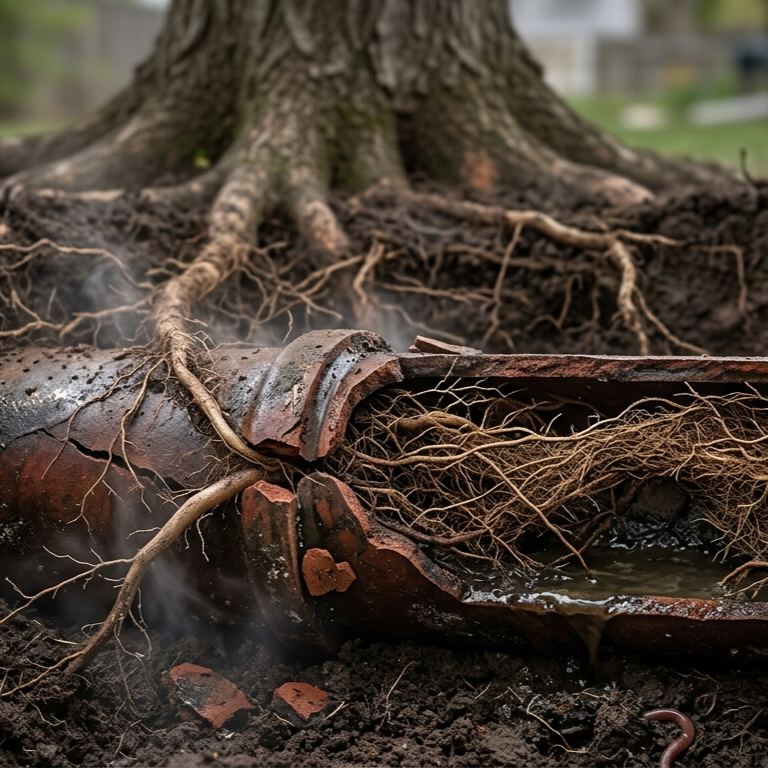
A sewer line buried a few feet down is one of the wettest, warmest things in your yard, and a tree spends its whole life hunting for exactly that. Roots do not break into a sealed pipe by force. They follow a trail of moisture leaking from a hairline crack or a tired joint, reach the source, and slip a thread-thin tip through the gap. From there, it is all growth. Once you see where roots find their opening, the clogs and slow drains in a tree-lined yard stop looking mysterious.
Roots Follow The Water Escaping The Line
A pipe carrying warm wastewater gives off a faint plume of moisture and vapor that seeps into the soil wherever the line is not perfectly sealed, most often at joints and small cracks. Fine feeder roots grow toward damp, nutrient-rich soil as a matter of survival, so they track that plume back to its source, where the pipe is the most reliable water supply around, especially through a dry stretch. The roots are not targeting your plumbing; they are chasing water, and your line leaks exactly what they need.
Where Roots Actually Get In
A root does not pierce the sound pipe wall. It exploits an existing opening: a shrinking gasket at a joint, an offset connection, a settling crack, or the mortared seam of older pipe. A tip no thicker than a hair works into that gap, and once inside the nutrient-loaded pipe, it branches into a fibrous mass. Two problems grow from there. The mass snags toilet paper, grease, and solids, sliding past into a net that chokes the flow to a trickle. Meanwhile, the thickening root acts like a slow wedge, prying the joint wider and shoving segments out of alignment. A leak the width of a pencil lead ends as both a blockage and a structural break.
Which Pipes Give Roots The Easiest Opening
Material and age decide how welcoming a line is. Older clay and cast-iron sewer pipes are the most exposed because those lines were laid in short segments with many joints, and decades underground have left the clay porous and cracked, and the cast iron rusted thin. Every joint is a potential doorway, and older jointed lines have dozens. Newer PVC is the opposite case: it runs in long stretches with far fewer connections, its joints seal tighter, and the plastic does not corrode, so a sound PVC line gives roots very little to work with. Put a mature or fast-growing tree over an old clay or cast-iron line, and you have the classic setup for repeat root trouble.
Reading The Warning Signs Before The Line Blocks
Root intrusion rarely blocks a line overnight, so it usually announces itself first. The tell that points most specifically at roots is a clog that keeps returning to the same spot after you clear it, because the mass regrows into the same gap. Watch also for several drains running slowly at once, gurgling from toilets or floor drains as trapped air escapes past a partial dam, and, as things worsen, sewage backing up into low fixtures. Some yards give an outdoor clue, too, a faint sewer odor over the buried line where seepage reaches the surface. A problem caught at the slow-drain stage is a far smaller job than one caught when the line backs up.
Confirming And Clearing Root Intrusion
To move past guessing, a plumber runs a sewer camera, a waterproof video head on a flexible cable fed down the line that shows the intrusion directly, marks how far along it sits, and reveals the pipe material and condition. That footage separates roots from a grease clog or a collapsed section. Clearing then goes one of two ways. A mechanical rooter, or auger, drives a rotating cutting head through the line to shear the roots back and reopen flow, which works fast on an active blockage. Hydro jetting instead uses a high-pressure water stream to scour roots and debris from the pipe wall more thoroughly. Either method clears what is there now, but neither closes the crack or joint the roots came through, so as long as that entry point stays open, the roots grow back. Clearing buys you working drains; it does not end the intrusion.
Fixing The Entry Point For Good
Ending the cycle means dealing with the opening itself and the camera survey guides to determine which route fits. A single bad joint or a short, damaged run can be handled as a spot repair by digging down to that section and replacing it. Where the pipe is sound apart from cracks and open joints, trenchless pipe lining, or CIPP, threads a resin-saturated liner into the pipe and cures it in place, forming a jointless pipe-within-a-pipe that seals the gaps without digging. A crushed, badly offset, or corroded line is past patching and needs replacement. As prevention, a foaming root treatment poured into the line coats the pipe wall and kills the root tips it contacts, slowing regrowth between visits, though it manages the problem rather than curing it. And when you plant, keep trees, especially fast-growing, thirsty species, well clear of the sewer run to keep aggressive roots away from the start.
Frequently Asked Questions
Usually yours, up to a point. In most areas, the homeowner owns and maintains the sewer lateral, the pipe running from the house out to where it connects to the public main, and root intrusion in that lateral is the homeowner's responsibility to fix. The dividing line is often the property line or the connection at the main, but it varies by municipality, so it is worth confirming with your utility before assuming the city will handle it. Roots most often invade the lateral because that is the older, jointed pipe closest to the yard's trees.
A foaming root treatment is the usual choice. Products based on an herbicide such as dichlobenil or metam-sodium foam up to fill the pipe and coat the crown of roots inside it, killing the intruding roots on contact while leaving the tree above unharmed, since only the roots in the pipe are exposed. Older home remedies like rock salt or copper sulfate are less favored because they work poorly in flowing lines and can harm soil and vegetation. Foaming treatment manages regrowth; it does not seal the crack through which the roots came.
Quickly, if the entry point is still open, often within a few months to a year or two. Clearing the pipe removes the current root mass but leaves the crack or joint that let the roots in, and because the roots outside are still alive and still drawn to the moisture, they return through the same opening. That is why cutting or jetting roots is a temporary measure on its own, and why lasting relief means sealing or replacing the section where the roots enter, not just clearing what has already grown in.
They do different things. A mechanical rooter, or auger, runs a cutting head down the line to shear the roots, which restores flow but tends to leave stubs behind that regrow. Hydro jetting uses high-pressure water to scour the pipe wall and flush the debris out, giving a more thorough cleaning that can strip finer roots the cutter misses. Jetting is often the better choice for a root-fouled line, but like any clearing method, it is temporary unless the entry point is addressed.
Yes, and that is much of its value. The camera carries a locator, a small transmitter called a sonde, so the plumber can pinpoint the depth and the surface location of the damage from above ground. That lets a repair be targeted to the bad section instead of excavating the whole yard, and it confirms whether the trouble is really roots versus grease, a collapse, or a foreign object. Before any digging, the utility-locate service is called so buried gas, power, and water lines are marked.
Often, through trenchless pipe lining. A resin-saturated liner is pulled or inverted into the cleared pipe and cured in place, forming a jointless pipe-within-a-pipe that seals the cracks and joints through which roots were entering, with no trench across the lawn. It works when the existing pipe is cleared and remains structurally sound enough to host the liner; a pipe that has collapsed badly or lost its shape needs a spot repair or replacement instead. A camera inspection tells which case you are in.
What This Means For A Yard With Mature Trees
Roots in a sewer line come down to a simple match: a line leaking moisture through a gap, and a tree hunting for exactly that. Steady growth then turns a hair-thin root into a clog and a broken joint. Older clay and cast-iron pipe under thirsty trees is where it shows up most, and recurring clogs, slow drains, and a whiff of sewage in the yard are your early notice. Clearing reopens the line, but only sealing the entry point keeps roots out, so a camera looking at the pipe turns a repeating headache into a decision made once.
If recurring backups have you suspecting tree roots in your line, we can camera-inspect it and clear the intrusion. American Discount Plumbing serves Phoenix and the Valley. ROC #150707. Call (602) 883-2787.