

Water Heater Leaking or Dead? Do This First
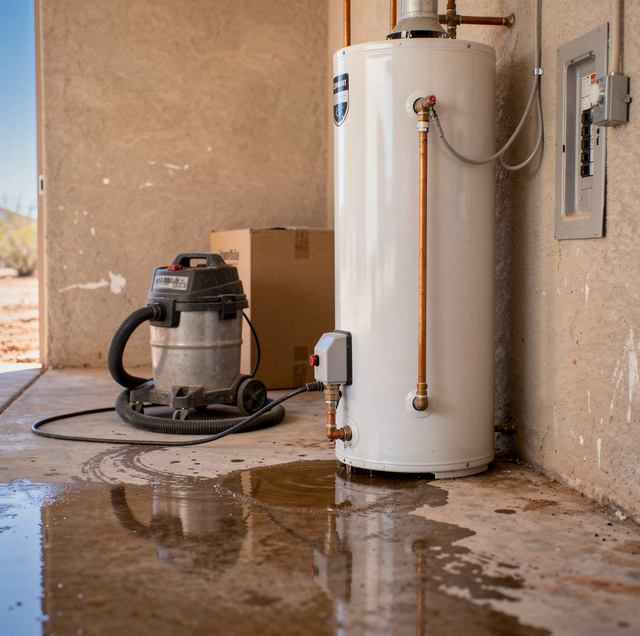
You reach for the shower handle and nothing but cold comes out, or you walk past the utility closet and find a puddle spreading across the floor. Either way, the next ten minutes matter more than anything else you do that day. A water heater rarely fails with a warning label attached, and what you do first decides whether this turns into a quick fix or a flooded floor and a burned-out unit waiting to happen.
Shut Off Power Or Gas Before You Touch Anything Else
Before you look at the leak, deal with the energy source. A water heater is either gas-fired or electric, and both can turn a simple failure into a hazard if they keep running dry or keep heating water that has nowhere to go.
For a gas unit: find the gas control valve near the bottom of the tank and turn the knob to the off position. If you smell gas at all, skip the valve, leave the area, and call your gas utility from outside before doing anything else.
For an electric unit: go to the breaker panel and switch off the circuit that feeds the heater, not just a wall switch if there is one. Running a heating element dry or exposing a live element to standing water is how a minor puddle becomes a shock hazard. If reaching the panel means walking through water, stay out of it and call a plumber or your utility instead.
Cutting the energy source first also protects the equipment. A gas burner or an electric element that keeps firing against an empty or partly empty tank can warp, crack, or burn out within minutes, turning a fixable problem into a guaranteed replacement.
Shut Off The Water Supply Next
Once the energy source is handled, stop new water from feeding the problem. Every heater has a cold-water shutoff valve on the inlet line at the top of the tank; turn it clockwise until it stops. If that valve is stuck, rusted, or out of reach, close the main shutoff for the house instead.
If the tank itself is leaking, closing the inlet doesn't drain what's already inside. A standard residential tank holds 40 to 50 gallons, and gravity keeps pushing that volume out through whatever opening it found until the tank empties or someone opens the drain valve to speed it along. Knowing that ahead of time keeps you from assuming a leak has stopped just because the drip slowed for a minute.
Contain What's Already On The Floor
With the sources cut off, turn to the water that's already out. Towels, a shop vacuum, and a few buckets handle most of what a slow leak produces; a full-tank failure calls for faster work, since 40-plus gallons spread a long way across a hard floor in a short time. Move anything on the floor nearby out of the path first: boxes, furniture legs, an extension cord, a stored appliance.
A floor drain or a drip pan plumbed outside will carry off some of the volume on its own, but neither guarantees against a tank failing at the seam. Check under the tank for a pan and follow where it drains before assuming the floor is protected. If water has reached a wall, a cabinet base, or absorbent flooring, drying it within the first day matters more for preventing mold than almost anything else you'll do this week.
Read The Symptom Before You Call For Repair Or Replacement
Once things are stable, the next question is what actually failed. A heater that stops producing hot water and a heater that leaks are often two different problems with two different answers, and the fix depends on which part is involved, not just what you're seeing on the surface.
No hot water on a gas unit usually traces back to the pilot light or the thermocouple, a small safety sensor that must detect a lit pilot before the gas valve releases fuel to the main burner. A pilot that won't stay lit points to a contained, inexpensive part, not the tank.
No hot water on an electric unit often means one of the two heating elements has burned out. A failed upper element usually kills hot water completely; a failed lower element can leave a short supply of lukewarm water because the top of the tank still heats. Neither says anything about the tank shell.
A leak high on the tank, at a fitting where the inlet or outlet pipe connects, or from the temperature-and-pressure relief valve and its discharge tube, is almost always a component issue. Fittings loosen with age and thermal cycling; a relief valve drips when it's worn or when the pressure inside the tank rises. Both are repairable without touching the tank itself.
A leak low on the tank, from the body itself, is a different story. The steel shell is protected by a glass lining and a sacrificial anode rod; once that protection is gone, corrosion attacks from the inside out until it perforates the metal. No patch, weld, or sealant makes a corroded, pressurized shell safe to keep running. That failure means replacement.
| What You See | Likely Cause | Repair Or Replace |
|---|---|---|
| Pilot won't stay lit, gas unit otherwise dry | Worn thermocouple or dirty pilot assembly | Repair |
| Lukewarm or no hot water, electric unit | Failed heating element or thermostat | Repair |
| Drip at a threaded fitting or union up top | Loose or worn connection | Repair |
| Steady drip from the relief valve discharge tube | Worn valve or high system pressure | Repair (valve or add expansion tank) |
| Wetness low on the tank shell, no fitting above it | Internal corrosion, perforated tank | Replace |
| Rust-colored hot water with no other source found | Interior lining failure | Replace |
When It's Safe To Wait For A Scheduled Repair
Not every failure needs someone at your door within the hour. A heater that's simply stopped producing hot water, with no water on the floor and no gas smell, is an inconvenience you can usually schedule around: shut the unit off if you're not using it, and book a repair for a normal appointment window.
A slow, traced leak at a single fitting, with the area dried, monitored, and showing no sign of spreading, also tolerates a short wait once the local shutoff or the main is closed. Watch it over a few hours; if the wet spot doesn't return and nothing feeds it, a scheduled repair rather than a rushed one is reasonable.
When It Needs Emergency Service Instead
Certain signs remove the option to wait. Water spreading fast rather than sitting as a traced drip, water reaching an outlet or the electrical panel, a gas smell near the unit, or very hot water discharging steadily from the relief valve all call for an emergency plumber, not a scheduled slot. A tank confirmed to be failing at the shell also belongs in that category, since a slow perforation can widen without warning and empty the full tank at once.
The same urgency applies if the unit sits somewhere a full-tank failure would do real damage: an upstairs closet over finished space, or a utility room with no floor drain. In those settings, even a small leak justifies calling sooner rather than waiting overnight.
Why Water Heaters Fail Without Warning
A sudden failure rarely comes out of nowhere; it's usually the visible end of something that had been building for a while. A few mechanisms account for most of it.
Age catches up all at once: Most tank heaters are built for roughly 8 to 12 years of service. The anode rod that protects the steel shell corrodes away gradually, and once it's spent, the tank's own steel starts absorbing the corrosion instead. That process is invisible from outside the tank until the shell finally gives way, which is why a heater can seem fine one week and fail the next.
Sediment buildup stresses the tank from below: Minerals that come out of solution as water heats settle at the bottom over years. That layer insulates the lowest section of steel from the burner or lower element, so that spot runs hotter than the rest of the tank and wears faster than age alone would suggest.
Pressure spikes finish off a weak point: A closed plumbing system with no expansion tank lets pressure climb every time the heater cycles, since heated water expands and has nowhere to go. That repeated stress finds the weakest seam, fitting, or valve in the system and can push a component that had years of life left into sudden failure.
A single component simply wears out: Thermocouples, heating elements, and relief valves are mechanical parts with a shorter service life than the tank itself. Their failure often looks dramatic: no hot water at all, or a valve suddenly discharging, but it's an isolated part reaching the end of its life, unrelated to the tank's condition.
Sudden outages and sudden leaks feel like the same emergency, but they usually point to different causes and different fixes. Reading which one you're actually facing is what keeps a bad morning from turning into a bigger repair than it needed to be.
Frequently Asked Questions
Check the top or side of the tank for a data plate; it lists the fuel type, model, and serial number. A gas unit has a flue pipe at the top and a control valve with a pilot light near the bottom; an electric unit has no flue, just electrical conduit entering the top where the elements and thermostats sit.
Most manufacturers print step-by-step relighting instructions on the tank, and following them for a pilot that simply went out is generally fine. If it won't stay lit after two or three attempts, or you smell gas at any point, stop and call a licensed plumber, since a recurring outage usually means a failing thermocouple or gas valve that a homeowner can't safely diagnose.
Condensation forms as an even film across a broad area of the tank, typically after a large hot-water draw refills it with cold water that sweats in humid air, and it fades as the tank warms back up. A genuine leak has a single point of origin and a trail that reappears in the same spot within minutes of being wiped dry. Drying the tank fully and watching where wetness returns first settles the question.
Yes. Mineral-heavy water speeds up both anode rod consumption and internal scale buildup, so a tank running on treated or softened water often reaches its corrosion-driven failure point later than an identical tank on untreated hard water. Softening doesn't stop the aging process, but it slows the two mechanisms, sediment and anode wear, that drive most premature tank failures.
If the tank body is the source, draining it through the built-in drain valve can reduce the volume still working its way out and make cleanup easier, provided the water supply is already shut off. Skip this step if you're not confident in locating the valve safely, or if the leak is severe enough that standing water is already a hazard; in that case, contain the spread and let a plumber handle the tank once they arrive.
Occasionally. A waterlogged expansion tank that has lost its air cushion can produce symptoms that mimic heater trouble, banging pipes, pressure swings, or a relief valve that won't stop dripping, even when the heater itself is sound. A plumber checks the expansion tank's air charge and the home's static water pressure as part of a full diagnosis, since fixing the heater alone won't solve a problem that's actually coming from elsewhere in the system.
Request water heater repair or replacement — get a same-day assessment before a small leak or outage turns into a bigger problem. American Discount Plumbing serves Phoenix and the Valley. ROC #150707. Call (602) 883-2787.
