

Water Pooling Around Your Water Heater? 6 Real Causes
Quick Answer: Water at the base of a water heater comes from one of a few places, ranging from harmless to urgent: condensation on a cold tank, a loose drain valve, a weeping temperature-and-pressure relief valve or its discharge tube, loose inlet or outlet connections, or a corroded tank that has begun to fail. Dry the area, watch where water returns, and trace it up. A tank leaking from its own body cannot be repaired and needs replacement. If water is spreading fast, shut the cold-water supply and call a plumber.
What A Puddle Under The Water Heater Is Telling You
A wet floor next to the water heater rarely means the whole thing has failed. Water follows gravity, so it collects at the lowest point no matter where it started higher up. The puddle is the symptom. The job is finding the source, and the good news is that most sources are minor and fixable long before the tank itself gives out.
Work through the possibilities from least serious to most serious. That order matters, because a small drip from a fitting looks identical to the first sign of a failing tank once the water has run down the shell and spread across the floor. Rule out the easy causes first, and you avoid replacing a heater that only needed a wrench turn.
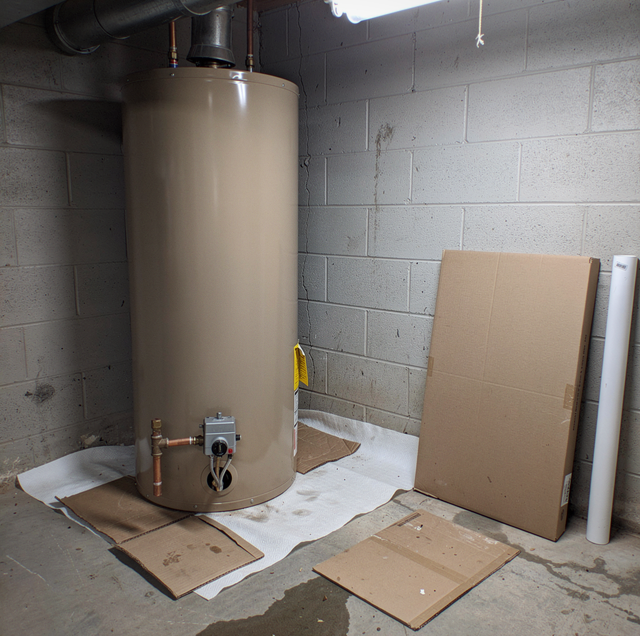
Start by drying everything and watching where water returns: Before checking anything else, wipe the top of the tank, the connections, the valves, and the floor completely dry. Slide a few paper towels or a sheet of cardboard underneath and around the base. Then leave it for an hour or two and come back.
Where the first new wetness appears tells you almost everything. Water showing up high on the tank points to a fitting or the relief valve. Water only at the very bottom, with everything above bone dry, points to the tank base or the drain valve. This single test saves more misdiagnoses than any other step.
To find the source, dry the top of the tank, the fittings, the valves, and the floor completely, then slide paper towels or cardboard under the base and wait an hour or two. Where the first new wetness appears tells you almost everything: high on the tank points to a fitting or the relief valve, while wetness only at the very bottom points to the tank base or the drain valve.
The Likely Sources, From Harmless To Serious
Condensation on a cold or new tank: The most benign cause is condensation. When cold incoming water fills the tank, the outside of the shell can drop below the dew point of the surrounding air, and moisture beads on the metal and drips down. A brand-new unit, a tank recovering after heavy hot-water use, or a heater in a humid utility space all sweat this way.
Condensation shows up as a light, even film over a broad area of the tank, not a stream from one point. It appears during or right after a big draw of hot water and fades as the tank warms back up. If the "leak" comes and goes with usage and never traces to a single fitting, condensation is the likely answer, and it is not a repair.
A loose or dripping drain valve: Near the bottom of the tank is the drain valve, the spigot used to empty the heater for maintenance. Its handle or cap can loosen over time, or the valve can fail to seat fully after draining. A slow drip here lands right at the base and reads as a bottom-of-tank leak.
Check whether the drain valve is snug and whether water is beading at its outlet. A gentle hand-tightening of a plastic cap, or seating the valve fully closed, sometimes stops it. If it keeps weeping, the valve washer or seat is worn, and a plumber can swap the valve.
A weeping temperature-and-pressure relief valve or its discharge tube: Higher up on the tank, on the top or upper side, sits the temperature-and-pressure relief valve, usually called the T&P valve. A pipe, the discharge tube, runs from it down toward the floor. Water arriving at the base by way of that tube did not come from the tank body. It came from the relief valve releasing.
This one deserves its own section because the T&P valve is a safety function, not a random drip. More on that below.
Loose inlet or outlet connections: Two water lines meet the top of the heater: the cold inlet and the hot outlet. Their fittings, flex connectors, or dielectric unions can loosen with years of thermal expansion and contraction, and hard water leaves scale that keeps a seal from closing cleanly. A drip here runs down the outside of the tank and pools at the base, mimicking a tank leak exactly.
Feel around the top connections with a dry hand or paper towel. If the wetness starts at a threaded joint or a flex line up top and the trail runs downward from there, the fix is usually tightening or resealing that connection rather than replacing the heater.
A failing tank leaking from internal corrosion: The most serious source is the tank itself. Inside every steel tank is a glass lining and a sacrificial anode rod that corrodes on purpose to protect the steel. Once the anode is spent and the lining cracks, the steel rusts from the inside out. Eventually it perforates, and water seeps or streams from the body of the tank, often low on the shell or straight from the bottom, with no fitting or valve above it to blame.
Hard water speeds this along, since scale and mineral load accelerate corrosion and wear the anode faster. A tank leaking from its own welded seam or shell is at the end of its service life. This is the one source you cannot fix, and it is covered below.
What A T&P Valve Discharge Actually Means
The temperature-and-pressure relief valve is the single most important safety device on the heater. Its only job is to open and let water out if the pressure or the temperature inside the tank climbs too high. A sealed tank of superheated water is dangerous, and the T&P valve is the release that keeps that from becoming a rupture.
So water dripping from the end of the discharge tube is often the valve doing exactly what it should, telling you the tank saw excess pressure or heat. That can trace to thermal expansion in a closed plumbing system, a thermostat set too high, or a worn valve that no longer seats. A valve that only weeps now and then may just need replacing; one that discharges steadily or releases very hot water is flagging a real pressure or temperature problem that a plumber needs to diagnose.
One rule overrides everything else here. Never cap, plug, or thread a fitting onto the T&P valve or its discharge tube to stop the drip. Blocking that valve removes the tank's pressure release and turns the heater into a sealed vessel that can burst. If the T&P valve is the source, leave it open to the tube and get it looked at.
Never cap, plug, or thread a fitting onto the T&P valve or its discharge tube to stop the drip. Blocking that valve removes the tank's pressure release and turns the heater into a sealed vessel that can burst. If the valve keeps discharging or releases very hot water, it is flagging a real pressure or temperature problem for a plumber to diagnose.
Condensation Versus A Real Leak
Telling a harmless sweat from a genuine leak comes down to pattern, and a bathroom mirror after a hot shower is the everyday version of the same physics: a cold surface pulls moisture out of warm air. That fog is not a plumbing failure, and neither is a film of condensation on a cold tank.
A real leak has a source point and a trail. Dry the tank fully, then look for where water re-forms first and follow the trail up to a fitting, a valve, or a spot on the shell. A leak tends to persist and often grows; condensation is even, broad, tied to hot-water use, and clears as the tank heats. When you cannot trace wetness to any single point, and it disappears between draws, you are almost certainly looking at condensation rather than a fault.
Why A Leaking Tank Means Replacement
When the source is the tank body itself, repair is not on the table. The steel shell is lined with glass and, once that lining fails and the steel corrodes through, there is no patch, weld, or sealant that safely restores a vessel holding dozens of gallons under household water pressure. A patched tank would simply fail again, and next time possibly all at once.
This is why plumbers replace rather than repair a leaking tank. A weld or epoxy on a corroded, pressurized shell is a liability, not a fix. The practical signal is a leak coming from the body of the tank, low on the shell or from the bottom seam, with the drain valve, T&P valve, and all top fittings confirmed dry. At that point, the heater has reached the end of its life, and continuing to run it risks a full-volume failure across the floor.
The Drip Pan And Shutoff You Should Know
Many heaters sit in a drip pan, a shallow tray plumbed to a drain or routed outside. The pan is not a fix; it is a catch. It buys time and limits damage by carrying small leaks away instead of letting them soak the floor. If your heater has a pan and it holds standing water, that is a signal the tank or a fitting above is losing water, not proof that everything is fine.
Above the heater, on the cold inlet, is a shutoff valve. Knowing where it is before there is ever a problem is worth a minute of your time. If a leak turns serious, closing that valve stops fresh water from feeding the tank and slows the flooding while you wait for a plumber. Locate it, make sure it turns, and remember it.
When it becomes an emergency: Some situations call for immediate action. Water spreading fast across the floor, a steady stream rather than a drip, water reaching electrical outlets or a nearby panel, or very hot water discharging from the T&P valve all count as urgent.
In those cases, shut off the cold-water supply at the valve above the heater. For a gas unit, also turn the gas control knob to the off position. For an electric unit, the safe move is to keep clear of standing water and the electrical connections and let a professional handle the power side. Do not open the burner compartment, touch the gas burner, or work on the electric heating elements yourself. Shutting off the water, shutting off the gas, and calling a plumber is the correct and safe response.
Frequently Asked Questions
Sediment is the mineral grit that settles at the bottom of the tank, and in hard-water areas a heater can accumulate an inch or more within a couple of years. It does not itself cause a leak, but it traps heat against the steel bottom, which overheats and stresses that section and can hasten corrosion there. Flushing a few gallons from the drain valve once a year clears loose sediment; if what drains out is mostly rusty flakes rather than clean grit, the tank interior is already corroding.
Yes, indirectly. The anode rod is a magnesium or aluminum rod that corrodes in place of the steel tank, and it is the one part that can extend tank life. Once it is fully consumed, usually somewhere around the three-to-five-year mark on hard water, the steel starts corroding next. Having the anode checked and replaced before it is gone is the single maintenance step most likely to postpone a tank-body leak, though it does nothing once the tank has already perforated.
It can. If incoming municipal pressure exceeds roughly 80 psi, or a closed system has no expansion tank to absorb thermal expansion, pressure spikes push the T&P valve open. The lasting fix is a pressure-reducing valve on the main line or a thermal expansion tank on the cold inlet, not repeated valve replacement. A plumber can put a gauge on a hose bibb to read your actual static pressure in seconds.
Most standard tank heaters run 8 to 12 years, but that assumes moderate water. In heavy hard-water regions, the practical lifespan often lands at the shorter end because scale accelerates corrosion and burns through the anode faster. A heater past the ten-year mark that starts leaking from the body is almost always at end of life rather than a candidate for repair, so age is a useful tiebreaker when you are deciding.
For a minor, traced puddle, you do not have to shut anything immediately, but turning the water supply off at the inlet valve while you investigate prevents a small drip from feeding continuously. Leave the heater's power or gas as-is for a truly small leak unless the tank body is the source. If you cannot find the source within a short look, closing the cold inlet and calling a plumber is the low-risk choice.
It can, and quietly. A slow leak that wicks under vinyl, tile, or into a wood subfloor can rot the material and feed mold well before you notice standing water, which is exactly why a drip pan routed to a drain matters. On a slab, the concern is less structural and more about water tracking to nearby walls, baseboards, and any adjacent cabinetry. Catching the source early, even a minor one, is what keeps a fitting drip from becoming a flooring repair.
Trace the puddle before it becomes a flood — a fast diagnosis today saves your floor and your water heater tomorrow. American Discount Plumbing serves Phoenix and the Valley. ROC #150707. Call (602) 883-2787.
