

High Water Usage Overnight: What Runs While You Sleep
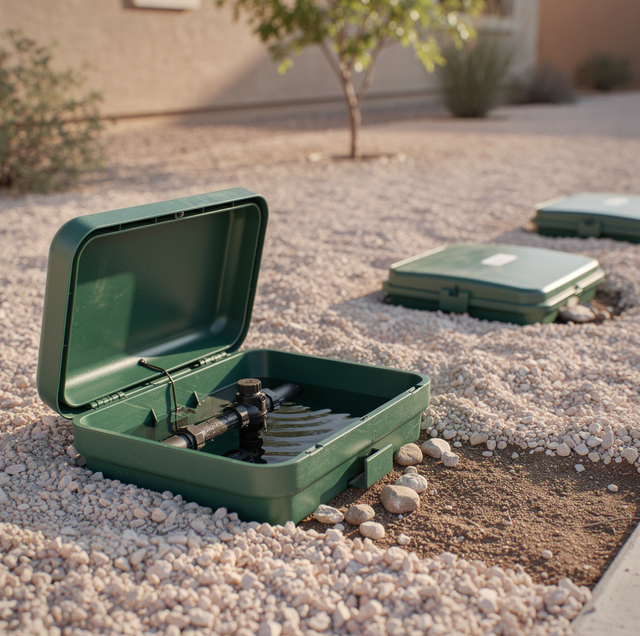
The valve boxes at the edge of the yard usually look identical to each other, four green lids set flush in the gravel. This morning one of them doesn't. You lift the lid and find a shallow ring of standing water settled in the bottom of the box while the three beside it are as dry as the ground around them, hours after any zone was scheduled to run. Nobody was awake to turn anything on, and by the time the sun is fully up, there is nothing left on the surface to show for it. That is the shape of the problem with water use that climbs overnight: whatever is moving it does so without a person, and leaves very little behind by the time anyone is up to look.
Quick Answer: An overnight climb usually traces to something on a timer or schedule, not a person: a toilet fill valve, an irrigation zone, a water softener regenerating, or pool equipment, not necessarily a leak in the pipes themselves.
What Actually Runs While the House Sleeps
During the day, household water use is dominated by people doing things: a shower running, a load of laundry, a sprinkler someone turned on by hand, a dishwasher started after dinner. All of that adds up to a use pattern that's unpredictable from hour to hour, and a small continuous flow gets lost inside it. Once everyone's asleep, that variable, person-driven demand drops close to zero. Whatever keeps moving after that point isn't a person forgetting to turn something off; it's equipment operating on its own schedule, cycling or refilling without anyone touching a handle.
A handful of systems commonly run unattended overnight:
- Toilets: A fill valve that tops off the tank on its own timing, not a faucet anyone left open.
- Irrigation: Zone valves controlled by a timer, often set to start in the pre-dawn hours.
- Water treatment equipment: A softener or conditioner regenerating on a schedule or a meter.
- Pool equipment: An autofill valve and circulation pump that can both run while the house is dark.
None of those four is inherently a problem. Each one is designed to run without a person present. The question worth answering is whether one of them is running longer or more often than its design intends.
A Toilet That Refills Itself Long After Everyone Is in Bed
Your toilet's fill valve doesn't only work when someone flushes. It's tied to a float that watches the water level in the tank, and if the flapper at the bottom of the tank isn't sealing completely, that same float will trip the fill valve to top the tank back up. In a toilet with a worn flapper, or a fill valve whose seat has accumulated mineral buildup from hard water, that top-off cycle can repeat many times over the course of a night, each lasting only a few seconds. Because nobody's standing in the bathroom to hear the brief hiss of water entering the tank, it goes unnoticed until a bill or a usage graph makes the pattern visible. This kind of overnight cycling is different from a toilet that's obviously running nonstop; it's short, repeated, and quiet enough to go unnoticed for weeks.
Irrigation Valves That Don't Know Everyone Has Gone to Bed
Sprinkler and drip systems are usually programmed to start well before sunrise, when wind is calmest, and the sun hasn't started pulling moisture back out of the soil, so a scheduled irrigation cycle running at 3 or 4 a.m. is normal by design, not a malfunction. What isn't normal is a valve that doesn't fully close at the end of its cycle. A solenoid valve with debris caught in the diaphragm, or one that's simply aged past its service life, can leave a zone weeping or running longer than your controller told it to. Because that valve typically sits underground or inside a manifold box at the edge of the yard, the water it's losing doesn't necessarily surface as an obvious wet patch the next morning; caliche soil and summer heat can pull moisture back down and evaporate it before anyone walks past.
Yard irrigation isn't limited to the hottest months, either. Established plants and lawns still get scheduled runs through the cooler part of the year, just spaced further apart, so a valve problem can show up on the usage graph in January as easily as in July.
Water Treatment Equipment Running Its Own Overnight Cycle
Your water softener or conditioner is built to regenerate on a schedule, usually overnight when nobody's likely to need hot or treated water, cycling water through its resin bed and flushing the byproduct to a drain line. That draw is expected and normally brief. What's worth a second look is a unit stuck partway through that cycle, or a bypass valve that doesn't fully seat closed once the cycle finishes, either of which lets water keep moving through the equipment well past when it should have stopped. Because the unit is typically tucked in a garage or utility closet, the continued draw is easy to miss unless someone happens to be standing near it during its active hours.
Pool Equipment That Tops Off and Circulates While You Sleep
Your pool works on the same basic principle as a toilet tank: a float-operated valve monitors the water level and opens to refill it once evaporation drops it below a set point. Pumps and filtration equipment are also frequently set on timers, and many owners schedule the longest run, or the coolest, quietest hours, overnight rather than during the day. Dry evaporation is real work for that autofill valve; a pool loses water to the air year-round in this climate, more in summer heat, but it doesn't stop entirely once temperatures cool off. If the float sticks or the fill-line valve doesn't close all the way, the system keeps adding water well beyond what evaporation alone would explain, and because the pump is already running on its own schedule, nothing in the pattern looks unusual to the equipment itself. If the pool checks out along with everything else on this list, the overnight climb is no longer an equipment question, and confirming where the water is actually going becomes the work of a dedicated detection specialist, with the plumbing contractor repairing whatever gets marked.
Reading the Shape of the Overnight Climb
The shape of the climb on an hourly graph carries information the nightly total does not. A draw that rises and stops in defined blocks, on for a few minutes, flat for a stretch, on again, is equipment cycling: a fill valve topping off, a zone opening and closing, a softener stepping through its stages. A draw that holds one low, unbroken line from midnight until the first person gets up is a different animal, because none of the scheduled equipment in a house is built to run for six hours without pausing.
Two nights of data is worth more than one, and three is worth more than two. A single odd night can have an ordinary explanation behind it: a guest, a long fill, a cycle that ran late. The same climb at the same hours three nights running is a pattern with a mechanism behind it. Writing down which nights climbed, during which hours, and what was scheduled to run during those hours turns a vague number into something a technician can work from on arrival.
Frequently Asked Questions
Yes, and the absence of noise is the point. Residential fill valves moved from the old brass ballcock to diaphragm types and then to the float-cup, and piston designs common now, each generation quieter than the one before it. The more useful tell isn't sound at all: a valve topping the tank off behind a leaking flapper produces no flush noise, so what gives it away is a tank refilling when nobody has flushed.
Often, yes, and that's expected. Multi-zone controllers commonly stagger each zone's start time rather than running them all at once, so a legitimate cycle for one zone might begin at 2 a.m. while another doesn't start until 4 a.m., which is worth knowing before assuming a single odd hour means something is wrong.
It's possible. Many residential softeners are metered rather than clock-based, meaning they regenerate based on how many gallons pass through rather than on a fixed number of days, so a household using more water than usual for any reason can push a metered unit into an extra, unscheduled regeneration overnight.
They work on a similar float principle, but a pool's autofill line usually ties in downstream of a backflow preventer rather than to a shutoff under a tank lid, and the float itself sits either in the skimmer or in a separate deck-mounted leveler, where a technician checks it first.
There are still a few appliances that draw water on their own timing, including an ice maker's fill line topping off its reservoir and, in homes that have one installed, a reverse-osmosis unit refilling its storage tank, which sends several times the delivered volume to the drain on every fill.
Partly, and the exception is the useful part. A toilet is fed by a stop valve directly under the tank, so closing that one stop does take it out of the picture. The other three draw from valves nowhere near a faucet handle, out at the irrigation manifold, inside the softener's bypass assembly, or at the pool equipment pad. That difference is also the method: close one fixture stop at a time, leave it closed overnight, and compare the next night's graph. The source that disappears from the graph is the one that was closed.
Get the overnight pattern checked — a same-day visit can confirm what's running and rule out a leak before it grows. American Discount Plumbing serves Phoenix and the Valley. ROC #150707. Call (602) 883-2787.
