

Why Multiple Drains Back Up at Once: The Main-Line Clue
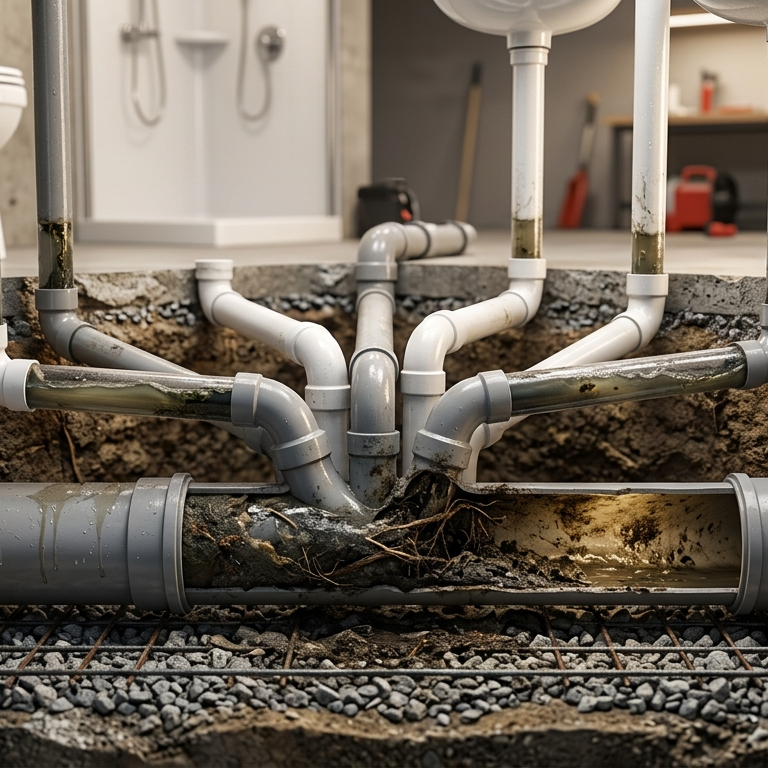
Quick Answer: Multiple drains backing up together point to a blockage in the main sewer line, the single pipe that carries waste from your whole house to the city sewer or your septic tank. Individual fixtures are not clogged on their own; they are all downstream of one obstruction. Stop running water, avoid flushing, and get the main line inspected and cleared.
When one sink drains slowly, you probably have a local clog in that fixture's trap. When the toilet, the tub, and the floor drain all misbehave at the same time, something different is happening. The problem is no longer at any single fixture. It has moved to the pipe they all share.
That shared pipe is the main sewer line, and reading the pattern correctly is the difference between a five-minute fix and a repair that needs a camera and a machine.
Every Drain in the House Feeds One Pipe
Think of your home's drainage the way you would think of a river system. Each fixture, the kitchen sink, the bathroom sink, the tub, the toilet, has its own small branch line. Those branches join larger branches, and eventually all of them empty into a single main line that runs under the house and out to the street sewer or to a septic tank in the yard. Water only moves in one direction: downhill, toward the main.
This layout is why the symptoms tell you where the trouble sits. If the obstruction is inside one fixture's branch, only that fixture acts up. The others keep draining because their path to the main is still open. But if the obstruction is in the main itself, every fixture upstream of it is affected at once, because they all have to pass through the same choke point to leave the house.
So the count matters. One slow drain is a local story. Several drains failing in the same window is a main-line story, and that changes what you do next.
How to Read the Tells
A main-line blockage announces itself in a fairly consistent set of signs. You do not need special tools to spot them, just attention to which fixtures react and in what order.
The lowest fixtures back up first- Waste that cannot get past the blockage has to go somewhere, and it takes the path of least resistance, which means the lowest opening in the system. That is usually a basement or garage floor drain, a downstairs tub, or a ground-floor toilet. If dirty water is surfacing in the shower pan while the upstairs sinks still seem fine, that is a classic main-line signature.
One fixture reacts when you use another- This is the most telling sign of all. Flush a toilet and listen for the nearby tub or shower to gurgle, bubble, or rise. Run the washing machine and watch whether a floor drain or a laundry-room sink starts to back up as the machine pumps out. When using one fixture disturbs a completely different one, the two are connected by a blocked main, and the water displaced by the first has nowhere to go but up through the second.
A sewage smell- When waste stalls in the line instead of flowing out, gas that would normally vent past it starts to work backward into the house through drains and floor openings. A persistent sewer odor near low drains often accompanies the other symptoms.
If you are seeing several of these together, treat it as a main-line event rather than a stubborn single clog. Reaching for a bottle of drain product at one sink will not touch a blockage that sits well downstream of every fixture.
What Actually Blocks the Main
The main line is a large pipe, so it takes a real obstruction to close it off. A handful of causes account for most cases.
Tree roots at the joints- Roots are drawn to the steady moisture and nutrients inside a sewer line, and they find their way in through the small gaps at pipe joints and through hairline cracks. Once inside, they continue to grow, and the fine root hairs act like a net that snags passing debris. Over months, the mass thickens into a mat that narrows and finally chokes the pipe. This is the leading cause in older neighborhoods where mature trees sit near the sewer path.
Grease, debris, and wipes- Cooking grease pours down warm and liquid, then cools and congeals on the pipe wall, gradually shrinking the opening. So-called flushable wipes do not break apart the way toilet paper does; they catch on any rough spot and build up. Together, they form the soft, sticky blockages that plague kitchen-adjacent and heavily used lines.
A belly in the pipe- If a section of the line has settled over the years, it can develop a low spot, a sag that plumbers call a belly. Waste water pools in the dip instead of flowing through, and solids drop out and accumulate there until the low point clogs.
Old, failing pipe- Cast iron corrodes and scales from the inside, roughening the wall and narrowing the bore. Clay tile cracks and shifts at its joints. Orangeburg, a tar-and-paper pipe used in some mid-century homes, delaminates and collapses inward as it ages. A pipe that is deforming or breaking apart both blocks flow and gives roots and debris more to grab.
A clog right at the cleanout, or a septic problem- Sometimes the obstruction sits at the main cleanout access. And on a home with a septic system rather than city sewer, the same whole-house symptoms can come from a tank that is full or a drain field that has stopped absorbing, which backs the whole system up from the far end.
City Sewer or Septic Changes the Picture
Where your waste goes matters for how you interpret a backup. On a city sewer connection, multiple slow drains almost always mean an obstruction somewhere in your lateral line between the house and the street main.
On a septic system, the same symptoms have an extra suspect. If the tank is full or the drain field is saturated, waste has nowhere to go and backs up toward the house, even though the pipe itself is clear. A backup shortly after heavy water use, or one paired with soggy ground over the drain field, points toward the tank rather than a line clog. Knowing which system you have tells the plumber where to look first.
What to Do the Moment You Notice It
Your first instinct when a drain backs up is often to run more water or flush again to push it through. With a main-line blockage, that is exactly wrong, because there is nowhere for the extra water to go except back into the house.
- Stop running water everywhere- No dishwasher, no laundry, no long showers. Every gallon you send down has to fit into a system that already cannot empty.
- Stop flushing the toilet- A blocked main means the bowl's contents may come up in the tub instead of going out.
- Locate the main cleanout- It is a capped pipe, often near the foundation or out in the yard along the sewer path. You do not have to open it, but knowing where it is speeds the repair and gives a pro a pressure-relief point.
- Call for a camera inspection and professional clearing- A plumber runs a camera to see the obstruction, then clears it with a powered auger or a hydro-jet that scours the pipe wall.
One more point that is not optional: sewage is a biohazard. Backed-up water carries bacteria and pathogens, and a compromised main line is not a plunger job. This is work for a licensed plumber with the right equipment and protection, not a weekend project.
Frequently Asked Questions
An upstairs fixture usually stays clear because it sits above the level the backed-up water actually rises to, and its own vent keeps letting air in, so the trapped water is not forced up through it. With that higher path effectively closed off, the water seeks the lowest trap it can reach instead, which is why a basement floor drain or a downstairs tub floods first. The fixture that overflows is chosen by height, not by where the clog sits, so the flooding point rarely marks the blockage.
A flush sends a sudden surge of water into the drainage system. When that surge hits a main-line blockage, it cannot pass, so the displaced water and the air it pushes ahead of it look for the nearest escape, which is usually a lower drain like the shower or tub. You hear that as gurgling, or you see the water level rise in the pan. This linked reaction between two separate fixtures is one of the clearest hallmarks of a main clog rather than a local one.
Tree roots. They grow toward the moisture inside a sewer line and push into the pipe through the tiny gaps at its joints. Once inside, the roots keep expanding, and their fine hairs snag whatever flows past, so debris collects on them and the whole mass grows into a dense mat that eventually chokes the line. Homes with mature trees near the sewer path are the most prone, and the intrusion tends to recur unless the roots are fully cleared and the entry points addressed.
Look for a Y or T fitting with a threaded or square-headed cap, often white PVC or black cast iron near the foundation, and do not confuse it with the vent pipe that runs up through the roof. It matters for two reasons. It lets a plumber send a camera and a clearing tool straight into the main instead of working through a fixture, and opening the cap can relieve an active backup by letting the trapped water and pressure release outside on the ground rather than up into your tub and floor drains.
Yes, and it removes the guesswork. A sewer camera sent down the line shows exactly what the obstruction is, whether it is a root intrusion, a grease clog, a sagging belly holding water, or a collapsed section of pipe. It also pinpoints the depth and the distance of the problem from the access point, so any repair or clearing is aimed at the right spot instead of the whole line being torn up on a guess.
Yes. On a septic home, several slow or backed-up drains often mean the tank is full, or the drain field has become saturated and can no longer absorb, rather than a clog in the pipe. Because of that, the tank level is checked and the tank pumped before anyone assumes there is a line blockage. Clearing a pipe that is not actually clogged does nothing if the real problem is a system that has run out of room at the far end.
Book a camera inspection and main-line clearing before the next backup reaches your floors — catch the real cause fast and clear it right the first time. American Discount Plumbing serves Phoenix and the Valley. ROC #150707. Call (602) 883-2787.