

Intermittent Water Leak in the House: It Still Has a Trigger
Quick Answer: A leak that comes and goes almost always tracks to a specific trigger: a fixture running, a hot line, or an appliance mid-cycle. Confirming the trigger, not staring at the spot after it dries, is what narrows the search.
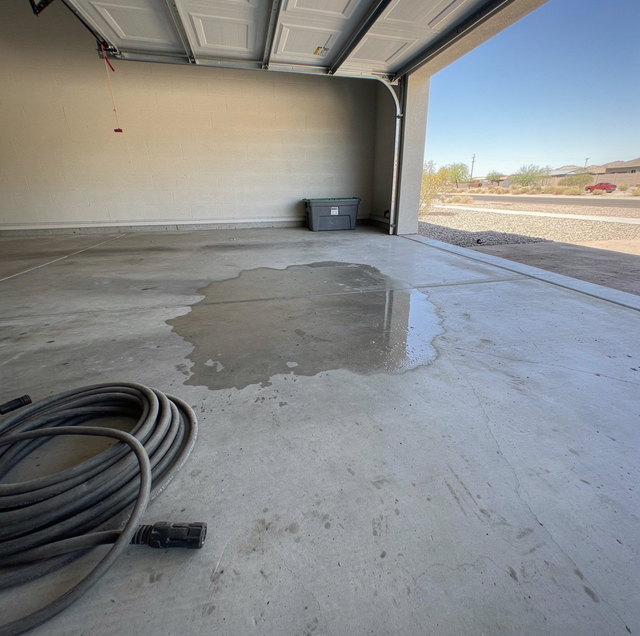
You crouch down at the same spot on the garage floor you photographed yesterday morning, running a thumb across the concrete to check it's really dry this time. It is. No sheen, no dark ring, nothing. You almost feel foolish for calling, and you start rehearsing how to explain to a plumber that the thing you need looked at isn't actually there anymore. But a leak that behaves this way, present one hour and gone the next, isn't a leak that healed itself. It's a leak with a trigger, and the trigger is still sitting somewhere in the house waiting for the same conditions to line up again.
What Starts It When One Fixture Runs
The most common version of this pattern is tied to a single fixture, not the whole house. A supply line under a sink can hold pressure fine while nothing is drawing from it, then show a bead of moisture the moment the faucet opens, and the line pressurizes under flow, only for the fitting to reseat and dry once the water's shut off again. A toilet can do something similar right at the fill valve: dry all day while the tank sits full and static, then damp for the few seconds it takes to refill after a flush. A shower or tub valve downstream of a worn seat can wet a spot only while that fixture is actively running and nowhere near it the rest of the time.
A few of the usual culprits behind this pattern:
A supply line coupling nut: Barely tight enough to seal under no flow, but not enough to hold once water is moving through it under pressure.
A toilet fill valve or the line feeding it: Dry between flushes, damp only during the several seconds the tank is actively refilling.
A cartridge or valve seat inside a shower or tub fixture: Weeping downstream only while that one fixture is turned on, sealed the rest of the time.
None of these show anything useful to a person standing in the room an hour after the fixture was last used, which is exactly why a spot that reads dry on inspection doesn't rule any of them out.
What Starts It When the Line Runs Hot
A second pattern has nothing to do with which fixture is on and everything to do with temperature. Pipe expands as hot water moves through it and contracts again as it cools, and a threaded or compression joint that holds fine through any single cycle can be worked gradually looser across hundreds of them. Where a run is strapped tight, passes through a plate, or is held against a stud, the pipe moves and the restraint does not, so the nearest joint is what takes up that repeated movement, over and over. A joint loosened that way tends to weep while hot water is actually moving past it and to stop once the line cools back down. This kind of weep tends to show up near a water heater or along a hot branch line, and it can be too small to announce itself except right after something pulls a sustained draw of hot water: a full dishwasher cycle, a load of laundry on hot, back-to-back showers. Once the draw ends and the line cools, the joint can reseal well enough that a look an hour later finds nothing.
This is a mechanism, not a season. A hot line runs hot in any month, so a joint that only weeps under thermal expansion does the same thing in July and January. What changes between seasons is how often the house happens to pull a long hot draw, not whether the joint itself is capable of leaking.
What Starts It When an Appliance Cycles
A third pattern is tied to a machine's own cycle rather than to a person turning a handle. A washing machine's supply valve can leak only during the fill portion of a cycle and sit bone dry through the wash and spin. A dishwasher can do the same in reverse, dry through the fill and wash, then show water only during the drain pump-out at the very end. A washing machine's drain hose can also outpace the standpipe it empties into for a few seconds at peak pump-out flow, which can read at first like a supply-side leak on the exact same schedule, even though the water is coming from the drain side of the machine rather than the supply side. Sorting out which side of that particular machine is actually responsible is determined on-site rather than settled by watching the floor.
Why a Dried Spot in This Climate Isn't a Closed Case
The reason "it dried up" feels like good news is that it looks like a leak that stopped. In this climate, it usually isn't. A thin film of water sitting on a sun-warmed concrete floor, a driveway apron, or tile near an exterior wall can evaporate off within a few hours under low humidity and high daytime heat, well before anyone comes back to check it a second time. A spot that was visibly wet at seven in the morning can read completely dry by early afternoon with nothing about the underlying trigger having changed at all. Dry, in other words, describes the surface at the moment you looked, not the condition of whatever is causing the water to show up there in the first place. The trigger that produced the moisture the first time is still on the same schedule as yesterday, and it's due to a fire again the next time a fixture runs, a line carries hot water, or an appliance reaches that same point in its cycle.
How the Pattern Gets Read, Not Guessed At
None of the three triggers above get sorted out by staring harder at a dry spot. They get sorted out by matching the moisture to whatever was happening in the house at the exact moment it appeared, which is a different kind of information than "there was water here yesterday." Once a household can say roughly what was running, or narrow it to hot water versus cold, or place it against a specific appliance's cycle, that's the starting point for confirming the source rather than searching the whole house blind. Locating exactly where the water is escaping, once a trigger has narrowed the search, is specialist work done with equipment designed to find what's hidden behind a wall or under a floor. Closing the leak once that point is confirmed is a separate piece of work that follows after, carried out by the plumbing contractor rather than the specialist who located it. Two different jobs, done in that order, on the same call.
Frequently Asked Questions
Reproducing the trigger is standard practice rather than a last resort. If a household can identify roughly what was happening when the leak last showed, running that same fixture or appliance again during the visit lets a technician start from that specific condition instead of working through every possibility in the house one at a time.
Yes, and how it is taken matters as much as when. Hold the phone low and put a flashlight almost flat against the floor so the light rakes across the surface: that angle picks up the drying edge of the wet area and shows which direction the edge is retreating from, which tells a technician which side of the room the water traveled from. A photo taken straight down on a dark patch records that water was there and nothing else.
It can. A surface reading dry doesn't mean what's beneath it- subfloor, drywall, or a cabinet base- has fully dried between episodes, since those materials hold moisture far longer than an exposed concrete or tile surface does. Repeated short wetting cycles at the same spot can degrade what's underneath well before the surface itself ever looks like a problem.
A line that carries both hot and cold water to the same fixture can weep under either mechanism, and the distinguishing detail is whether the wet spot ever appears during cold-only use or strictly after hot water has been running. That one detail, checked before anyone calls, separates a fixture-cycle cause from a temperature-driven one.
It's possible, and the water itself often carries the difference. Drain-side water tends to arrive warm or soapy and dries down to a faint detergent film or a tide line, while supply-side water is clear and cold and dries without leaving residue behind. Where it sits is the other tell: a standpipe that momentarily overflows wets a ring around the base of the standpipe itself, rather than marking a spot at one fitting, as a supply connection does.
Differently, and that difference is itself a clue. A trigger-driven leak tends to show as short, repeated spikes on a usage graph that line up with activity, a shower, a laundry load, a dishwasher cycle, rather than as one steady higher baseline that holds no matter what anyone in the house is doing at the time.
Call to have the trigger for intermittent leaks confirmed and the repair handled in one job. American Discount Plumbing serves Phoenix and Scottsdale. ROC #150707. Call (602) 883-2787.
