

First Water Bill After Moving In: Why It’s So High
Quick Answer: A high first water bill after a move usually traces to a billing period covering days before you moved in, a system left on the previous owner's schedule, or a stretch the house sat empty, rather than a new problem you caused.
Three weeks in the house, and the billing period printed on the invoice is longer than that. Those two facts do not line up, and the longer of the two was charged. That mismatch is most of the reason a first water bill after a move reads like somebody else's month rather than your own. There is nothing yet to measure it against either: no earlier bill of your own, no feel for what this particular house costs to run, just a total and a sense that it is a lot for two people and a dog.
The Bill Rarely Starts the Day You Got the Keys
Utilities read meters on a fixed cycle of their own, one that has nothing to do with closing dates or move-in dates. When service changes hands, the utility typically takes a reading at the changeover, but depending on how that date falls inside the existing cycle, the reading can land mid-period rather than lining up cleanly with the day you took possession. The practical result is that your very first invoice can blend days that belonged to whoever lived there before you, whether that was the seller, a tenant, or nobody at all, together with your own early days in the house, all totaled under one number with no visible split between the two.
An Irrigation Schedule Nobody Has Touched Yet
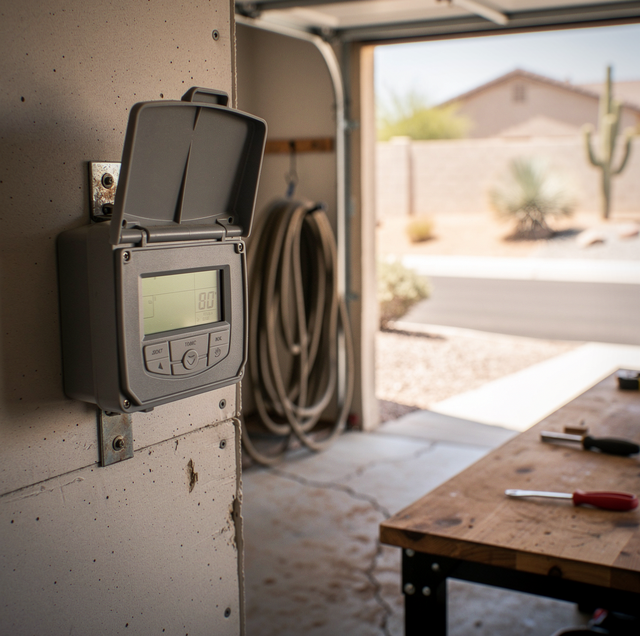
Plenty of houses transfer with a working irrigation controller already programmed, running zones on a schedule set for a different season or a different owner's habits than whatever you're planning for the yard. Nobody has to have done anything wrong for this to go unnoticed for weeks. A controller keeps executing its stored program regardless of who owns the house, and a first-time homeowner walking past the panel in the garage often doesn't yet know how to open it, let alone read what's scheduled to run and when. A system watering more zones, more days a week, or longer per cycle than the yard actually needs does its work quietly, with nothing to see above ground beyond grass that might look a shade greener than the rest.
A schedule is correctable in an afternoon once somebody can read it. A break in the buried line that schedule feeds is not, and finding it is work for a dedicated detection specialist, who brings the equipment; the plumbing contractor makes the repair once the point is marked.
A House That Sat Empty Still Leaves a Number Behind
Some houses sit unoccupied for weeks or months between the last resident and the new one, whether that gap falls between closing and moving day or during work done before anyone lives there full time. A house empty of people isn't necessarily empty of water use. An irrigation controller keeps running during a vacancy exactly as it would if someone were home. A pool's automatic fill valve keeps replacing what evaporates whether anyone swims in it or not. And if the water heater's tank was drained before the vacancy, refilling it draws a real volume in a single sitting once someone finally turns the water back on. None of that shows up as a puddle. It shows up as a total on the first bill that reflects weeks nobody was there, folded into the same invoice as your first days of actually living in the house.
Habits the Last Owner Adjusted Around
Long-term residents get used to a fixture that has always sounded a certain way, and eventually they stop hearing it at all. A sound heard every day for years stops registering as a sound. What gets inherited with the house, then, is whatever was quiet enough to live alongside: a toilet that keeps topping off after a flush, a faucet cartridge worn enough to leave a thin trickle at the spout with the handle turned fully closed, a supply nut under a sink weeping slowly enough that it dries on the underside of the cabinet before it ever pools.
The toilet is worth a second look for a reason unrelated to sound. A flapper that was already replaced once, somewhere in the house's history, is often a near-fit rather than the part that the valve was designed around. Flappers are sold as universal; the seats they land on are not, and a slightly wrong profile can seal well on the day it is fitted and then drift as the rubber takes a set. You inherit that decision without anybody having to mention it, and there is nothing about it you could have caught on a walkthrough.
Most of what arrives this way sits within arm's reach of a fixture, and it is found by working through the toilets, the faucets, and the supply connections one at a time rather than walking the house looking for something wet.
The Meter Reading That Actually Belongs to You
Once you've worked through what the first bill could be carrying, the more useful move is to stop trying to make sense of that particular number and start your own record instead. Take a reading yourself, note the date, and treat that as the true starting point, since nothing before you moved in reflects how this house behaves under your own use. Compare the next full cycle against that mark rather than against the total that surprised you, because that first bill was never going to be a clean read on your habits to begin with. A house tells you what it actually costs to run only after you've been the one running it for a full cycle, not before.
Frequently Asked Questions
Not directly. Ask the utility for the exact transfer read date and compare it against your closing date; if the two are more than a few days apart, request an itemized read history rather than accepting the total as a single lump, since that history is the only way to see where the split actually falls.
Some controllers hold their program through a short power interruption using an internal battery or capacitor, but if that backup fails or the outage runs long enough to drain it, the controller can revert to a factory default program, and on many models the default runs more zones, more often, than a typical custom schedule would.
Usually not reliably. An inspection is a visual check at one point in time, and a fixture tested once during a walkthrough can look fine that day and still behave differently once it's sat under continuous use for a week, since a flapper or valve under mild mineral buildup can seat properly on demand and drift open again once nobody's watching.
If your utility's online portal shows a day-by-day or interval breakdown rather than only a monthly total, you can often see whether the higher use was already happening before your move-in date or started after it. A jump that begins exactly on your move-in day points to something in your own use; a steady higher pattern running through the days before you had a key points backward instead.
Only in one narrow case. A tank left full with the gas valve turned down, or the breaker switched off, which is what usually happens when a house gets closed up, moves no water at all, and contributes nothing to the meter, however long the vacancy ran. The heater can only appear on a bill if the tank was actually drained and then refilled, and that is a single volume drawn on the day the water went back on, not something accumulating across the empty weeks.
No, and waiting is usually the slower answer. Most utilities will send someone to re-read a meter on request inside an existing billing period, and many accept a customer-submitted read through the account portal, either of which gives you a second dated data point weeks before the next invoice would. Two reads a fortnight apart, with a note of what was running between them, says considerably more about whether a loss is ongoing than any single monthly total can.
Start your record with a house that's already been checked — a visit that clears the toilets, faucets, and supply connections gives your own first reading something to mean. American Discount Plumbing serves Phoenix and the Valley. ROC #150707. Call (602) 883-2787.
