

Why Your Faucet Drips After You Shut It Off (And the One Part to Blame)
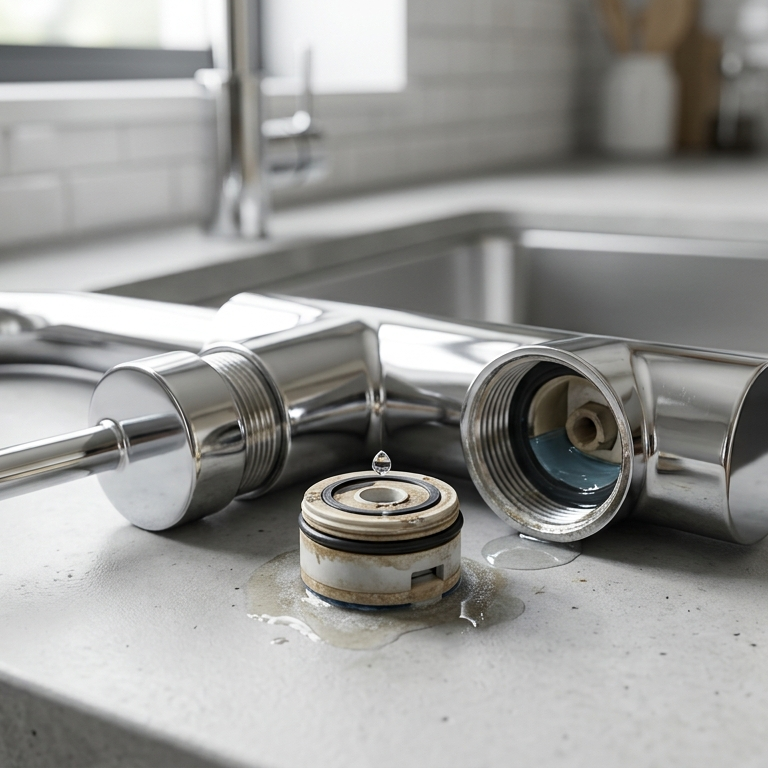
Quick Answer: A faucet drips after the shut-off because a worn internal sealing part is letting pressurized water slip past. On two-handle compression faucets, that part is a rubber washer or the valve seat it presses against. On single-handle cartridge, ball, or ceramic-disc faucets, it is the cartridge, the springs and rubber seats, or the disc. Mineral scale, a corroded seat, a worn O-ring, or a bit of grit stuck in the valve can all break the seal, too. The fix is almost always replacing the one worn part, not the entire faucet.
You crank the handle closed, walk away, and a minute later you hear it: the slow tap of water hitting the basin. The handle is off. The water is off. And the faucet is still leaking. If that has you wondering whether something is broken deep inside the fixture, you are reading the situation correctly. A faucet that drips after you shut it off almost always has one worn internal part that no longer forms a tight seal against the water pressure sitting behind it.
The good news buried in that sentence is that the failure is usually one small, replaceable piece rather than the whole faucet. The tricky part is that which piece it is depends entirely on what kind of faucet you own. Below is how the seal actually works, why yours stopped working, and what it takes to make the drip stop.
How a Faucet Actually Stops the Water
Think of the inside of your faucet like a door being held shut against a strong wind. When you turn the handle to off, you are pressing a sealing surface firmly against an opening, and the water pressure in your supply line is the wind constantly pushing to get through. As long as the seal is smooth and complete, nothing leaks. The moment that the sealing surface gets a hard spot, a crack, a rough patch, or a piece of debris wedged under it, the water finds the gap and slips through, one drop at a time.
That is why a drip after shutoff is different from water simply draining out of the spout. It is not leftover water finishing its exit. It is live, pressurized water from your main line pushing past a seal that has stopped working. The seal will not fix itself, and because the water never stops pushing, the gap only widens over time. A drip you ignore in spring becomes a steady trickle by fall.
Which Part Fails Depends on Your Faucet Type
Faucets are not all built the same way inside, so the first step is figuring out which of the four common designs you have. This matters because each type fails at a different part.
Compression faucets are the oldest style and the easiest to spot: two separate handles, one for hot and one for cold, and each handle screws down noticeably as you tighten it off. Inside each handle is a rubber washer at the bottom of a stem. When you close the handle, the washer compresses against a metal valve seat to block the water. Over years of compression and release, the rubber hardens, flattens, or splits, and it can no longer fill the seat. Just as often, the brass valve seat underneath develops corrosion or a rough, pitted ring that the washer cannot seal against, no matter how new the washer is. Either problem produces the classic compression-faucet drip.
Cartridge faucets usually have a single handle that moves up and down for volume and side to side for temperature, or sometimes two handles that turn only a quarter of the way. A one-piece cartridge inside controls the flow. The cartridge has internal seals and openings that line up to let water through or shut it off. When those wear down, crack, or lose their shape, they stop closing fully, and the faucet drips.
Ball faucets have a single handle that sits on a domed cap and rocks in every direction. Underneath is a slotted metal or plastic ball, and beneath the ball sit small rubber seats backed by tiny springs. Those springs and seats are the sealing points; they are the parts that wear out and start letting water through.
Ceramic-disc faucets use a single lever over a wide cylindrical cartridge that contains two polished ceramic discs. The discs slide across each other to open and close the flow. They are extremely durable, but they can still develop wear or, more commonly, pick up a film of mineral buildup that keeps them from meeting flat and tight.
The Usual Culprits Behind a Broken Seal
Within those faucet types, a handful of specific problems account for most drips.
A worn or hardened washer is the number-one cause in compression faucet problems. Rubber is a consumable part inside a faucet, and it simply does not last forever under constant pressure and repeated crushing.
A corroded or pitted valve seat is the partner problem. Even a perfect new washer cannot seal against a seat that has gone rough. Sometimes the seat can be resurfaced with a seat-dressing tool; if it is too far gone, the seat itself gets swapped out.
Mineral scale is a quiet, constant saboteur, especially where the water is hard. Dissolved calcium and magnesium precipitate out and crust onto the valve seat, the cartridge surfaces, the ceramic discs, and the O-rings. That crust holds the sealing surfaces a hair apart, and the faucet weeps.
A worn O-ring is the part responsible for drips that show up at the handle rather than the spout. The O-ring is a rubber gasket that seals around the stem or cartridge body, and when it flattens or dries out, water escapes at the base of the handle.
Debris or grit is the wild card. A grain of sediment or a broken chip of scale can float down the line and lodge on a seat or inside a cartridge, propping the valve open just enough to drip even when everything else is in good shape.
Read the Drip: Spout Versus Handle Base
Before you take anything apart, watch where the water is actually coming from, because the location narrows down the part.
If the drip falls from the end of the spout, the failure is at the main shutoff seal: a washer and seat on a compression faucet, or the cartridge, ball seats, or disc on a single-handle unit. That is the part that is supposed to stop water from reaching the spout at all.
If the water instead seeps out around the base of the handle or pools at the handle collar when the faucet runs, the culprit is almost certainly a worn O-ring around the stem or cartridge, not the spout seal. Those are two different parts in two different places, and knowing which one you are chasing saves you from pulling the wrong piece.
Why This Is Worth Handling Sooner Than Later
A drip feels minor, and each drop is. Together they are not. A steady faucet drip runs continuously, all day and all night, and the volume adds up faster than most people expect on a water bill. Beyond the waste, the leak is a progress report on a seal that is actively failing. Because the water pressure never lets up, a small gap becomes a larger one, and an occasional drip becomes a constant stream. Handling it while it is still a single worn part is far simpler than waiting until water is running down the back of the faucet or into the cabinet.
Hard water makes all of this happen faster. The same minerals that leave spots on your glasses are grinding away at the rubber and coating the sealing surfaces inside the faucet, so homes with harder water tend to face this repair more often and sooner.
What the Repair Actually Involves
The repair follows the same shape regardless of faucet type. First, identify which of the four designs you have, because that tells you which parts to buy. Next, shut off the water at the supply stops under the sink, then open the faucet to bleed off the pressure still trapped in the lines. This step is not optional; taking a faucet apart with the supply live turns a repair into a flood.
From there, the work is a straight swap of the worn part. On a compression faucet, that means a new washer and, if the seat is rough, a fresh valve seat or a resurfacing pass. On a cartridge faucet, you pull the old cartridge and drop in a matching replacement. On a ball faucet, you replace the spring-and-seat sets and often the whole ball-and-cam kit. On a ceramic-disc faucet, you either clean the mineral film off the discs or replace the disc cartridge. When scale is the problem, cleaning the affected surfaces and flushing the line can restore the seal without any new parts.
The one time a full faucet replacement makes sense is when the faucet body itself is the problem: an old fixture whose seat is corroded past resurfacing, or a body so pitted inside that no new washer or cartridge will seat cleanly against it. Short of that, the drip is a cheap part repair, not a reason to buy a new faucet.
Frequently Asked Questions
A compression faucet is fixed with a new washer and often by dressing the corroded valve seat with a seat wrench, which recuts the metal ring flat enough for the washer to seal again. A cartridge faucet instead needs a matching replacement cartridge that fits the exact brand and model, since cartridges are not interchangeable across makers. A ceramic-disc faucet is the odd one out: the disc itself rarely wears, so the parts that actually fail are the inlet seals and the small springs behind them.
On a ball-type faucet, the base can seep past the adjusting ring and cam packing that sit right under the handle, which is a separate adjustment from the spout seals. Tightening or replacing that ring stops a handle-base leak without touching the parts that control the spout. So a handle-base leak and a spout drip are fixed at two different parts, and confirming which one is wet before you open anything keeps you from swapping the wrong piece.
Water above roughly 7 grains per gallon is generally considered hard, and that is the point where scale starts building fast enough to matter. Beyond stiffening the rubber, that scale crusts onto the aerator and the cartridge, and a periodic vinegar soak of both clears it before it holds a seal apart. Softening the water, or keeping up that soak, slows how quickly a faucet starts to drip.
The one-time replacement clearly wins when the faucet is old enough that its cartridge has been discontinued and no shop stocks a replacement. Without that exact part, a reseal simply is not possible, so a new faucet becomes the only route back to a tight shutoff. Short of a discontinued part, almost every drip is a small-part repair rather than a reason to buy a whole new fixture.
A few seconds of drip right after the shutoff is just the spout draining the last of its standing water, and that is normal on any faucet. What is not normal is a drip that returns a minute or two later, or a faint gurgle of air being drawn in as it drips, because that means a worn seal is allowing pressurized water to pass. That second pattern is the leak worth chasing; the first stops on its own.
This shows up most often right after work on the water main or a meter swap stirs sediment into the lines, which is why a brand-new faucet can start dripping days after nearby plumbing was touched. The aerator screen at the tip of the spout is the first place that loosened grit collects, so unscrewing and rinsing the aerator is the first check before you open the valve. If the aerator is clear, the grit has moved deeper to the seat or cartridge, and the valve gets flushed next.
Book a faucet repair with our licensed team — stop the drip before it climbs your water bill. American Discount Plumbing serves Phoenix and the Valley. ROC #150707. Call (602) 883-2787.