

What a Plumber Documents After a Water Leak, and Where It Stops
Two years after the repair, a folder comes off the shelf. There is a rectangle of newer paint on the hallway ceiling. A buyer's agent has asked what it was, and the homeowner is at the kitchen table, working through a stack of papers for the one page that explains it. She finds the invoice. It carries the address and a date, and, under the description, two words: leak repair.
Somewhere above that patch is a length of pipe that was cut out and replaced, at a spot someone measured off the door frame before the ceiling went back. None of that is written anywhere she can find.
A plumbing repair becomes invisible the moment the access is closed. What survives the visit is the paperwork, which is why what goes onto it matters more than it seems on the day the water is running again.
The Record Starts Before Anything Gets Opened
The useful part of a repair record begins at the front door, not at the pipe. What you reported gets written down close to the way you said it: what you saw, which room, when it started, whether it came and went or held steady, and whether anything changed after you stopped using a particular fixture. That description is the only account of the condition before anyone touched the system, and once the repair is finished nobody can observe it again.
Next comes what was ruled out. Narrowing a leak means isolating branches or fixtures one at a time and watching what happens, and what turned out to be fine is worth recording alongside what was not. A note that a supply was isolated and the symptom continued tells a later reader something real about the rest of the system.
Where a dedicated detection specialist was brought in, that specialist supplies the equipment and the locate, and leaves a mark on the finished surface along with their own written findings. The plumbing contractor's record notes what it received and worked from rather than restating how the locate was performed. Two businesses, two documents, and it is worth knowing which you are holding.
What Gets Written Down While the Pipe Is Exposed
Once access is open, the pipe can be seen for the first time, and this is the narrow window through which the most specific entries are made. A record that is worth keeping names four things.
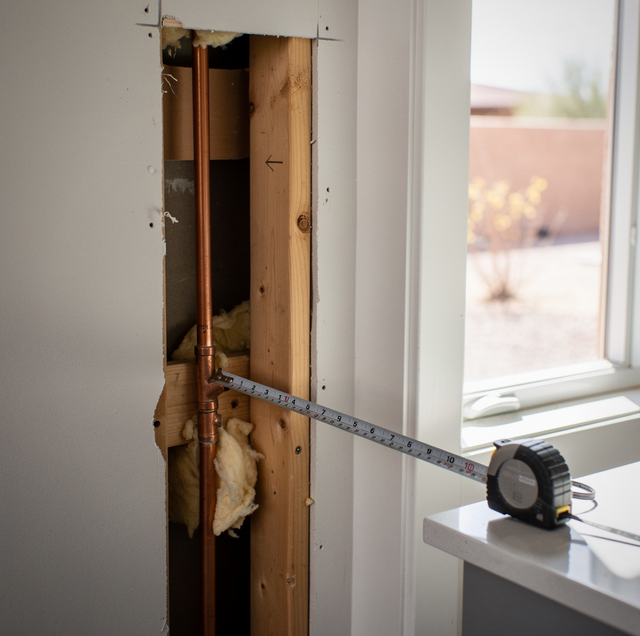
The location: Not the kitchen wall, but which wall, which side of it, roughly what height, and measured off something that will still be there in ten years, such as a door frame, a corner, or a stud line. A room name alone is close to useless once the surface is closed.
The condition found: Whether water was escaping from the body of the pipe, from a joint or threaded connection, from a fitting, or from mechanical damage where something was driven through the line. These are different findings, and they read differently to whoever next sees the record.
The work performed: What was cut out, how much of it, what went back in its place, and whether any valve or fitting was changed at the same time.
The extent of the opening: Which surface was cut, how large the opening is, and what else was found sharing that cavity. Anyone opening the same spot later benefits from knowing what is behind it.
That level of detail is not thoroughness for its own sake. A repair sitting inside a wall or under a floor cannot be inspected again without cutting, so the written entry becomes the only description available.
Showing the Repair Holds Belongs on the Record Too
A repair is not finished when the last connection is made, and the verification earns its own entry rather than being folded into the phrase work completed. What makes that entry usable is what it names: which fixtures were opened and for how long, whether the joint was watched with the branch static or with water flowing through it, and whether anyone besides the plumber was standing at the opening when it held. A line reading tested, no leaks tells a later reader nothing about what was actually done, and a later reader is the only audience that entry has.
Dated photographs are the other half of it, and they can only be taken during that same window. A photograph of an open cavity with the finished connection visible cannot be recreated once the drywall is replaced or the surface is patched. It is the one part of the record that shows rather than asserts.
Note: Photographs of a finished repair have to be taken while the access is still open. Once a wall, ceiling, or floor is closed, that image cannot be recreated without cutting the same surface a second time.
Where the Plumbing Record Stops
A plumbing repair record is a description of plumbing work. That boundary is worth stating plainly because the paperwork is being asked to carry weight it was never built for.
It is not an assessment of damage to the structure. It does not assess how far water traveled through framing, cabinetry, or flooring, nor does it measure how wet anything is. It does not put a figure on what was lost, nor does it attribute responsibility to any person or party. Those are separate disciplines with their own credentials and their own paperwork.
The plumbing contractor does not coordinate or guarantee insurance claims, and does not advise on insurance questions. Those sit between you and your insurer. What the plumbing contractor produces is a record of what was found, what was repaired, and that the repair held.
The same limit applies to the surfaces around the work. Closing the opening, drying the space, and restoring finishes are handled by other trades, and each keeps its own record. A plumbing record that reached into those areas would be worth less, not more, because a reader would no longer know where its authority ended.
A Repair Record Outlives the Wall That Hides It
The reason to care arrives later, usually at an inconvenient moment. A plumber working in the same area years later reads the record and knows what lies beneath the surface before making the first cut. A second symptom in the same room is weighed against what was already repaired, rather than being diagnosed from scratch. A patch of newer paint stops being a mystery and becomes a finished piece of work with a date on it.
That is the difference between a line that says leak repair and a record that says which pipe, where, in what condition, replaced with what, verified how, and photographed on which date. Nothing about the visit changes either way. Only one version is still useful to you when the folder comes off the shelf.
A record like that is far easier to write down on the day than to reconstruct years later.
Frequently Asked Questions
Yes, but name what you want photographed when you book the visit, not on the day. By default, a crew photographing takes one frame of the finished connection. Three more are worth putting on the work order: the failed section laid out on a drop cloth with the point of failure turned toward the camera, the new joint in place with a rule or a tape in shot fixing its position off the door frame, and one wide frame showing what else shares that cavity beside the pipe.
It states the condition observed at the point of failure, which is not the same as a history of how it got there. A weeping threaded connection can look much the same whether it seeped slowly for a year or was disturbed by nearby work, and nothing visible at the time of the repair separates the two. The record describes what was in front of the plumber and stops there.
The content is the same, but it usually goes to a property manager or a designated building contact rather than to whoever occupies the space. Notes about access matter more in that setting because several tenants may share one system, and a repair made for one unit can sit within a wall belonging to another. Getting the record to the person who holds the building file is the part most often missed.
It should, and it should be kept separate from the work performed. A section that was seen and deliberately left alone, or an area that could not be reached without opening another surface, gets noted as exactly that. Without it, a later visit reads the record and assumes the whole run was inspected, which is how a second problem in the same line becomes a surprise.
Ask using the service address and the approximate date rather than a name, since a contractor files against both the address and the customer who was billed. In practice, that means a request from someone who was not the billing customer normally has to come through that customer, which catches out a managing agent, a tenant, or a spouse whose name was never on the invoice. Having the invoice number, even from a bank statement line, shortens the search considerably.
Three things, all of them faster to correct while the crew is still in the driveway. The location entry should point at something permanent, a door frame, a corner, a stud line, rather than naming a room. Anything ruled out should sit on its own line rather than be folded into the description of work performed. And the date carried on the photographs should match the date on the invoice. If a detection specialist was involved, ask whether their findings are attached as a separate document, because the plumbing invoice will not contain them.
Ask for the full repair record when you book — a written account of what was found, what was repaired, and proof that it holds. American Discount Plumbing serves Phoenix and Scottsdale. ROC #150707. Call (602) 883-2787.
