

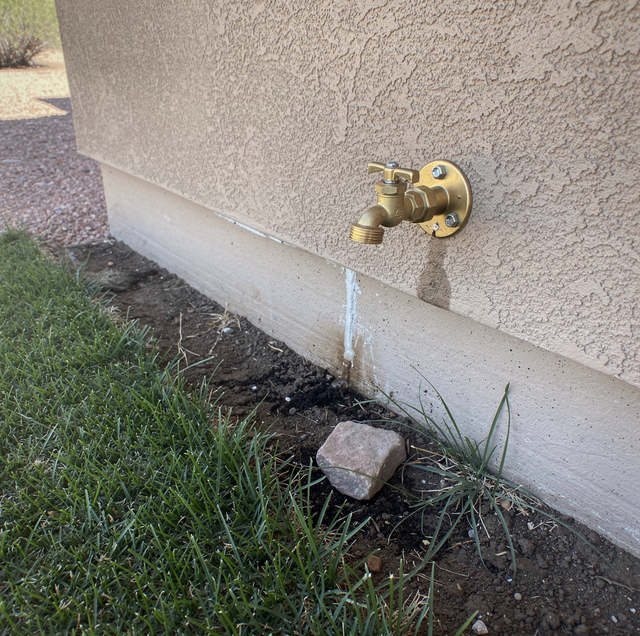
Quick Answer: Outdoor leaks concentrate at four points working out from the house: the hose bib and its wall penetration, the buried line feeding it, the irrigation take-off and valve box, and any pipe or fitting left exposed to sun and heat.
The yard looks exactly like it did last month. The grass along the fence line might be a shade greener than the rest, but nothing is standing in a puddle, nothing sounds like running water when you step outside at night, and there is no damp patch working its way across the patio. Everything above ground reads normal. The water bill does not agree.
That mismatch is common enough outdoors that it deserves its own explanation, separate from the wet-spot-in-the-house kind of leak. Indoor water usually has to travel through finished surfaces before it shows itself, so a stain or a soft patch of drywall eventually forces the issue. Outdoors, water can seep into open soil and simply sink downward and sideways, with nothing above it ever changing color. The leak is real. It just never had to announce itself.
The Hose Bib and the Line Feeding It
Start at the wall itself. A hose bib, sometimes called a sillcock, passes through the exterior wall on its own short run, sealed where it penetrates the stucco or siding with caulk or a foam collar that ages and shrinks over the years. A leak at that penetration does not always show up as water on the wall. Just as often it tracks down inside the wall cavity or straight into the soil at the foundation line, so the visible clue is a soft or discolored patch of ground directly below the fitting rather than anything on the bib itself.
Behind the wall, a branch line runs from where it splits off near the house out to that hose bib, usually a short run of copper or PEX buried a modest depth below grade. Because that run is short and close to the foundation, a leak on it tends to concentrate water in one place instead of spreading it, which is why the ground near an exterior faucet is worth a closer look before assuming the source is farther out in the yard. The fitting itself can also fail at the handle packing or where it threads onto the branch line, and either failure point can leak steadily without ever wetting the visible spout.
Irrigation Take-Offs and the Valve Box Downstream
Move farther from the house and the next concentration point is wherever the irrigation system taps into the supply. That take-off almost always includes a backflow prevention device, either a simple anti-siphon vacuum breaker mounted above grade or, on a dedicated irrigation line, a reduced-pressure or double-check assembly. Its job is to prevent water in the irrigation piping from being pulled back into the drinking-water side of the house, and its seals and internal check mechanisms are also common points for slow, easy-to-miss seepage.
From the take-off, the system runs to one or more valve boxes: the green or black plastic boxes set flush with the ground that hold the solenoid-operated zone valves, the low-voltage wiring from the controller, and the PVC lateral lines splitting off toward sprinkler heads or drip emitter tubing. Everything inside a valve box is designed to sit wet occasionally, since a valve opens and closes with every watering cycle, which is exactly what makes a genuine leak there easy to talk yourself out of investigating. A box that is damp right after a cycle is normal. A box that stays full or refills on its own between cycles is not.
The backflow device: The seals here fail slowly, seeping only when the irrigation line is pressurized. The valve box: houses the zone valves, wiring, and the lateral-line splits; standing water that returns after the box is checked points past a normal cycle. The lateral lines and emitter tubing: Thin-wall drip tubing splits and punctures more easily than the solid PVC feeding it.
Once the box itself is ruled in or out, narrowing a buried loss to a specific fitting rather than a general area of the yard is the work of a dedicated detection specialist, who brings the equipment; the plumbing contractor makes the repair once the point is marked.
What Sun and Heat Do to Exposed Fittings
Anywhere a pipe, riser, or fitting sits above grade rather than buried, sun and heat become the dominant stressors, and this is the piece that ties the whole outdoor system together. Ultraviolet light breaks down the polymer chains in exposed PVC over time, and the visible sign is a pipe that has gone chalky or slightly faded compared to when it was installed, a surface change that usually means the material underneath has gotten more brittle along with it. Heat adds a second mechanism on top of that: a fitting sitting in full sun swings through a wide temperature range between a summer afternoon and the cool hours before dawn, and that repeated expansion and contraction works a threaded connection loose over hundreds of cycles, and loads a solvent-welded joint until a poorly made one, cold or dry, cracks at the fitting hub or is racked out of alignment.
That same exposed fitting takes on a second, smaller stressor in the higher-elevation parts of the service area, where overnight temperatures often drop below freezing, so any water trapped in a valve, backflow device, or a short above-grade run can freeze, expand, and split the fitting from the inside. Away from those higher elevations, heat and sun do essentially the same job to the same kind of fitting, just on a slower, year-round schedule instead of a single cold night. Either way, the part most likely to fail first is whichever one was never buried or shaded in the first place.
The Water Bill Is the First Real Clue
None of this requires digging to start narrowing down. The pattern that separates an outdoor leak from ordinary watering is persistence: usage that stays higher than normal on days the irrigation controller never ran, or that keeps climbing across a billing cycle instead of settling back down once a watering schedule finishes. That kind of pattern points outdoors, toward one of the concentration points described above, well before anyone opens a valve box or pulls a hose bib off the wall.
Getting to an answer sooner mostly comes down to noticing the mismatch early and describing it accurately: which fixtures or zones were and were not running when the usage spiked, and whether the affected ground stays consistently damp or only after specific cycles. Written down as it happens, that account is worth more to whoever arrives than a month of guessing at the yard.
Frequently Asked Questions
An anti-siphon vacuum breaker works on gravity, so it has to be mounted above the highest sprinkler head or emitter on the zone it protects, by whatever margin its manufacturer specifies rather than a height anyone should eyeball. A yard that gained a raised planter bed or a head partway up a slope after the system went in can leave that device sitting lower than the highest outlet it now feeds, which is worth pointing out to whoever inspects the take-off.
Generally no. Drip tubing runs downstream of a pressure-reducing device built into most drip systems, so a punctured emitter line leaks at a comparatively slow, steady rate. A split in a solid PVC lateral before the pressure reduction is a different situation, since that section is still carrying full-house pressure and can lose water much faster.
Sun exposure is not the only mechanism outdoors. A buried PVC lateral can crack at a coupling when the soil around it settles or shifts, which is more likely in areas with uneven fill or caliche layers near the surface. The pipe itself is protected from UV, but it is not protected from the ground moving around it.
Yes. Valve boxes sit flush with grade with an open or slotted bottom resting on gravel, so grading that channels runoff toward that corner of the yard, or a box set low in a shallow swale, puts water in it with nothing wrong anywhere upstream. Overspray is the other ordinary source: water from the zone's own heads lands on the lid and drains straight through the wire and pipe penetrations in the box wall.
Some do, though it depends on the equipment installed rather than the controller alone. A flow sensor threaded into the mainline just past the backflow device can compare the flow each zone is actually using against what is expected and flag a zone running unusually high, but this is an add-on component, not something built into most existing systems already in the ground.
It does, though not in the direction most people assume. The polyethylene tubing used in drip systems is carbon-black loaded and stabilized to lie on the surface in sunlight, which is the job it was built for. Rigid PVC used for risers and above-grade runs is not: left unpainted, it chalks and grows brittle under ultraviolet exposure, which is why manufacturers generally recommend an exterior-rated paint or a protective wrap on any PVC standing in permanent direct sun. The exposed component most likely to fail first is usually an unpainted PVC riser or fitting, not the tubing running past it.
Schedule an outdoor leak check before the water bill climbs any further — get the hose bib, irrigation lines, and valve boxes checked as a system. American Discount Plumbing serves Phoenix and the Valley. ROC #150707. Call (602) 883-2787.
