

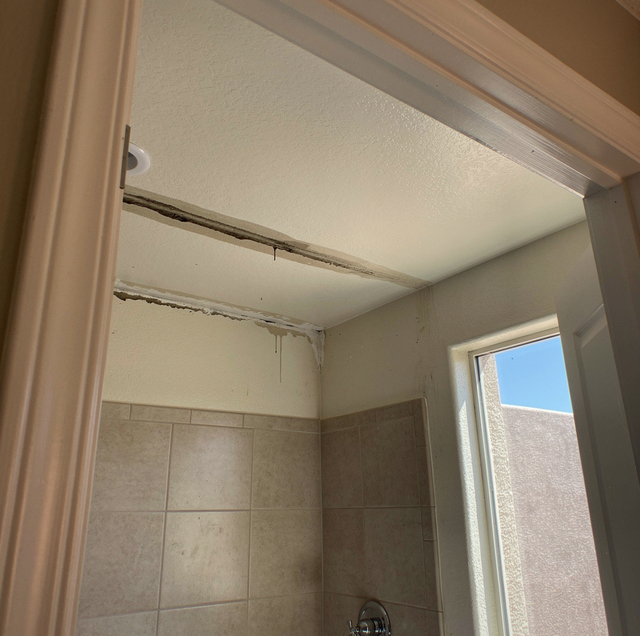
Two facts about the same house refuse to agree. The ceiling under the bathroom carries a dark line that gets a little longer every week, and the baseboard in the next room goes damp on the same schedule. Yet nobody in the house has taken a bath in months. The toilet is dry at its base, the sink cabinet underneath is clean and stays clean, and running the tub or filling and draining the sink produces nothing at all. The only thing that room does is take showers, and the wet line grows while one is running and stops within a few minutes of the handle going off. That contradiction is not a dead end. It is the most useful evidence available because it rules out most of the plumbing in the house and narrows the search to a short list of places where water appears only when that one fixture is on.
What the Valve Body and Its Escutcheon Are Hiding
Behind the wall, the shower valve is a small metal body set into blocking between the studs, with a cartridge inside that mixes hot and cold and a decorative escutcheon plate on the finished side that hides the rough opening around it. The cartridge, whether it's a single pressure-balance unit or a two-cartridge thermostatic setup, seals against the valve body with a set of O-rings and washers, and those seals only see water when you turn the handle and open a path through them. A cartridge that has started to fail internally can let water past those seals and into the valve body itself, wetting the cavity behind the wall without ever producing a visible drip at the trim or the spout, which is exactly why this location matches the timing you're seeing.
Note: A valve-body leak and a pan-liner leak stain the same ceiling in the same shape, and opening the wall for the wrong one costs a repair. A detection specialist marks the actual point first.
Where a valve-area leak usually starts:
- The cartridge seals: Water passes internally when the valve opens, with no drip ever reaching the visible trim.
- The valve body's threaded ports: A fitting that was never fully seated during installation, weeping only under the flow of an open valve.
The Shower Arm and the Drop-Ell Feeding It
Above the valve, a short length of pipe runs up inside the wall to a fitting called a drop-ell, an elbow that redirects the supply out through the finished wall to the shower arm and head. That drop-ell is fastened to its blocking during rough-in, while the cavity is still open and the entire run can be inspected. The joint made last is not the ell itself: it is the shower arm, which threads into that ell after the wall has been closed, tiled and finished. That makes the arm-to-ell connection the one joint in the run tightened by feel, by hand, with the cavity already sealed and nothing about the seal visible to whoever is making it. It is a plausible spot for a small persistent weep, and because nothing flows through it except when the shower head is delivering water, a leak there behaves exactly like the pattern you're describing: present only while the shower runs, silent the rest of the time.
Two Kinds of Water, and Why the Distinction Matters Here
It helps to separate two different things happening inside that wall, because they point in different directions. Water under pressure, the kind that fills the pipe feeding the valve continuously, doesn't need the shower running to leak; a pinhole or a loose joint on that pressurized side is usually wet on its own schedule, independent of whether anyone has touched the handle in hours. Water that only moves while draining is a different animal entirely, held up by nothing but gravity, present in the pipe only for the seconds or minutes water is actually flowing toward it, and gone the instant flow stops. A leak that shows up strictly when the shower runs and dries up right after usually means one of two things: either the pressurized supply only reaches the leak point when the valve is open, which is the case for the valve body and the drop-ell above, or the leak isn't on the supply side at all, and it's the drain path underneath doing the leaking instead.
The Drain Path Underneath the Shower Floor
Below the shower, the drain assembly connects the shower base or pan to the waste line via a rubber or plastic fitting, often clamped or solvent-welded depending on the drain style, and that connection carries water only while the shower is actively draining. A gasket that's compressed unevenly, a clamp that's loosened over time, or a connection that was never fully seated during installation will leak in exact rhythm with use: wet while you're standing under the water and for a short while after, dry the moment the floor clears. This is the drain-side possibility worth naming, separate from anything covered above, and it's one more reason the timing detail you've already noticed is worth repeating to whoever comes to look, since it points away from the pressurized side of the wall entirely.
When the Enclosure Itself Is the Source
The last place water this pattern can come from isn't the plumbing at all. Tiled shower enclosures are built over a waterproofing membrane or a pan liner set beneath the mortar bed, and that liner typically includes small weep holes near the drain's clamping ring so any moisture that gets past the tile and grout has a way back into the drain instead of pooling under the floor. When those weep holes clog with thinset or debris during construction, or when the membrane itself has failed at a seam or a corner, water that gets behind the tile during a shower has nowhere to go but sideways into the framing, again only while the shower is actually running. This is a waterproofing and tile question rather than a plumbing one, and it's worth naming as a real possibility precisely because chasing it as a supply or drain issue wastes time that could go toward the trade that actually handles pans, liners, and tile.
The One Observation Worth Repeating Word for Word
Whichever of these it turns out to be, the detail that matters most before anyone opens a wall is the one you already have: water present only during use, gone shortly after, never showing up on its own between showers. That single observation is what separates a valve or drop-ell leak, both fed by pressurized supply that only reaches them when the handle is turned, from a drain-side or enclosure leak, both fed by nothing but gravity and active flow. Reporting it accurately, including how quickly the wet line stops growing once the water's off, shortens the diagnostic step considerably.
Frequently Asked Questions
The arm seals on tapered threads dressed with PTFE tape or pipe dope, not on a mechanical fitting or a joined connection, so the seal depends on how far the arm is turned in. Then a cosmetic requirement conflicts with it: once the arm is tight, the head still has to point straight and level. Backing the arm off part of a turn to square the head up gives back exactly the thread engagement the seal was relying on, and nobody can see what that costs from the finished side of the wall.
It can, and two finishing mistakes do it. Shower valves ship with a plastic plaster guard meant to be cut away once the wall is finished, and leaving one in place acts as a shroud that carries an escaping drip back into the cavity rather than out to the tile face. An escutcheon caulked in a full circle does the same thing. That bead is supposed to stop short at the bottom edge, leaving a deliberate gap so anything getting behind the plate weeps out where somebody sees it.
Not necessarily. Some escutcheon plates seat against a foam or rubber gasket, and old caulk anchoring the plate to the tile can trap water against the wall well after the plate is off, so a dry-looking cavity right after removal doesn't rule out a slow source.
That split points at the pan or the membrane rather than the valve. A supply-side leak starts the moment the handle opens and does not care how long anyone stands there. A liner failure requires both volume and dwell time: water has to work past the grout, collect on the membrane beneath, and build up enough depth to run sideways to whichever seam or corner has failed. A five-minute rinse rarely gets there. A twenty-minute shower gets there every time, which is why the same enclosure can look fine all week and only misbehave on the long ones.
It usually points toward a saturated wall cavity slowly releasing water it has already absorbed, rather than an active new source, which is a different pattern from a drain-side leak, which typically stops within moments of the floor clearing, since nothing but gravity was moving that water in the first place.
It can. A thermostatic valve runs two separate cartridges, one for volume and one for temperature, each sealed against the valve body on its own, which doubles the number of internal seal points that can eventually let water past compared to a single-cartridge pressure-balance valve.
See water only when the shower runs — call before it travels further into framing you can't see. American Discount Plumbing serves Phoenix and the Valley. ROC #150707. Call (602) 883-2787.
