
Hydro Jetting: The Drain Fix a Snake Simply Cannot Match
Quick Answer: Hydro jetting clears a drain or sewer line by sending water through a specialized nozzle at very high pressure, scouring grease, scale, sludge, and small roots off the full inside wall of the pipe. A cable auger, or snake, only bores a hole through the clog. Because the pressure is high enough to injure a person and to damage a weak pipe, jetting is professional work, and a camera inspection should confirm the line is sound before the water goes in.
Scouring the Pipe Versus Punching Through It
The fastest way to understand hydro jetting is to compare it with the tool most people already know: the drain snake. A snake, also called a cable auger, is a long flexible cable with a cutting or grabbing head. It spins down the line, catches the blockage, and bores an opening through it. Water starts moving again, so the drain seems fixed. What it actually did was drill a channel through the middle of whatever was stuck. The grease, scale, or sludge coating the pipe wall is still there, and the opening it left closes back up as new debris collects on the same buildup.
Hydro jetting works the pipe wall itself. Instead of one cable pushing through the center, it floods the line with water driven hard enough to strip the interior surface all the way around. Grease films off the wall, mineral scale breaks loose, sludge flushes downstream, and the pipe comes back to close to its original diameter. That is the core difference: a snake reopens a path, jetting resurfaces the pipe. Which one a line needs depends on what is in it and, just as important, on whether the pipe is strong enough to take the pressure.
How Hydro Jetting Actually Works
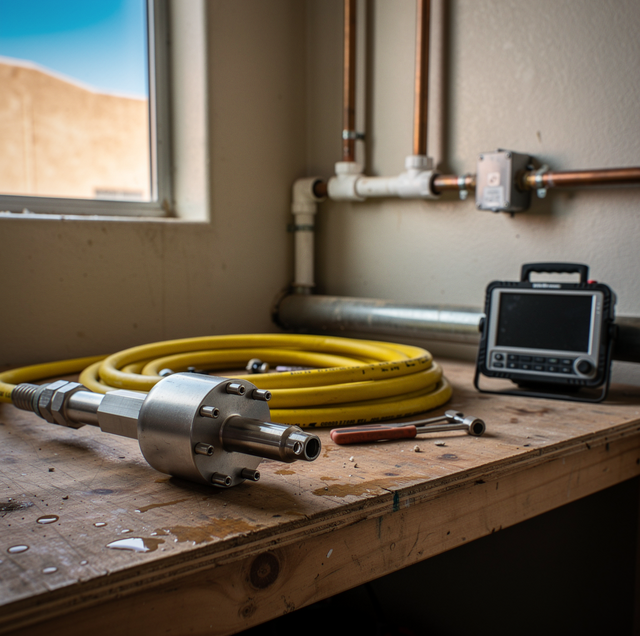
The equipment is a water tank feeding a pump that raises ordinary water to a working pressure measured in thousands of pounds per square inch, with flow rated in gallons per minute. Pressure alone does not clean a pipe. The flow behind that pressure is what carries loosened debris out of the line. Both numbers matter, and a technician matches them to the pipe size and the job.
The business end is the nozzle, and it is doing two jobs at once through its angled jets:
Reverse jets pull and clean: Most of the nozzle's openings angle backward. These rear-facing jets do two things at the same time. Their thrust drives the hose forward and drags it up the line without anyone shoving it, and the same backward spray blasts the pipe wall behind the nozzle, so the surface is being scoured as the head advances.
Forward jets break the path open: A smaller forward jet, when the nozzle has one, drills into the blockage ahead so the head can pass, breaking up a dense plug of grease or a root ball enough for the rear jets to finish the walls.
The technician feeds the hose in, lets the reverse thrust carry it to the far end, then works it back, cleaning the full run rather than one spot. Different nozzles handle different problems: a straight-cutting head for a solid grease plug, a rotating or chain-tipped head for hard scale, a root-cutting head for intrusions. Choosing the wrong one wastes the pass or scars a pipe, which is one reason this is not rental-counter work.
What Hydro Jetting Clears
Because it cleans the wall and not just the center, jetting handles the buildup a snake leaves behind:
- Grease and fat: Kitchen lines glaze over with a hardened grease layer that a cable slices through but cannot lift. Water pressure shears it off the wall.
- Mineral scale: Hard water leaves a rough scale lining that narrows the pipe and snags everything passing through. Jetting knocks the deposits loose so the bore opens back up.
- Sludge and soap: Slow-draining laundry and bathroom lines fill with a soft paste of soap, hair, and grit that packs the pipe. Jetting flushes the whole mass downstream.
- Small roots: Fine feeder roots that have slipped through a joint can be cut and cleared with the right head. Thick structural roots or a root-broken pipe are a repair, not a cleaning.
- Full-diameter restoration: Because the wall is scoured all the way around, the line comes back near its built diameter, which is why a jetted drain tends to stay clear far longer than a snaked one.
Why the Camera Goes In First
A camera inspection before jetting is not an upsell. It is the safety check that decides whether jetting is even an option. A technician runs a waterproof camera down the line to see the pipe's material, its condition, and what is actually blocking it. Old cast iron can be scaled but sound, or it can be flaking and thin. Clay tile can be intact or cracked at the joints. That view answers the one question that governs the whole job: can this pipe take the pressure?
The camera also finds problems a jetter should never be pointed at, such as a bellied section holding standing water, a collapsed segment, or an offset joint where the pipe has shifted. Those are structural failures. Blasting water at them does not fix anything and can turn a repair into an emergency. Seeing the line first is what separates a clean job from an expensive mistake.
Ask for a camera inspection before any line is jetted. It confirms the pipe material and condition and whether the blockage is buildup or a structural problem like a belly, a collapse, or an offset joint that jetting cannot fix and could worsen. That single view is what keeps a cleaning from becoming a wrecked pipe.
When Jetting Is the Right Call, and When It Is Not
Jetting earns its place on lines where buildup keeps coming back or coats the whole run:
Good candidates: Recurring clogs that a snake clears for a few weeks and then return. Kitchen and restaurant lines carrying grease. Whole-house slowness where several fixtures drain sluggishly at once, pointing to a coated main rather than one trapped clog. Routine sewer maintenance on a known problem line, cleaning it on a schedule before it backs up.
Poor or unsafe candidates: The same pressure that scours a healthy pipe can finish off a failing one. Fragile or aged pipe is the clearest no. Old clay tile that is already cracked, or Orangeburg pipe, a tar-and-paper material used decades ago that softens and deforms with age, can be split or crushed by full-pressure jetting. A collapsed or badly offset line will not clear no matter the pressure, because the blockage is the broken pipe itself. And a line that just had chemical drain cleaner poured into it should never be jetted until it is flushed, because high-pressure water can throw caustic splashback onto the technician. In these cases, the camera pass is what turns a bad call into a repair plan instead of a wrecked pipe.
The two-sided point is worth holding onto. Jetting is powerful because it moves water with real force, and that same force is exactly why it can wreck a compromised line. The tool is not gentler or harsher by season or setting; its fit depends entirely on the pipe it is aimed at.
An Analogy That Holds Up
A snake is a drill; hydro jetting is a pressure washer. A drill bit bores a clean hole through a stuck door lock but leaves the surface around it untouched. A pressure washer strips a whole patio back to bare surface, which is what you want on grime and exactly what you do not want on cracked, crumbling masonry that the blast would tear apart. Same logic underground: match the force to what the surface can survive.
Why This Is Professional Work
Hydro jetting runs water at pressures high enough to cut skin and cause serious injury, which is why it is not a rental-counter or do-it-yourself job. The operator has to control hose thrust in a confined line, read the camera, pick the right nozzle, and know when to stop. There is also the biohazard: sewer water carries bacteria, and jetting can aerosolize it, so containment and cleanup matter. A trained technician manages the pressure, protects the pipe, and keeps the mess and the health risk contained. Done right, it is one of the most effective cleanings a drain can get. Done wrong, it injures the operator or destroys the pipe.
Hydro jetting runs water at pressures high enough to cut skin and cause serious injury, which is why it is not a rental-counter or do-it-yourself job. Sewer water also carries bacteria that jetting can aerosolize, so containment matters, and a line that just had chemical drain cleaner poured in should never be jetted until it is flushed, since high-pressure water can throw caustic splashback.
Frequently Asked Questions
For a busy kitchen or restaurant line, many plumbers set a maintenance interval of every 3 to 6 months, because grease reglazes the wall steadily even with good habits. A residential kitchen line that has scaled once may go a year or more. The right interval is set from the camera view and how fast the line coats back up, not from a fixed calendar rule.
No. Modern PVC and ABS drain lines in sound condition are well within the pressure jetting uses, which is a large part of why a technician checks pipe material on the camera pass first. The concern is aged or brittle material such as thin cast iron, cracked clay, or Orangeburg, where the same pressure that is harmless to plastic can split a wall already near failure.
A jetter can work into a standing, fully blocked line; the forward jet bores into the plug and the rear jets clear behind it as the head advances. What it cannot beat is a structural blockage, a collapsed or crushed section, where there is no intact pipe left to clear. That distinction is exactly what the camera confirms before the pump is turned on.
No, and people mix them up. Jetting is a cleaning method that removes buildup from the inside of an existing pipe. Trenchless lining is a repair that installs a new cured resin liner inside a damaged pipe. They are often paired, since a pipe usually has to be jetted clean before a liner can bond to the wall, but one cleans and the other rebuilds.
It cuts and flushes the roots that are present, which restores flow, but it does not kill the root system outside the pipe or seal the crack or joint the roots entered through. Roots regrow toward the same moisture, so a jetted root line usually needs the entry point repaired, or periodic maintenance, to keep from reintruding.
Repeat snaking is a signal, not a solution. A cable that clears a line for two or three weeks and then loses it again is boring through buildup that immediately reforms on the coating it left behind. That pattern is the classic case for a camera and a jetting cleaning, which strips the wall so debris has nothing to re-collect on, rather than paying to reopen the same channel over and over.
Tired of the same drain backing up every few weeks — get it scoured clean and inspected the right way. American Discount Plumbing serves Phoenix, Scottsdale, and the Valley. ROC #150707. Call (602) 883-2787.
