

PEX vs. Copper vs. PVC: It Depends on Your Water
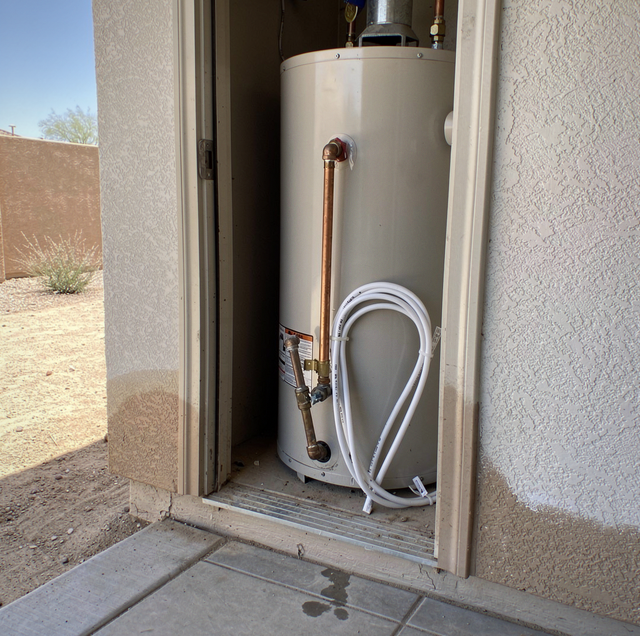
Pull the access panel off an older home's water heater closet, and you might find three plumbing eras stacked into one line: a stub of galvanized pipe capped off years ago, a run of copper still feeding the tank, and a coil of white PEX tubing running out to a fixture added in a later remodel. Each material got picked because it was the obvious choice for that specific run, in that specific wall, at that specific time.
That's also the real answer to which one lasts longest: none of them, as a fixed property. Copper, PEX, and PVC or CPVC each fail for different reasons, and which one gives out first in your house depends on what's dissolved in your water and where the pipe actually runs. Knowing what kills each one tells you which failure to watch for in your own house.
Copper Fails From What's Already in the Water
Copper doesn't fail simply because it's old. It fails when the water moving through it chemically attacks the tube wall faster than the pipe's own thin oxide coating can rebuild itself. Water on the acidic side, below about pH 6.5, drives that: it dissolves the protective layer as fast as it forms, and the tube wall thins from the inside until a pinhole opens. On a horizontal run, that shows up along the bottom of the tube, where settled sediment holds aggressive water against one patch of wall. Whether a stain on drywall means a leak is already active is a separate diagnostic question. It doesn't change which pipe failed or why.
The other driver is speed. Water moving too fast through a copper line scours the oxide layer off the tube wall by force, and that erosion is most severe right where the water changes direction: elbows, tees, and any spot downstream of a partly closed valve. Plumbing trade guidance on copper tube caps: continuous-flow velocity is around 5 to 8 feet per second, tighter on the hot side than the cold, because faster flow strips that protective layer faster than it can reform.
One failure copper shares with the other two is a freeze. Water expands as it turns to ice, and pressure builds in the trapped column between the ice plug and a closed fixture. Copper is rigid, so the tube bursts where that column loads hardest. Rigid PVC and CPVC are more brittle than copper when cold and split lengthwise. PEX is one of the three with real tolerance for it, since the tubing swells around the ice and pulls back afterward, though the fittings on that line can still be forced past their limit.
A pipe that splits during a freeze can hold back water until it thaws, regardless of the material. After a hard freeze, shut the main valve before restoring heat to that area, since a hidden split shows itself once water moves.
PEX Fails From the Inside, From Light, and From Teeth
Where copper's enemy is what's dissolved in the water, PEX's enemy is the water's own disinfectant. Chlorine and, increasingly, chloramine keep water safe to drink by oxidizing organic material, and the cross-linked plastic in PEX tubing is itself organic. At the temperatures found in a hot-water line, chlorine and chloramine slowly oxidize the tubing wall from the inside, which is why manufacturers write chlorine-resistance requirements into their PEX specifications. Cold lines see the same chemistry at a much slower pace, which is why the hot-water PEX run feeding a fixture ages differently than the cold line feeding the same one.
PEX has a second vulnerability that starts outside the tubing: sunlight. The same tubing that lasts for decades inside a wall becomes brittle within weeks if it's left exposed outdoors or run across a sunlit attic without cover, because ultraviolet light breaks down the polymer chains that give the tubing its flexibility. Manufacturer installation instructions cap direct sunlight exposure at 30 to 60 days depending on the brand, before or after installation, and a length that exceeds that window can crack the first time it's flexed, even though it never carried a drop of aggressive water.
Then there's the failure mode nobody puts in a brochure: rodents. PEX tubing is flexible plastic that sits in the same attics, crawl spaces, and wall cavities that mice and rats travel through, and it is chewed easily. Unlike a burst copper joint, a gnawed PEX line doesn't announce itself right away; it weeps at a puncture that can sit unnoticed inside insulation for months. Plumbing trade and insurance-claim reporting both describe it as a recurring failure mode, and it's specific to PEX here, since neither copper nor rigid PVC gives a rodent anything to bite through.
PVC and CPVC Fail With Age and at the Joint
PVC and its heat-rated cousin CPVC share a plastic's two classic weaknesses: they get more brittle as they age, and they're only as strong as the joint holding them together. Both harden slightly over years of thermal cycling, and both lose more of that flexibility under sunlight, which is why a supply line run in daylight, an exterior wall penetration, or an unfinished garage ceiling near a window is a candidate for cracking that a buried or wall-hidden run of the same age isn't.
Plain PVC is also limited by heat. Manufacturer pressure-and-temperature tables rate standard PVC pressure pipe for roughly 140°F of continuous water temperature, which is why it shows up on drains and cold-water lines rather than hot supply. CPVC exists to fix exactly that: its added chlorination raises that continuous-temperature ceiling to somewhere around 200°F, which is what lets it carry hot water and connect to a water heater.
A solvent-weld joint is as much a chemical bond as a mechanical one: primer softens the pipe and fitting surfaces, cement fuses them into effectively one piece, and the joint ends up just as good as when it was assembled on the day it was made. A dry-fit that skipped primer, a fitting that wasn't given a quarter-turn to spread the cement evenly, or a joint pressurized before the cement fully cured all leave a weak spot that behaves fine for months or years until it doesn't. Once a solvent-weld joint has set, its quality is locked in at the moment of assembly and invisible to any later inspection.
Solvent-weld PVC and CPVC joints reach handling strength in about 15 minutes, but full cure takes up to 24 hours depending on pipe size and humidity. A joint tested before that window closes can look sound and still fail later.
Local Rules Decide Where Each Pipe Can Go
Local code adds a constraint of its own: the best-performing material for a job is only usable where it's approved. What's allowed for a given use, potable supply versus drains, interior versus buried, PEX versus copper versus CPVC, varies by which plumbing code a jurisdiction has adopted and how it's been amended locally, and that answer belongs to your local building department. The same material approved for a repipe on one street may require a different fitting type a few miles away, due to different local amendments. Confirm what's allowed locally before assuming a material is a given.
A Repipe Looks Different Depending on the Material
The material also determines how much of your house needs to be opened up to replace it. Copper is rigid, so a repipe means cutting and soldering new runs section by section, which calls for opening drywall at more points along a wall or ceiling to get a torch and fittings into position. PEX bends around obstacles that would stop a rigid pipe cold, so a PEX repipe can be fished through existing top-plate holes and wall cavities from a central manifold, sometimes running a dedicated line to each fixture, cutting far fewer access holes than a copper job would. CPVC sits in between: rigid enough to need real access for its solvent-weld joints, but lighter and easier to route through tight framing than copper.
The Joint Fails Before the Pipe Does
Follow all three materials back to an actual failure and the same pattern shows up. A copper line pinholes along its wall, but a copper fitting fails where the solder never fully wetted the socket. A PEX tube can take chlorine and sunlight for years, but a crimp ring set at the wrong depth or an expansion fitting that was never fully seated leaks from day one. A solvent-welded PVC or CPVC joint is only as good as the primer-and-cement job that made it. The joint is the weak point in each of those systems, which is why a plumber inspecting an aging system checks connections before condemning the material feeding them.
Joint density is worth knowing about your own house for that reason. A straight run through open framing carries almost no risk on its own, while a stretch of pipe threading around a stack of floor joists picks up a fitting at every direction change, and each of those is one more assembly that had to be made right on the day it went in.
Frequently Asked Questions
Yes, through a transition fitting rather than a direct joint. PEX doesn't sweat-solder the way copper does, so the connection point is a brass transition fitting with a solder or threaded end for the copper side and a crimp, clamp, or expansion end for the PEX side. Copper and PEX don't have a galvanic corrosion problem the way copper and steel do, since PEX is a plastic and can't form the metal-to-metal reaction that corrosion requires, so the fitting's job is purely mechanical. That's the arrangement whenever a copper system is extended with PEX during a remodel.
No. Red and blue PEX are colored that way purely so an installer can track which line is hot and which is cold at a glance, while white and gray tubing can carry either. The tubing's UV inhibitors and chlorine-resistance additives are part of the underlying plastic formulation. A red line and a white line from the same manufacturer age the same way under the same conditions.
There are clues short of cutting, though no single tool settles it. A stud finder set to metal-detection mode picks up copper through drywall but reads nothing over PEX, since PEX contains no metal at all. Combined with your home's build date, which points toward what was standard when that section was plumbed, that gives a plumber a strong guess before ever opening a wall to confirm it.
Sometimes, and the mechanism is worth naming correctly. A PEX connection is held by stored elastic energy: an expansion fitting relies on the tubing's own shape memory, stretched over the barb and then contracting back onto it, while a crimp or clamp ring grips because the metal stays sprung against the tubing. Creep, the slow deformation of plastic under sustained load, is what erodes that grip over time, which is why fitting systems are qualified by long-term sustained-pressure testing. Manufacturer instructions for expansion PEX also set a waiting period before the line is pressure-tested, since a joint checked too soon hasn't finished contracting.
Yes, in one specific way. PEX for a closed-loop radiant heating system is specified with an oxygen-barrier layer bonded to the tubing, because dissolved oxygen diffusing through the tube wall can corrode the system's metal boiler components over years of continuous circulation. PEX carrying potable water has no closed metal loop to protect, so that barrier layer isn't part of the specification.
It can shift the water's chemistry in a direction that matters, separate from whatever the water's original hardness or acidity was already doing. Ion-exchange softening trades calcium and magnesium for sodium, which lowers the water's mineral buffering capacity and can nudge softened water toward the more aggressive end of the range that drives pinhole corrosion in copper. That's what the bypass blend valve on a softener is for: it mixes a set fraction of untreated water back into the output so your supply leaves the unit carrying some hardness rather than none.
Your water decides the material — have a plumber test pH, hardness, and chlorine before you commit to a repipe, and pick the pipe built for what's running through your lines. American Discount Plumbing serves Phoenix and the Valley. ROC #150707. Call (602) 883-2787.
