

Pipe Repair or Full Repipe? How to Tell Which Fits
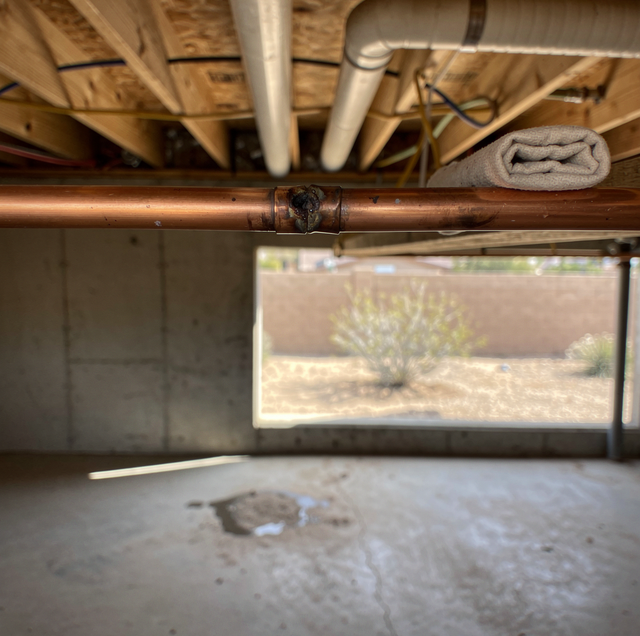
Copper pipe almost never fails everywhere in your house at once. A pinhole opens at one weak point, often a joint where flux was never rinsed out, and the wall thins from the inside until it gives way there while the rest of your line stays sound. Galvanized pipe fails on the opposite clock, wearing down along its entire length at nearly the same rate.
You are choosing between two things: fixing the leak you have, or replacing the line before your next one opens elsewhere in your house. Your own pipe shows you which one you actually need. You live with that call, not your pipe's calendar age, so look at what your pipe is actually doing before you decide what you want.
Corrosion Attacks One Spot, Not the Whole Line
Pitting corrosion is a chemical attack that concentrates on one spot; it does not spread evenly across the pipe wall. A pinhole forms where water moves fast enough to strip the oxide layer that protects copper, where two metals touch at a fitting and set up a small current, or where flux residue was never rinsed after soldering. Once that layer is gone, the copper underneath dissolves into the passing water until the wall is thin enough to weep, then to leak outright.
A single pinhole leak at a joint usually requires a repair. Leaks in several unrelated spots, failing galvanized or polybutylene pipe, or steady low pressure and discolored water point toward a repipe instead.
That is why a single pinhole rarely proves that the whole line is compromised. The attack happens at a point of chemical or electrical stress, not uniformly across every foot of pipe in your house. A ten-year-old run with one poorly soldered fitting can develop a leak while a thirty-year-old run with clean joints stays sound for years longer. Age plays a role, but the joint's own history of water speed, mixed metal, and leftover flux actually starts the pitting, not the calendar.
What Feeds a Single Pinhole Leak Versus a Pattern of Them?
A single leak usually traces back to one local condition: a fitting with dissimilar metals, a run where water speed is unusually high, or a joint that was never cleaned before it was soldered. Fix that one point and the rest of your copper, never under the same local stress, has no particular reason to fail next.
A slab home makes locating a hidden leak harder than a crawlspace home does, since the line runs inside solid concrete, not in an open space that you or a technician can simply open up, look at, and inspect by hand.
A pattern of leaks points to something shared across your whole system: water chemistry that is aggressive toward copper wherever it touches, pipe from a single bad manufacturing run, or plain age catching up to every joint at once. When a second or third pinhole shows up in an unrelated part of your house, the shared condition is doing the damage, not a single unlucky fitting, so if you fixed one leak, a second one is worth watching for.
Galvanized Steel Fails on a Timeline, Not by Chance
Galvanized pipe carries a zinc coating over steel, and that coating actually keeps the steel from rusting for as long as it lasts. Every gallon that passes through wears away a microscopic layer of zinc, and this water, running at roughly 12 to 20 grains per gallon of hardness, speeds up that wear by depositing scale on top of the zinc, trapping moisture against the metal underneath. The coating does not fail at one random point the way a copper joint does; it thins on a schedule set mostly by how much water has passed through and how hard that water is, which means two galvanized runs installed on the same day in your house, carrying the same water, are wearing down at close to the same rate even if only one of them has actually rusted through so far.
Once the zinc is gone in one section, rust starts forming on bare steel, and rust takes up more space than the metal it replaces, narrowing the pipe from the inside. That narrowing shows up first as reduced pressure at the fixture farthest from your water main, then as rust-colored water once a piece of scale finally breaks loose.
Because every foot of a galvanized line went into your walls on the same day and has carried the same water ever since, one section rusting through is a reasonable signal that nearby sections are close behind on the same clock. A repair at one spot buys you time; it does not reset the clock on the rest of the run.
Polybutylene and Galvanized Carry a Different Repair Math
Some older homes built in the 1970s and 1980s were plumbed in polybutylene, a gray or blue plastic pipe known for failing without warning even when a section shows no visible damage. It is no longer installed anywhere, and finding it in your wall or slab changes the question you are asking, because the risk sits in the material itself, not in any one fitting.
With copper, a repaired joint is sound afterward, because the chemistry that caused the pinhole was local to that joint and the fix removes it. With polybutylene or aging galvanized pipe, a newly repaired section sits directly next to material with the same manufacturing history and the same years of hard water and pressure cycling, so a clean repair reveals very little about what the next foot of that run is doing.
Recurring pinhole leaks scattered across your house, a pipe you can identify as polybutylene or badly rusted galvanized, and steady low pressure with discolored water at multiple fixtures are three signs worth treating as one pattern, not three separate repair calls.
Repair or Repipe: Reading the Same Symptoms Two Ways
The same wet drywall patch or the same pressure drop can point to either answer, so the reading depends on where else the symptom appears in your house and which pipe it is coming from. A table makes the split easier to hold in your head.
| What You're Seeing | Usually points to a repair | Usually points to a repipe |
|---|---|---|
| Leak count | One leak, one location | Two or more unrelated locations |
| Pipe material | Sound copper elsewhere in the run | Polybutylene, or badly rusted galvanized |
| Water pressure | Normal everywhere else | Low and falling at several fixtures |
| Water color | Clear except right at the leak | Rust-colored or cloudy at multiple taps |
| Wall/slab access | One small, contained opening | Repeated openings across several rooms |
None of those rows is decisive alone. A low-pressure fixture with clear water and no leak history anywhere else in your house is far more likely a clogged aerator than the start of a system-wide failure, and it is worth ruling that out before either estimate gets written.
What Feeds the Choice Between Patching a Section and Rerouting the Whole Line?
The number of prior repairs on the same run carries real weight. One fix that has held for years is doing exactly what a repair should do, but two or three fixes on the same stretch mean each patch treats a symptom, not the cause.
Slab-on-grade construction and caliche soil packed dense enough to resist digging add their own weight here, since opening your concrete once is a lighter ask than doing it three times.
PEX Rerouting Changes the Risk Profile, Not Just the Material
PEX is a flexible plastic tubing with no metal to corrode, which removes the pitting and zinc-depletion mechanisms described above at the source rather than treating either after the fact. It does not carry a current between dissimilar metals, and it does not rust, so the two failure patterns that drive most repair-versus-repipe decisions in copper and galvanized homes do not apply to it, which matters if you are comparing quotes side by side.
In a slab-on-grade home, PEX for a whole-house repipe is typically routed overhead through your attic rather than beneath the slab, avoiding the same caliche that made locating your original leak so hard to pin down. That routing choice reflects how the repipe is planned, not a claim that PEX outlasts every other material.
The Number of Leaks Matters More Than the Age of the House
An older home is not automatically a repipe candidate, and a newer home is not automatically safe from one either. A forty-year-old copper system with clean joints and one isolated pinhole can be a simple repair, not a wholesale replacement, while a fifteen-year-old system built with a bad batch of fittings or plumbed in polybutylene can already show the multi-location pattern that calls for a repipe. The calendar marks when the pipe went into your house; it does not show how that pipe has held up since.
What carries the weight is the number and location of leaks, the materials involved, and whether pressure and water color hold steady throughout your house. A single failed joint in an otherwise sound copper line is not a reason to replumb the house, and a pattern of unrelated leaks in old galvanized or polybutylene is not something a third patch will resolve. The pipe's own record, taken fixture by fixture, is the basis for that call, not an assumption about what a house of a certain age needs, no matter how old your home is.
Frequently Asked Questions
A properly repaired joint removes the local conditions that caused the original pinhole, so you should not expect that exact spot in your own line to fail again. What is more likely is that a different nearby joint will fail later if it shares the same water speed or a mixed-metal setup, which is why a plumber checks the two or three fittings around your repair, not only the one you had fixed.
Two unrelated pinhole leaks within a year or so, particularly when they show up in different parts of your house and not on the same short run, is generally something you should have evaluated across your whole system. A third leak on the same run, or leaks that keep outpacing the patches you put on them, means the conversation usually shifts from treating each spot as its own repair toward a second opinion on your whole line before you lose the next section of your house.
No. Low pressure at your single fixture is often a clogged aerator, a partly closed shutoff valve, or a worn cartridge inside that fixture, and none of those involve your supply line at all. Low pressure at several fixtures in your house at once, with discolored water, points toward narrowing inside your pipe, not a problem at one tap itself.
A repipe is typically planned using a single consistent material for the sections being replaced, since joining galvanized and copper at a new fitting recreates the same dissimilar-metal condition that initiates pitting corrosion. If only part of your system is being addressed, your transition point between old and new material is where a plumber pays closest attention, since that single joint carries the same risk as your original leak.
No. Polybutylene has not been installed in new construction for decades, and it can fail without visible warning even when a section still looks intact. Its presence in your home, if it was built in the 1970s or 1980s, is treated as a material-wide concern, not a single-joint question, regardless of how many leaks you have actually seen, because the material itself is aging, not just the joint in front of you today.
Rust-colored water from more than one faucet in your house, especially if it appears after the water has sat unused for a few hours, means galvanized pipe is rusting somewhere upstream of both fixtures, not at either fixture itself. That is worth a full look at your affected run before you treat any single faucet as the whole problem, since the visible rust appears downstream of where your pipe first narrowed, and treating only the faucet leaves the real narrowing untouched. Whether the color returns each time after it clears is the detail worth mentioning when you call, because it points a plumber toward roughly how far upstream the affected section runs before it reaches your own isolated fixture.
Schedule a pipe evaluation — get a clear read on whether your leak is a one-spot repair or the start of a repipe, in writing, with the reasoning explained before any work starts and no pressure at all to move forward with the bigger job. American Discount Plumbing serves Phoenix and the Valley. ROC #150707. Call (602) 883-2787.
