

A Water Leak in a Shared Condo Wall Is Never Just Yours
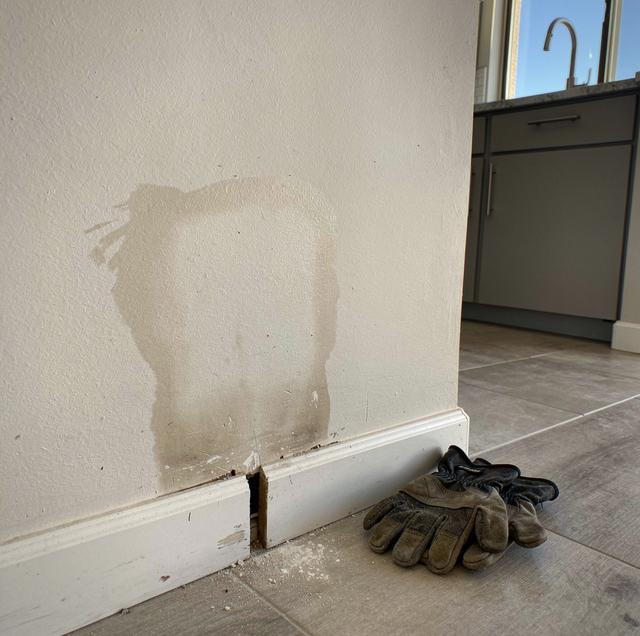
Quick Answer: A shared wall or floor can carry plumbing for both units, and your shutoff is sometimes outside your unit entirely. Locating the exact source before anything opens is more important here, since the wrong guess can open a neighbor's space instead of yours.
A stain spreading across a wall in a condo or a shared-wall townhouse does not necessarily belong to the side of it you are standing on. Most of the plumbing in attached housing is not in the boundary between two units at all. It is in the wet wall that two kitchens or two baths back onto, and in the vertical chase carrying risers past every floor, and both of those are shared in a way the paint on your side gives no clue about. A mark on your wall says almost nothing about which unit's plumbing it originates in until somebody looks.
A Shared Wall Carries More Than One Household's Plumbing
Detached houses give a plumber one house to think about. Attached housing rarely does. The wall between two units is rarely one thing: a rated demising assembly generally keeps each unit's plumbing on its own side, and what actually gets shared is the wet wall two kitchens or two baths back onto, along with the vertical chase carrying risers past every floor. Three features of that construction change how a leak gets approached from the start.
- The demising assembly: The fire-rated separation between one unit and the next, commonly framed as a double-stud or staggered-stud wall with penetrations restricted by design, which is exactly why it is generally not where either household's plumbing runs.
- The shared wet wall: The framing two kitchens or two bathrooms back onto, built deeper than an ordinary partition to carry drain and vent piping, and the one place where lines serving either side sit close enough together that a stain on one face settles nothing.
- A vertical chase: In a stacked building, risers supplying multiple floors often run inside one enclosure, so water entering a chase on a floor above can travel down past more than one ceiling before it shows itself.
None of that is unique to older buildings. Newer attached construction still runs plumbing through shared assemblies for the simple reason that stacking units means stacking their plumbing too.
Why the Wrong Wall Is a Different Kind of Wrong
A misjudged cut in a detached house is a bad day and a drywall repair. In a shared wall, the same guess can open a hole into a neighbor's bedroom, kitchen, or closet instead of your own, on the strength of a stain that may simply be the nearest place the water found to come out. That is a different order of mistake, and it is why narrowing the source to an exact point before anyone opens anything matters even more here than in a standalone house.
Attached housing also asks the locate to answer something a detached house never asks. Fixing a point on a wall is not enough on its own, because that point still has to be assigned to a side: a stud face inches from the boundary between two homes can carry either household's water. A dedicated detection specialist brings the equipment that settles both questions, and the plumbing contractor opens a surface only once the side is as clear as the spot.
A Valve That May Not Be Behind Your Own Door
In a detached house, a shutoff problem is usually a matter of finding the right handle. In attached housing, the harder problem is that the valve controlling your unit's supply may not be inside your unit at all. It can sit in a neighboring unit's utility space, in a locked common-area closet down the hall, or behind an access panel that belongs to the building rather than to any single household.
That does not change what gets done about a leak, but it changes the timing. A repair that would take an afternoon in a detached house can stretch into a scheduling problem first: reaching whoever can open that door and arranging a window when both a technician and an access-holder are available before any repair work can start. The valve itself, and who operates it, sits with the trades handling that step; what is worth naming here is the access problem, not the mechanics of the valve.
Reaching Everyone Who Needs to Be There
The coordination does not stop at a locked utility closet. If the leak's source turns out to be on the far side of a shared wall, confirming and repairing it may require reaching the household on that side as well, not just the door with the meter or the panel behind it. That is a different kind of scheduling than a single-household repair, and it is worth planning for before a technician is already standing in the hallway.
Renting changes who that first contact is. If you lease rather than own, the property manager or an on-site management office is often the right first call, since that office typically keeps a current line to owners and, in some buildings, a key or access log for shared mechanical spaces. That is a practical routing question. Confirming the source and reaching the people who can grant access to it can move forward on its own.
Two Different Layouts, Two Different Paths to the Source
Side-by-side units and stacked units are not the same problem wearing different clothes. A side-by-side leak sits inside a single wall assembly shared by two households on the same floor, and the search is largely lateral, working across that one wall. A stacked leak moves vertically through a chase, and because that chase can run past more than one ceiling on its way down, a drip showing up in your unit does not necessarily mean the nearest unit above yours is where the water entered the chase in the first place. Establishing which layout applies changes where a specialist starts looking, and it is one of the first things worth telling a technician on the phone before anyone arrives.
Layout is not the only thing that shifts the search, either. Not every symptom behind a shared wall turns out to be a supply-line leak: a drain running inside that same cavity can produce a similar-looking stain, and ruling a drain in or out is part of what a proper diagnosis does before repair work is scoped, rather than something to guess at from the stain alone.
Frequently Asked Questions
It can, in a way a single-household locate usually does not. When the source narrows toward the far side of a wall or chase, the specialist can rule your side in or out on the first visit, then has to return once access to the neighboring unit or chase is arranged to finish narrowing the point. A standalone-house locate rarely needs a second appointment for that reason, since there is no second household's access to wait on.
Yes. Shared framing carries sound as well as water, and a hiss or a steady drip inside a wall or chase cavity can be audible from the neighboring side before either household sees a mark. It is not unusual for the first report of a problem to come from a neighbor who heard something, not from a stain on either side.
No. A slab leak, by definition, involves plumbing in contact with the ground-floor slab, so the term does not apply once a unit sits above ground level. A leak on an upper floor travels through framed floor and ceiling assemblies and vertical chases instead, which is a different construction to search and a different repair path once the source is confirmed.
Ask what it is keyed to and how it is labeled, because both change how the visit has to be arranged. A riser closet is normally on a building master rather than on any unit key, which means the person who can open the door and the technician who needs it have to schedule two separate appointments rather than one. The closets are also usually labeled by stack rather than by unit number, so knowing which stack your unit sits on, and saying so on the phone, is what gets the right door opened on the first attempt instead of the one nearest your own.
It changes who has to be reached. A condo building usually has one on-site management office covering every unit in it, but a duplex or a shared-wall rental pair is often two separate rental properties with two separate landlords or management companies, so there is no single shared office to call. Reaching the other side means identifying which company manages that specific address, which is not always the one that manages yours.
It happens more in buildings with a mix of owner-occupied and investment units. Same-day priority for an active leak still applies to the side that can be reached and repaired right away, but confirming a source on the far side of a shared wall has to wait on someone authorized to open that unit, whether that is a manager, a listing service, or an owner reached by other means. That wait affects timing, not whether the leak gets found once access is arranged.
Schedule a leak evaluation for a shared-wall unit — get the source narrowed to a side before any wall is opened. American Discount Plumbing serves Phoenix and the Valley. ROC #150707. Call (602) 883-2787.
