

Leak Detection Company vs Plumber: Which One Repairs It
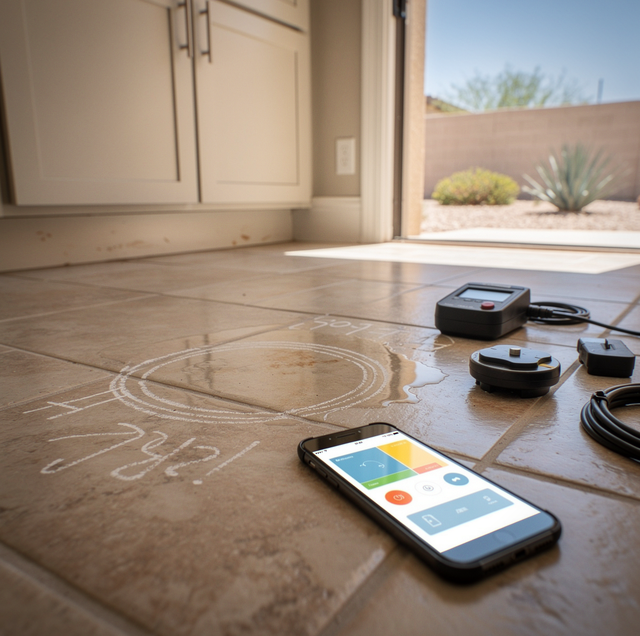
Quick Answer: A detection company locates the leak and stops there. A plumbing contractor can repair it and arrange the locate as part of the same job. Call detection alone when the location itself is what you need.
You are standing in the hallway with the phone against your ear, describing the faint hiss you can only hear once the house goes quiet. The person on the other end is helpful and specific. A technician comes out. Equipment goes down on the floor. The spot gets marked, photographed, and written up, and the report reaches you by email the same day. Then you ask what happens next, and the answer lands somewhere you were not expecting it to: you will need to call a plumber for the repair.
That is not a bait and switch. It is an accurate description of a business built to find leaks rather than to fix them. What it means for you is that the call you were about to make is one of two calls, and knowing that before you dial lets you choose the order on purpose.
Two Different Businesses Answer the Same Phone Call
Search for "leak help," and the results aren't all from the same kind of company, though most use the same words. Some are detection specialists. Their licensing, their vehicles, and their whole equipment investment sit on one side of the problem: establishing where water is escaping inside a structure nobody wants to open. Pool-leak companies belong to this group, and so do firms that locate underground service runs.
The other kind is a plumbing contractor, licensed to cut into and alter the piping itself. That license is the difference between altering a system and damaging it, and it is why a detection technician stops at the mark.
Neither model is better in the abstract. They answer different questions. One answers "where is it." The other answers "make the water stop and put the system back together." A homeowner under a wet ceiling wants both answers, and the deciding factor is how many companies they want to arrange to get them.
What a Detection-Only Visit Is Built to Deliver
The product of a detection-only visit is information, and it is good information. A specialist arrives with equipment a general plumbing van does not carry and leaves you with a marked location on the finished surface, photographs of that mark, and a written record of what was tested and what was ruled out. Some reports add notes on the depth or the run of the line. Detection specialists describe their own work as locating a leak to within inches, which is their claim to make rather than the repairing contractor's.
What the visit does not include is the opening, the repair, the reassembly, or the pressure check afterward. The engagement is complete when the location is established. If the report says the leak is beneath a particular section of tile, it has done its job, and the tile is still intact and still wet underneath.
For some situations, that is exactly the deliverable you want. For others it is the first half of an outcome you now have to go and buy the second half of.
What Changes When One Contractor Arranges Both
The alternative model is not that a plumbing contractor owns detection equipment. Most do not. A plumbing contractor working this way brings in a dedicated detection specialist who carries the equipment and locates the leak. The contractor then performs the repair, so the locate and the repair are arranged through one company and one phone call.
The technician standing over your floor may well be the same person either way. What differs is everything organized around that person. The findings go to the contractor who is going to act on them rather than to a homeowner who has to relay them. Scheduling for the second stage is already underway while the first stage is happening.
That is the honest version of the difference. Not better equipment. One point of contact, and one company holding the outcome rather than two companies each holding a piece of it.
Where a Handoff Between Two Companies Adds Friction
The friction in the two-company path is not dramatic, but it is real and almost entirely about information moving between strangers.
The mark is fragile: A location marked in chalk or marker on a floor gets mopped, walked on, or covered by a rug in the days between visits. It disappears entirely if the surface it is drawn on has to come up as part of the access.
The report is written for you, not for the repairing trade: A plain-language summary is the right thing to hand a homeowner and not always what a plumber most needs. Questions come up on the day about what was ruled out and what the technician noticed, and the person who can answer them is at another job for another company.
The gap between visits is not neutral: A supply-side leak under constant pressure keeps losing water for as long as the wait lasts. A leak that only wets when a fixture is in use behaves differently, and the wait matters less.
Disagreements get relayed through you: If the opening does not reveal a defect where the mark said it would be, someone has to go back to the detection firm and ask.
Which Model Fits Which Situation
A detection-only specialist is the right first call more often than a plumbing contractor would like to admit.
If water is disappearing from a pool rather than from the house, a pool-leak specialist is not merely acceptable; they are the correct trade. Finding a crack in a gunite shell or a failure at a skimmer throat is diving and pressure-testing work on a structure a building plumber has no business guessing about.
An independent locate also earns its place whenever you want the diagnosis to come from someone with no stake in what gets repaired. A landlord deciding whether a problem sits on their side of a wall, a buyer who wants an unaffiliated opinion before closing, or an owner in a shared building all have reason to separate the two roles. So does anyone whose repair contractor has already been chosen because a remodel is underway.
The single-contractor path fits the ordinary case: hidden water escaping from a home's pressurized supply piping, an owner who wants it stopped and the system working again, and no reason to hire two businesses to achieve the same result. If what you want at the end is dry, functioning plumbing rather than a document, the shorter chain of custody is usually the one worth choosing.
Frequently Asked Questions
Sometimes, within its own specialty. A pool-leak firm holding the right contractor license may repair the pool structure or the lines it just located, and an underground locating company may cut and repair a service run. What they will not do is open a wall or a slab inside the house and alter the building's supply piping, which is separately licensed work.
Both, and that is exactly the problem. Under two separate engagements, neither firm holds the outcome, only its own piece of it, so a technical disagreement gets relayed through the one person in the chain least equipped to settle it. The detection firm's position is that the mark was right. The plumbing contractor's position is that the pipe behind it was dry. You end up arbitrating. Where a single contractor engages the specialist, the same disagreement is internal: the specialist is re-tasked to come back and narrow it further on an already open job, and nobody asks you to rule on it. That is the practical reason to settle at booking who holds the chain of custody, before either visit happens.
It should report the negative as a finding, which is what makes the visit worth paying attention to rather than writing it off. A properly written report names what was tested, what was isolated while it was tested, what held, and what that rules out, instead of stopping at the sentence that no leak was located. Written that way, the result is reusable: hand it to the next contractor, and it saves them from repeating the same elimination from scratch. A report that says only "no leak found" is worth going back to the firm and asking to have expanded, and it is a reason to ask for a copy in your own name even when the visit ends without a mark.
The most useful line in the report is often the one describing what sits on top of the mark. A marked point under a kitchen island, a built-in cabinet run, a tiled shower pan, or a stair landing changes the access conversation entirely, because that construction has to come apart before the pipe is reachable and some of it will not go back the way it came. A specialist who noted it is telling the repairing contractor how large the job is, not only where it is. None of that survives as a chalk line, which is why the answer is both, and why the report is the half worth chasing.
It happens, and one leak can mask another while both are running, which is why a location is sometimes revisited after the first repair holds. The two models diverge here. A detection firm that engages directly treats the second look as a new booking, while a contractor holding both stages folds it back into an already open job.
Ask for one at booking. When a specialist is engaged by a contractor, the findings normally go to the contractor as part of the job rather than being issued to the homeowner as a standalone document. If you want a record in your own name, say so up front, because it is awkward to reconstruct once the wall is closed.
Call to have a hidden leak located and repaired through one contractor — the specialist locates it, and the repair follows on the same job. American Discount Plumbing serves Phoenix and Scottsdale. ROC #150707. Call (602) 883-2787.
