

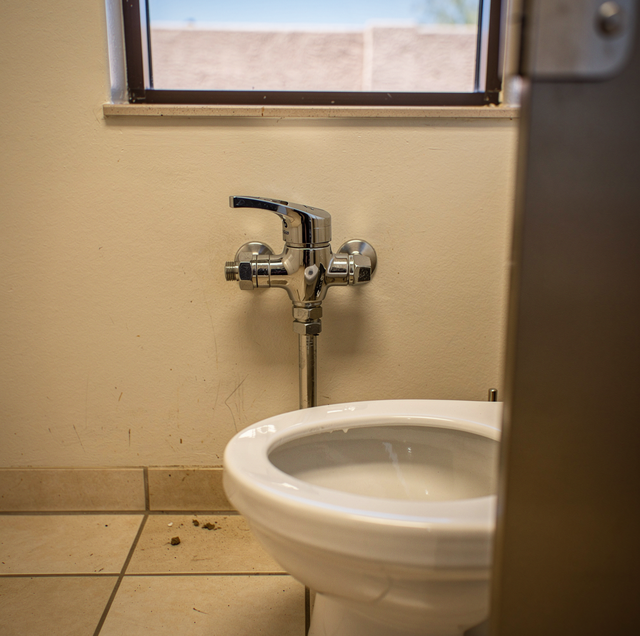
Open the last stall in the row and let the door swing shut behind you. The fixture in there gets used least and stays wrong longest, and nothing in the room will tell you so. A restroom on a leased floor makes its faults known late, and secondhand. The equipment behind that wall does not operate like a household toilet. There is no tank and no flapper. The valve sits directly on the supply line, opens onto full line pressure, passes a measured amount of water and shuts itself again, and the parts doing that work sit inside a brass body nobody opens on a walk. What a walk-through can establish about that room, and what it cannot, follows from that one difference.
The Flush Valve Works Straight Off Line Pressure
A flushometer is a valve with no cistern behind it. It mounts on the supply line above the bowl, and when the handle is pushed, or the sensor fires, it opens onto whatever pressure that line carries, releases a set amount of water, and closes again on its own hydraulics. Nothing is stored between flushes. The fixture recovers in seconds because of that, and it leans on the supply delivering more at that instant than a household line ever does.
A gauge on a closed system reads static pressure and looks fine; the number that matters is taken with the valve open, and it drops as more fixtures on one branch open simultaneously. In a room where the stalls all empty at once, the far end of the branch is the first place a shortfall shows.
What is visible on a walk is the difference between two positions: a bowl that clears on one cycle near the door and one that needs two at the row's end. Those are supply observations, and the fixtures may be identical. You cannot measure pressure yourself, and you can put that in front of somebody who can.
Sensor Valves Add an Electrical Failure Path
Newer restrooms on your floor may have no handles at all. An infrared sensor watches the space in front of the fixture and flushes when the user steps away. Sloan's specification sheets for concealed SOLIS models give a three-second delay after the user leaves range for a water closet and one to two seconds for a urinal, plus an eight-second arming delay before the unit is ready. Those are the behaviors you should see from a working unit.
The maintenance sheet's entry for a valve that flushes only when somebody walks by is a detection range set too long, picking up the opposite wall or a reflective surface. In a narrow room with a partition facing the fixture, that produces a valve cycling on foot traffic, which shows up as use the room never had. Standing at the end of the row for a minute while the room is empty is the whole of your check.
Power is the other path. The same sheet treats a sequence of four quick flashes as a low battery, and a unit that will not flush after the range is adjusted as a spent battery or a failed solenoid. Concealed units carry a manual override button in the wall plate, and the day you want it is not the day the sensor stops.
Flush Volume Is Printed on the Valve Itself
Flushometer parts are matched to a volume. Sloan identifies the flush volume of a Royal-style diaphragm assembly by the color of the relief valve and the refill head together with the shape of the flow ring, and its parts sheets are blunt about the consequence of getting it wrong: a kit rated for less water than the fixture was built around gives inadequate dilution in a urinal and improper evacuation in a closet. A bowl that has never cleared properly since someone worked on it is a matching question before anything else.
It matters to you on a walk because a row of identical bowls stops being identical the moment two of them have been rebuilt by different hands in different years. The stall number on your door isn't tied to anything the plumbing knows about, whereas the valve's own label is.
Photograph the flush volume printed on each valve beside the marking on its own fixture, and date the photo. A rebuild years later has to match the volume those labels carry.
Every Walk Should Leave a Readable Record
Sloan's own sheet states that the mechanical and electrical components in these valves are subject to normal wear and should be checked regularly and replaced as needed. It asks for a schedule. A schedule without a baseline gives you a fresh impression every time, and a fixture slowly getting worse for a year looks normal, because it looked like that last time too.
What makes two walks comparable is doing them in a fixed order, and the order is not decorative: the route fixes what you see, the label fixes which fixture you saw it at, and the observation means nothing until both are settled. So the route comes first, one sequence of rooms repeated at a fixed point in the week, because a floor behaves differently on a Monday than a Friday. The label comes second, on the valve body rather than on the stall door, so a fixture keeps its identity when a partition gets moved. The observation comes last and is recorded as something countable: whether the valve stopped on its own after the handle was released, and whether the bowl cleared in one cycle.
Then the meter. A reading taken at a stated hour on a night the building is closed settles a question no fixture can be asked: whether water is leaving while nobody is using it. Take it the same way twice and the difference belongs to the building rather than to the reading. It is also the one reading you can take without standing in front of the right fixture.
Which gets a call and which gets a note comes down to one split: whether what you saw is one fixture or what feeds several. One bowl needing a second cycle is a fixture. Three fixtures going weak in the same week is the branch behind them. Water on the floor is a call, whatever else is true: a wet floor in a public room has stopped being a plumbing question.
None of this asks you to open anything. It asks the walk to happen the same way twice, so that the second one has something to disagree with.
A Valve That Fails Open Sends Water Straight Down the Drain
A flush valve that fails open puts nothing on your floor. It passes line water through the fixture and down the drain for as long as it takes somebody to notice, and the room looks to you the way it did yesterday. Sloan's sheet for its concealed SOLIS valves treats that as the expected shape: the control stop is never opened beyond the fixture's own flow capability because the fixture must maintain continuous flow if the valve fails. A fault like that can run for weeks with nothing for your walk to find.
What closes a flushometer is the same pressure that opened it. Water bleeds back above the diaphragm through a metering hole called the bypass; the pressure there rebuilds, and the diaphragm reseats. Nothing about that hole is adjustable, which is why the instruction is to wash it rather than open it.
Frequently Asked Questions
Flowing pressure. A gauge goes on the control stop, and the valve is fired while the needle is watched; the only condition it means anything under. You cannot take that reading yourself, and your walk is the reason somebody comes and takes it for you.
Differently, because nothing has been running. Batteries in sensor valves draw whether the room is used or not, so a unit that was fine when the floor emptied can be dead when it fills. Run every fixture once before you hand the space back, and watch the first cycle rather than the second: it moves what has settled, and you will hear a valve that no longer closes cleanly. Anything needing a second try goes on your list before your tenant finds it.
Twice, if you can, for different reasons. A room under load lets you see how your fixtures behave when several are firing at once, which is the only condition a supply shortfall appears in. An empty room is quiet enough to hear a valve that has failed open, and the same valve is inaudible over a busy hour. The two walks are not substitutes.
Whoever will do it the same way every time. Your cleaning contractor is in that room more than anyone and sees more of it than you do, but they are looking at surfaces, and what matters to you is a change in behavior from one week to the next. If you hand it over, hand over the form as well, so what comes back to you is comparable to what you wrote last month.
Yes, for whatever sits downstream of it. Work on a line deposits debris into the water, and a flushometer's diaphragm assembly is where it lands: Sloan's parts sheets describe its Royal-style diaphragm as a preassembled unit with a plastic filtering ring above the rubber and another below it. Walk your fixtures nearest the work first, then again a week later, so your second pass catches what you loosened.
The one nothing runs through. A trap keeps its seal from water passing through it, so a floor drain in a corner or the last fixture in a row loses it without anything failing. It reaches you as a complaint about the room rather than a report about a fixture, so it lands with your cleaners. Heriot-Watt's building drainage researchers developed remote methods to identify depleted seals because you can't find anything wrong with the appliance. Put those on your route.
Schedule a restroom maintenance visit — a plumber puts a gauge on each flush valve while it is open and checks the diaphragms by hand, so you get measurements rather than a walk-through's impressions. American Discount Plumbing serves Phoenix and the Valley. ROC #150707. Call (602) 883-2787.