

Signs of a Hidden Wall Leak: What the Meter and the Wall Tell You
A leak behind a wall rarely introduces itself directly. The wall keeps its shape, the paint looks the same for a while, and the first real evidence usually comes from somewhere else: a meter that keeps turning after every fixture is off, a bill that no longer lines up with how much water the house actually used, or a patch of drywall that never quite dries out. A wall doesn't leak; it reports a leak somewhere behind it, the way a bruise reports an impact from beneath the skin that never broke. Reading that report early matters because the damage that costs money is almost always the wall, framing, and floor around the pipe, not the pipe itself.
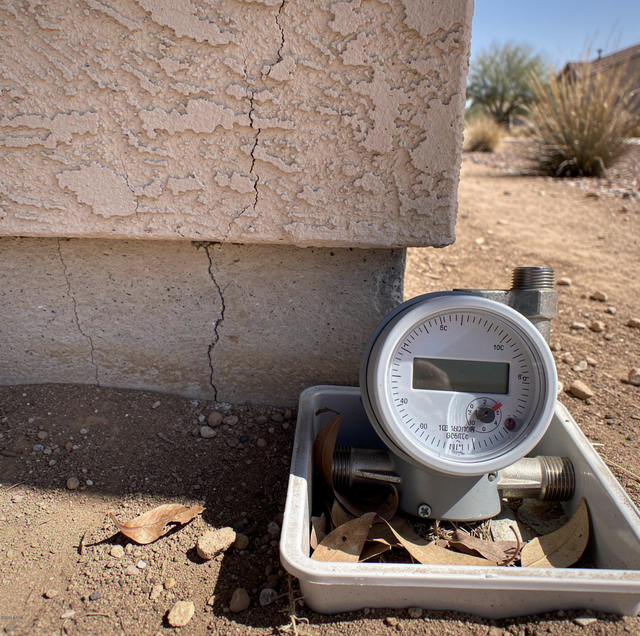
Before you inspect a single wall, walk to the water meter. Every meter has a small leak indicator built into the register, sometimes a red or black triangle, sometimes a star-shaped gear, sometimes a plain sweep hand, that turns with any flow passing through the line no matter how small. Shut off every fixture and every automatic water user in the house, the ice maker and the irrigation controller and a softener mid-regeneration included, then watch the indicator for ten to fifteen quiet minutes. Movement with nothing running means water is going somewhere between the meter and the last closed fixture, and a wall is a likely place it's headed. Stillness makes a significant constant supply-side leak unlikely, rather than ruling it out, since a very slow leak can be too small to move the indicator within that window, which is what the mark-and-recheck method below is for. It also says nothing about a drain leak that only appears when a specific fixture actually runs.
Note the exact meter reading before you start, then check it again after fifteen quiet minutes. A supply leak moves the number even when nothing in the house is running or making a sound.
What the Wall Itself Is Telling You
Paint fails in specific, readable ways when water sits behind it, and the pattern usually tells you more than the stain's color does. A stain that returns within days or weeks of a fresh coat of paint is not a paint problem. The moisture underneath it never actually stopped, and no amount of primer changes that. Press lightly on the drywall around any stain. A soft, spongy give under light pressure means the paper facing and gypsum core have already absorbed water and begun to break down, which is well past the earliest stage of this.
Never test or probe near an outlet or switch on a wall you suspect is wet. Water and house wiring often share the same cavity, and that combination means stop and call a professional rather than investigate further.
Watch how the paint itself behaves at the edge of a damp area. A line of small bubbles or blistering paint, rather than flat discoloration, means moisture is pushing outward from behind the surface with enough force to lift the paint film. A bulge, drywall pushed slightly out of plane even by a few millimeters, usually means water has been sitting against the back of that panel long enough to soften and swell it. And a subtler sign many people miss entirely: a faint vertical band of discoloration that tracks a stud line, or a horizontal band low on the wall that follows the bottom plate. Both patterns point to water running down inside the cavity and pooling or wicking along a framing member, rather than spreading in a random blob, as a surface stain from condensation usually does.
Signs That Never Touch the Drywall
Some of the clearest evidence has nothing to do with what you can see on a wall. Stand in a quiet room with every fixture off and listen for a faint hiss or trickle with no obvious source; a sound like that is one of the more reliable tells that a pressurized line is running somewhere it shouldn't be. A warm patch on a floor or wall, especially one that stays warm without any nearby heat source, points specifically at a hot supply line rather than a cold one, and it's one of the more dependable signs on this list, because warmth from a hot-water leak travels through drywall, tile, and even flooring in a way a cold leak simply doesn't.
A musty or mildew-like smell with no visible source in the room is worth taking seriously, even when the wall looks completely normal, since mold and mildew can establish themselves in a cavity well before enough moisture reaches the surface to show. And a jump in the water bill with no change in how the house is actually being used- same people, same habits, same season- is the signal that sends most homeowners to the meter in the first place.
Common Points Where These Leaks Start
Most of these leaks start at one of a handful of points inside a typical wall cavity.
A supply line running through the wall: Copper, PEX, or galvanized pipe feeding a fixture can develop a pinhole from age, corrosion, or a nail driven through it during some earlier project, and because it's pressurized, it leaks continuously once it starts.
A drain or vent stack: A cracked drain line or a failed vent-stack joint carries water only when that fixture is actually used, so evidence appears in bursts tied to specific plumbing activity rather than constantly.
The shower valve body and its escutcheon: This is the source most often mistaken for a plain wall leak, because the two can produce nearly identical staining on the other side of the wall. The distinction is timing: a shower leak only wets the wall while the shower is running or shortly after, while a true supply-line leak inside the wall keeps adding moisture around the clock, whether or not anyone has used that bathroom that day.
A tub overflow gasket: This seal is only tested when the tub fills past the overflow opening, which is why a slow overflow leak can go unnoticed for months in a household that mostly showers.
The supply line to an outdoor spigot. Where that line passes through an exterior wall, corrosion at the fitting or a failed joint can leak into the wall cavity from the outside in, sometimes showing up as a stain on an interior wall nowhere near any visible plumbing.
Supply Side or Drain Side Changes the Urgency
Whether the leak is on the supply side or the drain side changes how urgent it is. A supply line stays pressurized around the clock, so once it develops even a small opening, it leaks continuously, while you sleep, while you're at work, whether or not any fixture in the house is running. That constant loss usually shows up on the meter test and the water bill because the line never gets a break.
A drain line is different. It carries water only when the fixture connected to it is used, so a cracked drain pipe or a failing vent-stack joint produces water only in bursts tied to that specific activity: showering, running a load of laundry, or flushing. An intermittent stain that appears after specific fixture use and then seems to dry out between times is diagnostic information. The pattern itself points to which line is failing before anyone opens the wall to look.
How a Plumber Finds It Without Opening the Wall
Locating a leak before cutting into a wall starts with listening. Acoustic listening equipment picks up the specific sound a pressurized leak makes as water forces its way through a small opening, and a sensitive listening device can trace that sound along a wall or floor to find where it's loudest, which usually means closest to the source. It works best for supply-side leaks, since a drain leak at low or no pressure often doesn't make enough noise to detect this way.
A moisture meter reads moisture in the drywall and the material just behind it without needing to open anything. Pinless models press a sensor plate flat to the surface and read roughly the first three-quarters of an inch to an inch and a half, which makes them fast for sweeping a whole wall but keeps them out of the framing behind an intact panel. Pin-type meters take a reading between two short probes pushed into the surface, which gives a more specific number at the cost of two pinholes. Either kind is read as a comparison rather than a single figure: a plumber takes readings on drywall well away from the suspect area first, establishes what normal looks like for that material in that house, then works inward until the numbers climb. Moving the meter across a suspected area maps out where moisture is highest, narrowing the search from an entire wall to a much smaller zone before anyone reaches for a saw.
Thermal imaging reads surface temperature rather than moisture directly, which makes it especially useful for a hot-water supply leak: warm water spreading behind drywall raises the surface temperature just enough for an infrared camera to pick up a shape a naked eye can't see. It's less reliable on a cold-water leak, where the temperature difference from the surrounding wall is smaller, so a plumber typically pairs it with a moisture meter reading to confirm. A deliberate temperature difference helps: running the hot side for several minutes before scanning makes a hot-line leak stand out more sharply than it would on a wall sitting at room temperature.
Used together, these tools usually narrow a leak's location to a small, specific area rather than a whole wall, which helps keep the eventual opening small and targeted.
Why Waiting Costs More Than the Pipe
The pipe itself is rarely the expensive part of a hidden leak. A small pinhole or a loose fitting is often a quick repair once it's found; the cost climbs from everything the water touches on its way out. Wet drywall and wet wood framing are exactly the conditions mold needs to establish itself, and once a cavity stays damp for even a few days, that colonization is already underway by the time anyone notices a smell or a stain.
Framing takes damage on its own schedule too. Wood that stays wet for an extended stretch can begin to soften, warp, or develop rot at the point of contact with the leak, which turns a plumbing repair into a framing repair, and sometimes a structural one, depending on where the damaged member sits in the wall. None of this happens on the day the pipe starts leaking. It happens during the weeks someone decides to watch a stain and see if it gets worse.
That's the real argument for treating the meter test and the early wall signs as worth acting on immediately: the expense comes from what the leak sits against, and for how long, far more than from the pipe itself.
Frequently Asked Questions
Newer digital and AMI meters often display a small dripping-faucet icon or a flashing leak alert directly on the readout, instead of or alongside a spinning low-flow indicator, and some can flag unusual continuous flow to the utility without any action from you.
Mold can begin colonizing damp drywall paper or wood framing in as little as 24 to 48 hours under the right conditions, which is part of why watching a stain for a while gives up the narrow window before growth actually starts.
A sufficiently large pressurized supply leak diverts flow away from the rest of the system, so the fixture farthest from the leak can show a slight, easy-to-miss pressure drop even before any stain becomes visible.
Not always. Sometimes a gapped or loose escutcheon just lets shower spray get behind the plate through a caulking failure, with no actual valve or pipe leak involved, and re-caulking resolves it once that's confirmed.
Yes. Sun-warmed exterior walls, nearby ductwork, and even recessed lighting can create a temperature difference that looks similar to a hot-line leak on camera, which is why a plumber cross-checks any thermal reading against a moisture meter before deciding where to open a wall.
Acoustic listening tools can often pick up a pressurized leak's sound through several inches of drywall or slab, and professional-grade equipment can sometimes narrow the location to within roughly a foot along the pipe run before any cutting starts.
Notice signs of a leak behind a wall — Get it pinpointed with acoustic, moisture, or thermal detection before any cutting starts. American Discount Plumbing serves Phoenix and the Valley. ROC #150707. Call (602) 883-2787.
