

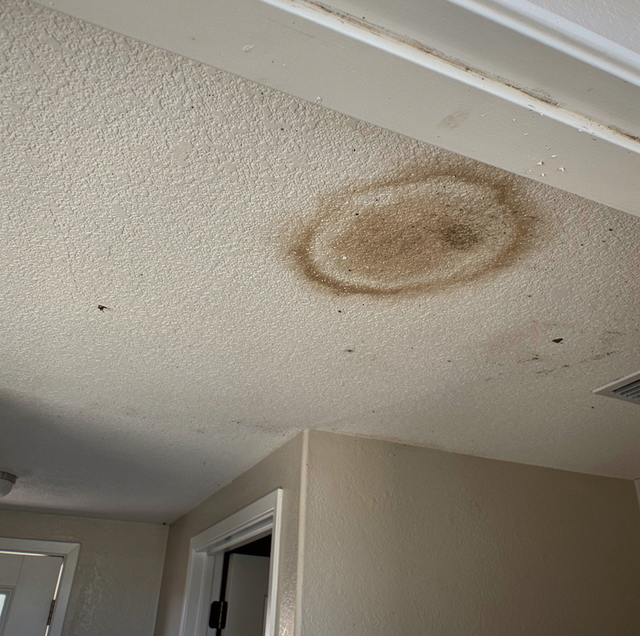
You spot it on a Tuesday: a soft brown ring on the hallway ceiling, about the size of a dinner plate, that wasn't there last week. Or it's lower down, a baseboard gone dark and slightly swollen at one corner, or a bloom spreading across the drywall behind the water heater closet, its edges too soft and gradual to look like anything but old moisture. Nothing is dripping. Nothing is pooling on the floor. By the time a pinhole in an aging supply line shows up this way, it has usually been weeping for weeks, moving through insulation and framing before it ever reached the surface.
That stain is one sign among several an aging system gives off, and each one traces back to a different mechanism working inside the pipe. The same stain, the same slow drop in pressure, or the same tint in your water can mean ordinary wear in one house and the tail end of a pipe's working life in another, depending on your water chemistry and what the pipe itself carries. Reading the sign starts with knowing which mechanism produced it, how early that mechanism tends to show, and whether it's showing up alone or with company.
A Pinhole's Stain Rarely Sits Where the Leak Started
A pinhole in copper opens at a weak point in a joint or bend, not evenly across the run, so the leak stays local while the rest of the line keeps working. What that means for reading the sign is that the stain and the leak are rarely in the same place: water follows a stud or a joist along the path of least resistance, and it can travel a foot or more before it finally darkens drywall or a ceiling.
On a vertical run inside a wall, gravity pulls the water down before it ever reaches paint, so the stain often sits well below the pinhole itself, closer to a baseboard than to the failing fitting. On a horizontal run above a ceiling, there's less distance for water to travel sideways, so the ring tends to center closer to the source.
The incised legend stamped along copper tube gives its type, K, L, or M, not its age. Type M carries the thinnest wall of the three, so it has the least material to lose before a pinhole opens.
A stain that stops widening once the surface dries was a weep that may have sealed itself with corrosion; one that keeps widening is an active leak, whatever the rest of the system looks like.
Scale Shows Up as a Whole-House Slide, Not One Weak Fixture
Scale is calcium and magnesium leaving solution as water heats, and it builds a mineral layer on the inside of the pipe wall, the same way it builds on a showerhead. Unlike a pinhole, it doesn't announce itself at one fixture; it narrows the whole line a little more every year.
Where incoming water runs in the range of 12 to 20 grains per gallon, that narrowing shows up as a slow, whole-house loss of flow: a tub that used to fill in a set stretch of time now takes noticeably longer, and the fixture at the end of the longest run is usually the first to lose real pressure. Under roughly 7 grains, scale has little to work with to begin with, so a flow loss on that kind of supply points elsewhere rather than to scale.
A single weak fixture with clear water is its own small problem, not a system sign. A gradual, months-long slide across several fixtures at once, hot side worse than cold, points to scale, once the water heater and the pressure regulator have been ruled out as the more common causes of a whole-house drop.
Galvanized Rust Reads Differently by Tap and by How Long It Runs
Galvanized pipe relies on a zinc layer to keep the steel underneath from rusting, and every gallon that passes wears a little of that layer away until the steel is exposed and starts to rust, taking up more room than the metal it replaced. That wear behaves like a tire's tread: not from one nick, but everywhere the surface meets friction.
The sign that matters is rust that never clears, on the cold side, at more than one tap: that is the galvanized pipe itself shedding, not flakes stirred up overnight or a tank on the hot side pushing rust downstream. That combination, more than one tap and the cold side included, is the stronger signal that the wear reaches beyond a single fixture.
What the Pipe Runs Through Decides How Soon You Catch the Sign
None of these mechanisms care whether a pipe sits in open framing or under a slab, but where it runs decides how soon the evidence reaches you. A line buried under a slab keeps a pinhole's evidence to itself. There is concrete above it, and in hard-packed ground that sets up like caliche, the water has nowhere quick to drain, so it spreads along the underside of the slab before anything shows on a wall or floor, and the first sign is usually the water meter or the bill. The identical leak sitting over a crawlspace, in open framing within easy reach, tends to leave a visible mark within days, since there's far less material standing between the leak and daylight.
Old Joints Wear in Clusters, Not Evenly Along the Run
Every time hot water runs, the pipe lengthens and shrinks a little, and the joint takes that stress, while flux residue left behind when it was made keeps working on the metal long after the solder cooled, so joints age faster than the straight pipe between them.
Don't open a torch on a weeping joint inside a wall or ceiling cavity; dry framing sits inches away. If a ceiling stain sags or sits near a light fixture, switch off that circuit and leave the opening to a plumber.
A single weeping joint on an otherwise dry, steady-pressure run is one joint. Green crust or damp at several fittings on the same stretch is that stretch's joints aging together.
Reading Two Signs Together Beats Reading One Alone
A single ring on the ceiling, one weak fixture, or one tap running rust-tinged after sitting overnight can each be a local, one-off event unrelated to how the rest of the system is aging. What separates that from a system running out of runway has less to do with how dramatic any one sign looks and more to do with which other signs are showing up alongside it, and when. A pinhole stain usually arrives alone, with no warning anywhere else. A pressure slide builds for months before a stain ever appears. Rust at several taps and weeps at several fittings on one stretch; each tends to occur in groups, since it comes from age spread along a run.
| What You Notice | Aging Mechanism Behind It | What It Usually Means |
|---|---|---|
| A stain, ring, or bloom on drywall or ceiling | Pinhole corrosion wicking through framing | Isolated unless paired with other signs |
| Gradual, system-wide pressure loss, hot side worse | Scale narrowing the bore | Points to the whole line, not one fixture |
| Discolored water at more than one tap, cold side included | Zinc depletion in galvanized pipe | Nearby sections of the same run are aging too |
| Recurring drips or discoloration near fittings | Joint fatigue from repeated thermal cycling | Concentrated wear at connections, not the pipe itself |
Frequently Asked Questions
Not on its own. A bang when a valve shuts fast is a pressure surge, not wear. But a run that has started knocking where it used to be quiet often has a loose strap or hanger, and a pipe free to move flexes at its nearest joints every time it knocks, wear the rest of the run never sees.
No. Beads on a cold line are condensation on the outside of a sound pipe, and they dry once the line warms. A pinhole wets one spot and keeps wetting it, while condensation wets the whole cold run evenly.
Yes. Condensation from a nearby air-conditioning line can leave a similar-looking stain with no plumbing involved at all. A supply-line stain keeps growing whether or not the AC runs, while a condensate stain grows during long compressor runs and dries back down once the system sits off, and it usually centers under the air handler's drain pan or along its drain line. Checking that the pan and the secondary drain are the first look before assuming the pipe.
Sometimes. A newer home's age doesn't protect it if the water reaching it runs on the acidic side or carries high levels of chlorine or chloramine, both of which thin copper's protective layer faster than neutral water would.
Yes. Copper wears fastest wherever flow runs hardest, not evenly by age. A hot-water recirculation pump keeps water moving through its loop around the clock, rather than only when a fixture opens, so the fittings just past that pump see far more cumulative flow than a branch that runs only when someone opens a tap. An undersized branch works the same way at a smaller scale, forcing the same volume through a narrower bore. Two branches plumbed the same year can end up at very different points in their working life for that reason alone.
Often, yes. Mixed materials on the same run, a newer fitting style, or clean, bright solder sitting among otherwise oxidized joints all indicate that a section was opened and repaired more recently than the rest of the line. That matters because a patch resets the clock on only the few feet it touched, not on the run around it.
Line up a whole-house pipe inspection — have every sign above read against your own water and your own walls before a stain becomes a repair job. American Discount Plumbing serves Phoenix and the Valley. ROC #150707. Call (602) 883-2787.