

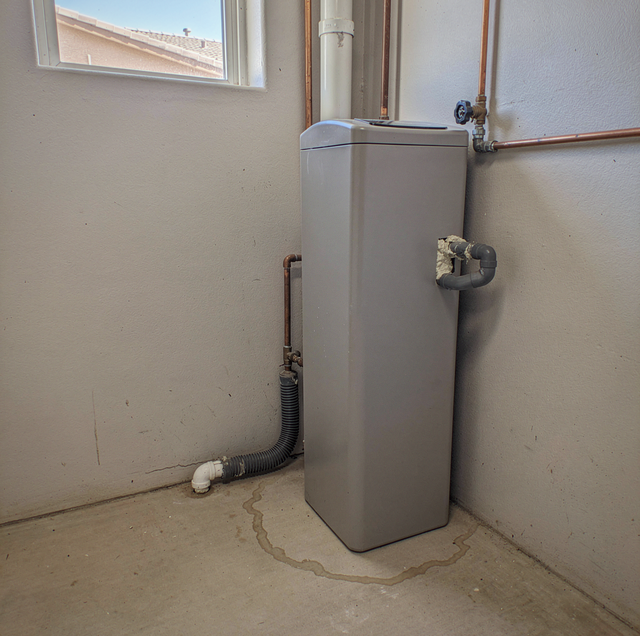
A water softener sending water to the drain is not, on its own, a sign that anything is wrong. A normal regeneration cycle moves water on purpose: it runs to the drain for a stretch while the resin bed is rinsed, draws brine from the salt tank to recharge the resin, then refills the tank before the unit goes back to treating water. From outside the cabinet, a resin tank's filling and rinsing can sound like water running somewhere it shouldn't, and a control valve cycling through its stages can look, at a glance, like something stuck open. What separates a normal cycle from a real leak is where the water ends up. A cycle intentionally sends water to the drain and stops once the final stage finishes. A leak puts water somewhere that has no drain underneath it: on the floor at the base of the cabinet, inside the brine tank above the salt line, or beading at a fitting that should stay dry.
With the control unplugged and the unit on bypass before any fitting is touched, each sign at the unit traces to its own source:
| What you're seeing | Source |
|---|---|
| Water running to the drain for a while, then stopping | A normal cycle |
| Water running to the drain without stopping | A valve stuck mid-cycle |
| A puddle at the base of the brine tank | A cracked brine tank or loose fitting |
| Water in the brine tank well above the salt | A brine refill that does not shut off, or brine that is not being drawn out |
| Drips at the bypass valve or the inlet and outlet connections | Worn O-rings or a loose connection |
| Wet floor at the drain line's end or its air gap | A drain line that is loose, kinked, or backing up |
| A damp spot that grows between regenerations | A leak at a supply-side fitting or pipe near the unit |
What a Regeneration Cycle Sends to the Drain and When
A softener regenerates by flushing the resin bed and refilling the brine tank on a timer or after a set volume of water, and each step sends water to the drain in its own stage rather than as one continuous flow. What matters for telling a cycle from a leak is the pattern at the drain line: a cycle runs, pauses, runs again as the valve advances through its stages, then goes fully quiet once the last one finishes. A flow that does not pause between stages, or one still running well past when the unit's last stage should have ended, reads as a control valve stuck partway through its sequence, or a valve seal that no longer closes, rather than a normal cycle. Checking the unit again a while later settles it either way: a normal cycle has gone quiet by then, and a stuck one has not.
The Brine Tank and Its Overflow
The brine tank holds the salt, or potassium chloride, the unit draws from to recharge the resin, and it refills with a set amount of water after each cycle, metered by the control valve on some units. At the same time, a safety float in the brine well closes the refill line if the level climbs too high. A refill that keeps running past that point can come from a float that hangs up or a fill valve that fails to close. A brine tank can also carry an overflow fitting near the top, plumbed through its own line to a floor drain, so an overfilling tank does not spill over the rim. Water leaving that overflow, or standing well above the salt, traces to a refill that does not shut off or to brine that is no longer being drawn out through a clogged injector or brine line, rather than to a cracked tank. A puddle under the tank, with the normal level inside it, traces the other way to a crack in the tank body or a fitting at its base that has worked loose.
The Bypass Valve and the Connections
The control head is disconnected from power at its plug before the bypass is turned on, so no fitting on the unit is handled while it is live. Three connections join the softener to the home's plumbing: the inlet bringing hard water in, the outlet sending softened water out, and the bypass valve that can route water around the unit entirely, mounted as a single assembly at the top of the resin tank. Each of those joints seals with an O-ring or a gasket, and those rubber seals dry out and stiffen with age rather than fail all at once. A bypass valve left partway between its two positions, not fully seated into either bypass or service, can weep at its seal whether the unit is running a cycle or sitting idle, since the valve's job is to route supply water, and that happens no matter what the resin tank is doing. Drips forming at the head fitting where it threads onto the resin tank, or at the inlet or outlet connection, trace to a worn O-ring, a joint left loose at installation, or a cracked fitting, rather than to anything inside the tank. Those sources can be isolated at the unit: drying the area and watching where the first bead of water reappears shows which fitting is responsible.
Standing water around an outlet or a water heater can carry current, and wading into it before the breaker is off risks a shock. The resin tank and control valve head hold water under pressure, and a plumber opens them.
The Drain Line and Its Air Gap
The drain line carries water away from the unit to a floor drain, standpipe, or laundry drain, and an installation can include an air gap fitting at that connection, or an open gap above a standpipe, so drain water can never be siphoned back into the treated supply. Because that fitting is open rather than sealed, a forceful stage of the cycle can send a brief splash over the funnel's rim, wetting the floor right at the drain end even though the unit and every fitting upstream of it are working as they should. A kinked or crimped drain line, or one that terminates too close to a floor drain that is already slow, backs water up instead of letting it clear. That backup can pool at the drain end or work back toward the unit, which can read as a leak at the cabinet even though the softener has done nothing wrong. Wetness that starts right at the drain line's discharge point, rather than working back from the resin tank or brine tank, traces to the line or the drain it empties into rather than to the softener itself.
Checking the Meter and the Unit on Bypass
The direct way to separate a softener problem from a plumbing leak nearby is to put the unit on bypass and read the water meter with every other fixture in the house off. With the softener bypassed, water still enters and leaves the house through the same meter, so if the meter's low-flow indicator keeps moving while the unit is isolated and nothing else is running, the water is going somewhere other than the resin and brine tanks, which the bypass has taken out of the flow. If the indicator stops once the unit is bypassed, the loss was coming from inside the softener's own plumbing, at the resin tank, the brine tank, or one of its fittings, and the next look should be back at that cabinet rather than elsewhere in the house. A unit stuck mid-cycle can also drive up a water bill the same way a real leak does, so the bypass test settles both questions at once: whether the water loss is a leak at all, and if not, whether it is a valve that needs to finish or be reset rather than something to trace outside the softener.
Frequently Asked Questions
It can be mistaken for a refill problem. A salt bridge is a hardened crust that forms across the tank when humidity cakes the salt, leaving a hollow space with water beneath it, so the tank looks full of salt while the unit draws weak brine and the water stops softening. A crust is loosened with a blunt-handled tool rather than a sharp one, which can crack the tank wall, and neither a cracked-tank repair nor a new O-ring addresses that problem.
It can, if the distributor tube inside the resin tank, the internal pipe that carries treated water up and out to the house supply, develops a crack. Instead of water pooling at the unit, small tan or amber resin beads start turning up in faucet aerators, the toilet tank, or an ice maker's screen, with no wet floor anywhere near the softener itself.
Yes. A drain line run too long, raised too high above the unit, or narrower than the unit's drain port builds backpressure, and that pressure can push water out of the open air gap even when the softener itself is working correctly.
Not entirely. Putting the unit on bypass isolates the resin and brine tanks from the rest of the plumbing, but it does not isolate the inlet and outlet fittings feeding into the bypass valve. A leak at one of those supply-side connections, upstream of where the bypass routes water around the tank, still shows on the meter even with the unit fully bypassed.
It can, when cold supply water runs through warm, humid air and the pipe's surface drops below the air's dew point. Condensation spreads as an even film along the entire cold run rather than as a drip from a single source, and it comes and goes with humidity rather than growing steadily, as a fitting leak does.
Yes. The control valve completes its stages and returns to service on schedule regardless of a drip at a fitting or a crack in the brine tank, since valve timing and tank-body integrity are separate systems; that is part of why a slow leak inside the cabinet can run for a while before anyone notices it. The cycle finishing on schedule is not proof that nothing nearby is leaking.
Order water softener repair with leak detection — bypass valve and O-ring service, brine tank float and overflow repair, drain line and air gap correction, and electronic leak detection on the supply side. American Discount Plumbing serves Phoenix and the Valley. ROC #150707. Call (602) 883-2787.