

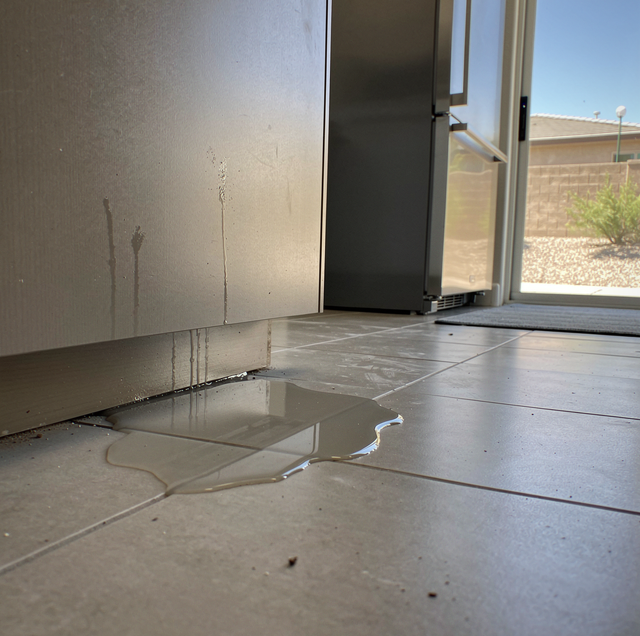
A refrigerator's water line stays under full-supply pressure around the clock, just like every other supply line in the house, whether the icemaker is filling or not. The run can start at a shutoff valve near a kitchen sink, in a basement or crawl space, or on a wall behind the unit, and then it travels through cabinets, a floor penetration, or a stud bay before reaching the back of the fridge. Because that path passes through spaces nobody checks on a regular basis, a small failure anywhere along it can go unnoticed for a long stretch, and by the time water shows up, it can be well away from the fridge itself: under a cabinet several feet off, through a ceiling in the room underneath, or along a baseboard clear across the kitchen.
Each point along that path fails a different way; the table pairs each one with where its water shows first and whether the fix is a plumbing repair or something on the fridge itself:
| Point on the Run | Where Its Water Shows First | Plumbing or Appliance |
|---|---|---|
| Shutoff valve at the source | A puddle at the cabinet base or the floor beneath the valve | Plumbing |
| Tubing run through cabinets or floor | Along the tubing's path: under flooring, inside a cabinet toe kick, or at a floor penetration | Plumbing |
| Connection at the back of the fridge | Directly behind or under the unit, sometimes wicking sideways into an adjacent cabinet | Plumbing |
| Fridge's inlet valve and fill tube | Inlet valve: under and behind the unit at the lower rear. Fill tube: inside the freezer or at the dispenser. | Appliance |
| Drain pan and defrost water | Under the fridge itself, staying close to where it collects rather than traveling | Appliance |
Where the Line Starts and How It Gets to the Fridge
The branch that feeds a refrigerator starts as a small tap off an existing cold water line: under a kitchen sink, in a basement or crawl space below the kitchen, or at a dedicated valve set into the wall behind the unit. From that tap, dedicated tubing, either braided stainless, copper, or a thinner plastic line, runs to the fridge through whichever path was open when it was installed: inside base cabinets, through a hole bored in the cabinet floor, or up through a wall box mounted near the fridge's own connection. In some homes, that branch is tapped from a whole-house water treatment or reverse osmosis line instead of straight off the cold line under the sink, which puts the shutoff for that branch in a different spot than a straight tap would. That branch runs on quarter-inch tubing rather than the larger lines feeding a sink or a toilet, and its connection at the fridge is a compression fitting, a nut and ferrule rather than a threaded joint.
Why the Water Shows Up Somewhere Else Entirely
A leak on this line need not wet the floor where it starts. Water released under pressure from a fitting or a small crack follows the tubing, gravity, and the framing: it runs along the outside of the tubing itself, drops through the same floor penetration or wall box the tubing uses, and follows a joist or a stud edge until it reaches an opening it can escape through. A cabinet base a few feet from the fridge, a floor seam at the far end of the kitchen, or a ceiling stain in the room directly below a floor-mounted tubing run can all be where that same water surfaces, well away from wherever the failure sits.
Telling a Supply-Side Leak from What the Fridge Itself Is Doing
Not every leak near a fridge is a plumbing problem. Water pooling directly under or inside the unit right after the icemaker has run can come from the appliance's own inlet valve, fill tube, or its defrost drain and pan, though a weeping connection at the back can also drip straight down under the unit; the appliance side belongs to an appliance technician rather than a plumber. What stays on the plumbing side is everything between the wall or floor connection and the shutoff at the source: the tubing itself, its fittings, and the valve it starts from.
Where This Line Fails
Failures on this line gather at the shutoff valve, along the tubing, and at the connection behind the fridge. The shutoff valve can weep at its stem or packing, a slow drip present whether the fridge has run water recently or not. The tubing between the valve and the fridge can crack at a kink, where it was bent sharply to route it around a cabinet corner or through a tight wall cavity, or it can wear thin at a point where it has rubbed against a sharp cabinet edge or a framing member for years. The connection at the back of the fridge, where the tubing meets the unit's own inlet, depends on a nut and a ferrule seated correctly around the tube; one that was never fully tightened, or one disturbed by pulling the fridge out and pushing it back in over the years, can weep at that single connection alone.
Finding a Leak That Runs Inside a Wall, Cabinet or Floor
Before any of this starts, the shutoff feeding that branch, or the main if a dedicated valve cannot be found, gets closed, and the fridge stays unplugged before anyone reaches behind it if there is standing water nearby. When the run behind a fridge passes through a finished wall, a cabinet back, or under flooring instead of staying in open space, finding exactly where it is failing takes more than a visual check, and that narrowing is its own step handled with dedicated moisture and tracing equipment before anyone opens a cabinet back or a section of floor. A built-in style kitchen fridge, set into cabinetry with a narrow gap around it, adds a real constraint here: the unit can need to be freed from its cabinet opening before the connection is visible at all.
A fridge pulled hard against a supply line with no slack can split the tubing under full pressure, a cord still plugged in beside standing water puts current within reach, and a sagging ceiling below can give way before the plumber arrives.
Repairing the Line or the Valve, and What Happens to the Wet Flooring
Repair on this line is narrow once the point is confirmed: the valve, the tubing, or the connection at the fridge gets replaced, and the new joint is pressure-tested before the fridge goes back into place. What happens to flooring or a cabinet base that stayed wet while the leak went unnoticed is a separate question with its own separate trade, since wet subflooring, swollen cabinet material, and a stained ceiling in the room below are restoration and finish work rather than plumbing.
A braided stainless connector comes in fixed lengths with factory-crimped fittings at both ends, so a failed plastic run replaced with one loses any couplings spliced in along the way, provided it reaches from the valve to the fridge.
Frequently Asked Questions
Yes. A saddle valve clamps onto an existing copper line and pierces it with a small needle to draw water. Hence, the gasket at that piercing point becomes its own place to check for a weep, separate from anything in the tubing or the connection at the fridge.
It can. A filter built into the fridge wets the floor under or in front of the unit, but an inline filter spliced into the tubing behind it is part of the supply run, and a leak at its fittings travels the same way the tubing's does.
When that branch has its own isolation valve, and it is turned fully closed, yes, it removes pressure from the tubing and the connection at the fridge without shutting off water anywhere else in the home. A valve that will not turn fully, or one that keeps weeping even closed, means the next valve upstream, up to the main, has to do that job instead.
Yes. Tracing follows the wetting back along the tubing's route, using moisture readings, rather than working outward from where the stain happens to show.
Not on its own. The supply tubing holds pressure the whole time, so wetness tied to fill cycles fits the appliance's own fill parts, but a marginal compression joint can also seep only under the shudder of the fill valve snapping shut, so the connection behind the fridge is checked either way.
It is a service loop, left so the fridge can roll out for cleaning or repair without pulling on the connection. When the fridge is pushed back hard, that loop can be crushed flat against the wall, and the tubing can kink or split at the pinched bend.
Enlist leak detection and repair for the refrigerator's water line — electronic tracing of the run from its shutoff to the fridge connection, with the failing valve, tubing, or fitting replaced. American Discount Plumbing serves Phoenix and the Valley. ROC #150707. Call (602) 883-2787.
