

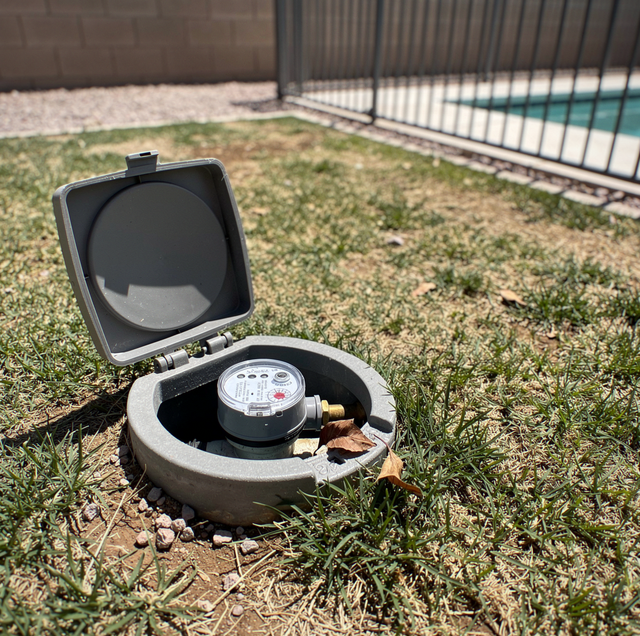
The meter lid is propped open, and the dial is turning, and across the yard the pool has been asking for water again. That gives one number on the bill two suspects: an autofill valve that no longer shuts, and a leak somewhere in the buried line that carries water from the meter to the house. Both draw from the same supply and both register on the same dial, and neither leaves a puddle that settles the argument. Each leaves a different trail: how the pool loses water with the autofill closed off, what the meter does with the autofill closed and then open, and what each suspect looks like on a walk of the property. The question is whether the water is going into the pool or somewhere else on the supply.
A Waterline Mark and a Bucket With the Autofill Closed Off
Start at the pool, before the meter, because this test needs no dial reading and it tells you whether the pool loses water on its own. Close the supply valve to the autofill if one is within easy reach. With the valve closed, no refill can disguise a drop in level.
Mark the waterline on the tile with a strip of tape or a waterproof marker when the pump is running on its normal schedule. Then fill a bucket with pool water to a depth of several inches, set it on a step so the water inside is level with the water outside, and weigh it down so it cannot tip. Mark the bucket's water level the same way. The bucket shares the pool's sun, wind, and air, and it has no way to lose water except evaporation.
Leave both for a full day with no one swimming and all water features in the same state throughout. Then compare the two marks.
Pool drop matches the bucket: the day's loss is evaporation, to within what a tape mark can show. Whatever the meter is doing, a leak in the pool structure is not driving it.
Pool drop is larger than the bucket: water is leaving the pool by some path other than evaporation, through the shell, a fitting, or the pool's own circulation plumbing. A working autofill will faithfully replace that loss, so the meter turns and the valve is blameless. Locating and repairing those leaks is a pool technician's work.
If the level nears the bottom of the skimmer opening before the day is out, top it up by hand with a hose, write down how much was added and when, and treat the early finish as part of the result. A pool that cannot last a day without help is losing more than the sun takes.
With the valve closed, a failing autofill has nothing to fail into, so this test says nothing about the valve itself. It shows only whether the pool has a loss of its own.
The Meter Read With the Autofill Closed, Then Open
The meter splits the suspects because the autofill has its own valve, and closing it takes the pool off the meter while everything else stays on. Before reading, make sure no fixtures are running and the irrigation controller is off, so nothing on the property should be drawing water on purpose.
First read with the autofill valve closed. Note the position of the sweep hand or the small low-flow indicator on the register, wait long enough for a leak to leave a visible change, and read again. A dial that is still moving is the important result. The flow is leaving upstream of the closed autofill valve, which clears the valve itself. What is left is everything else on the meter: a fixture inside the house leaking without a sound, such as a toilet flapper, or the buried supply, meaning the line from the meter to the house, a branch to the irrigation system, or the branch that feeds the pool. Closing the house valve and reading again separates the indoor share from the buried one.
That last branch deserves a note. A shutoff valve near the pool leaves the buried pipe between the supply and that valve under full pressure. A pinhole or a separated joint in that run keeps the meter turning with the valve closed, and it looks exactly like a mainline leak. The plumber repairs it as part of the supply system, not as pool equipment.
Then open the autofill valve and wait until the pool is back at its mark. This wait matters. After a day closed off, the pool is a little low from evaporation, and a healthy valve opens to make up that drop, so the meter moves for as long as the refill takes. That movement is the valve doing its job. Read the meter once the level has settled.
Photograph the register before and after each wait with a clock visible, and tape the waterline mark before you start. Two photographs and a time stamp give a plumber a measured rate to work from, not a description.
If the meter is still with the autofill closed and moves at a steady rate once the valve is open and the pool is full, the draw runs through the autofill branch. Pair that with the bucket result: a pool that matches its bucket has a valve passing water it does not need, and a pool that drops faster than its bucket has a valve replacing a real loss.
A Failing Autofill Valve at the Pool: What You See and Hear
A mechanical autofill is a float-operated valve, set either in the skimmer or in a lidded box in the deck beside the pool. A healthy one is shut almost the whole time. The float drops when the level falls; the valve opens; the level rises; the float lifts; the valve closes. A failing one stays open or leaks past a worn seat even after the float has lifted.
You can check it with your eyes and ears, without touching anything. At the skimmer, look for a stream or trickle entering the water when the level is at or above its usual mark, and listen for a hiss near the valve body. In a deck box, lift the lid and look for a float that has cracked and taken on water, a float arm sitting too high, or a white crust of mineral scale on the valve. Grit on the seat, scale, and a worn washer or diaphragm can each stop a valve from sealing.
A valve passing only a thin flow can make no sound and leave no visible stream, so the absence of a hiss does not clear it. The meter result decides.
Stop at looking and listening. The pool's pump, heater, and timer have live electrical connections, and nothing about a fill problem requires opening them. Replacing the autofill valve sits on the supply side and is plumbing work, while the pumps, filters, chemistry, and shell are a pool technician's.
An Underground Mainline Leak Above Ground: What Shows
The mainline is the buried run between the meter and the house. A leak in it behaves differently from the autofill in one respect: it does not care what the pool is doing. The meter keeps turning with the autofill closed and with the house valve shut. That result puts the loss in the pipe between the meter and the structure, or in a branch teed off it.
Above ground, the evidence is irregular. Water escaping under pressure takes the easiest path through the soil and may never reach the surface. When it does, the signs are a strip of ground that stays damp or soft along the route of the pipe, a band of lawn or groundcover noticeably greener than its neighbors, a patch of pavers or rock that has settled, and the sound of running water at the meter box or at an outdoor faucet in a quiet moment. Any of these can come from an irrigation line, so on their own they mark a stretch of yard and not a pipe.
Wet ground beside the pool needs the same caution. It can be a mainline leak, a pool shell leak, or a break in the pool's circulation plumbing, and the waterline test is what separates the pool-side causes from the others.
Never dig along the suspected route to expose the pipe, and never open the pump, heater, or timer panel to chase a fill problem. A leak specialist pinpoints buried leaks, a plumber exposes the line, and a pool technician handles the equipment.
Reading the Combinations of Results
No single result settles the question. The table below reads the waterline comparison and the two meter reads together.
| Waterline vs bucket | Meter, autofill closed | Meter, autofill open and pool at its mark | Reading |
|---|---|---|---|
| Pool matches bucket | Still | Moving | Autofill valve is passing water the pool does not need. A plumbing repair on the supply side. |
| Pool drops more | Still | Moving | Autofill is replacing a real loss. The leak is in the pool shell or its plumbing: a pool technician. |
| Pool matches bucket | Moving | Moving at the same rate | Loss is upstream of the autofill valve: a silent indoor fixture, the mainline, a buried branch to the pool, or the irrigation take-off. Autofill cleared. |
| Pool drops more | Moving | Moving faster | Two problems may be present. The extra movement with the valve open is the pool's share. |
| Pool matches bucket | Still | Still | Nothing is drawing at the moment of the test. Repeat at another time of day. |
A moving dial with the autofill closed cannot come from the valve, which is the row where the autofill is most likely to be blamed by mistake. The still-meter rows place the water on the pool side or nowhere. The last row is a real result: a loss that runs only part of the day can sit through a single reading, so repeat the reads at another hour before assuming the test missed something.
What to Hand the Plumber
Your share of the work is a strip of tape, a bucket, a clock, a meter lid, and a deck box lid. Exposing a buried line is excavation around utilities, and the pump and its controls are electrical, so both stay with the people trained for them. A plumber handles the autofill valve, the pool's fill branch and the mainline, with a leak-detection specialist pinpointing a buried leak before anything is opened. Anything beyond the pool's water supply, such as the pump, filter, chemistry, or a crack in the shell, is a pool technician's job.
What to hand over on the call is short: the waterline result, the meter readings with times and which valve was closed for each, and what was seen and heard at the autofill. With those, the visit starts at the right end of the property.
A spinning meter reports a quantity and never a culprit. Closing off one suspect at a time turns that quantity into an address, and an address is something a repair can be aimed at.
Frequently Asked Questions
Run the test twice if the pool loses more than the bucket: once with the pump on its normal schedule and once with it switched off at its usual control. A loss that shrinks when the pump is off can be in pressurized circulation plumbing, while a loss that is unchanged can be the shell or a fitting below the waterline. The difference is useful information for the pool technician who will handle either one.
Some systems use a level sensor and a solenoid valve in place of a float. The failure is the same: a valve that does not seat, but the hiss then comes from the valve body in a buried valve box and not from the pool edge. Water from a stuck solenoid can fill that box, and the box lid is where the symptom shows.
Some installations have a small valve inside the deck box on the supply side of the autofill, and others have nothing within reach. Do not look for one underground. A plumber can close the branch at the tee or at the house, and on the same visit can run the closed-versus-open meter comparison using the proper tools.
A constant flow of fresh water thins the pool's chemistry. A pool that keeps needing stabilizer or salt added, or whose readings drift low again right after a correction, is being diluted continuously. That is a clue worth passing to the pool technician as well as the plumber.
A working autofill opens only when the level drops, so its draw shows as short bursts with the meter still in between. A steady, unbroken movement with the pool at its mark is not the valve cycling. It is a valve held open, a supply-side leak, or a fixture running silently indoors, and the closed-versus-open comparison separates the valve from the other two.
Backwashing the filter or draining some water sends pool water out through the waste line, and the autofill then replaces it from the supply. That replacement is legitimate use and registers on the meter. Read the meter after the pool is back at its mark and a day has passed before drawing any conclusion.
Book a meter and autofill check — get a spinning dial pinned to the pool's fill valve or to the buried line before anyone talks about digging. American Discount Plumbing serves Phoenix and the Valley. ROC #150707. Call (602) 883-2787.
