

Recurring Water Leaks in the Same House: Bad Luck or a Pattern?
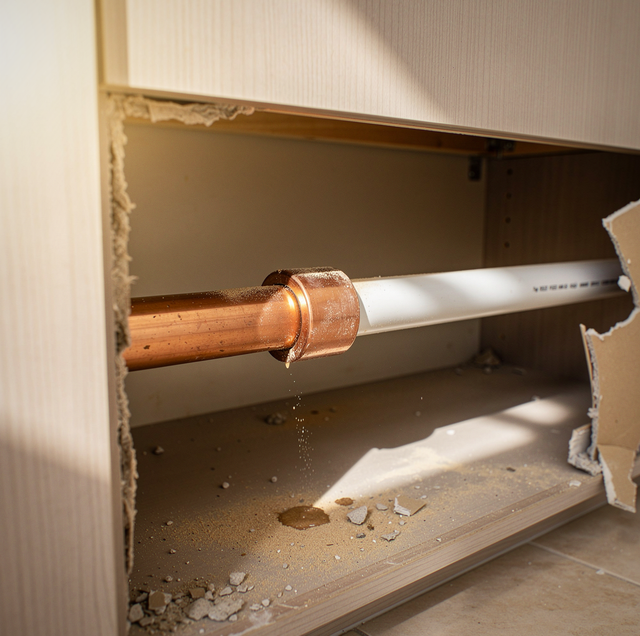
Quick Answer: A single repair indicates one failure point. A pattern (same branch, or hot lines failing before cold) is what turns "another leak" into a system question worth a closer look.
This is the third time this year a plumber has come back through the door for a leak, and it is not the same wall as the first two. The first was under a bathroom sink, small and slow. The second was behind a laundry connection, months later. Now it is a stretch of wall near the hallway, and the technician on the phone is careful not to promise anything until they see it. You are asking the question every homeowner in this position eventually asks: are these three unrelated accidents, or is something in the system itself causing the pipes to fail?
There is no single test that answers that from across the room. What answers it is comparing what one visit can actually observe against what only shows up once several visits are lined up next to each other.
One Visit Sees One Failure Point
When a plumber actually opens the wall or the slab and cuts into the failing section, that cut is its own small report. Three things in particular are worth reading:
The condition of the pipe at the cut: Whether the metal or material at the failure point looks pitted and thinned, or whether it looks otherwise sound apart from the one spot that gave out, points to different stories about what is driving the failure. Joint or wall: A failure right at a fitting is a different event than a failure in the middle of a straight run, away from any connection. Evidence of a prior repair on the same run: A coupling or patch already sitting in that stretch of pipe means something already went wrong here once before.
A joint that has come loose usually is not the result of one dramatic event. Several slow mechanisms end up in the same place: repeated thermal cycling during a hot run, a fitting racked slightly out of alignment when it was first made up, or a stretch of pipe carrying vibration from elsewhere in the house. A failure in the wall of the pipe itself, away from any joint, points somewhere else: pitting or thinning across the material reflects what has been moving through the line and how, not a single connection giving out.
If the technician finds a coupling or a patch already in that stretch, that is information too. Whether an earlier fix addressed the underlying cause or only closed that one hole is now part of the conversation.
Taken alone, one visit can only speak to what is right in front of the plumber cutting into the wall. It cannot say much about what is happening ten feet away on a different branch, or in a different room, until that data exists too.
Clustering, Scatter, and Which Lines Fail First
This is where a pattern starts to say something a single leak cannot. If every failure so far has turned up on the same branch, close enough together that a plumber could trace them along one run, that clustering usually points to something local to that stretch: how it was installed, the fittings used along it, or ordinary wear concentrated in one section rather than the whole house. Failures that scatter across unrelated branches- a bathroom line, then a laundry line, then a kitchen supply- with nothing connecting them but the house itself, point somewhere broader: toward whatever every line in the house has in common. That list is short, and it is qualitative rather than diagnostic. The chemistry of the water moving through all of it. How many years the system has been in service, since every branch has been in service the same number. And how the original installation was done, because workmanship applied once at rough-in was applied everywhere at once. Which of those is actually driving it is not a question a homeowner can settle, and it is not one a single visit settles either. It is the question to put to the plumbing contractor with every visit's findings laid out together.
Which lines fail matters too. A hot line failing before its cold counterpart on the same run is common enough that plumbers notice it: hot water expands and contracts a pipe more than cold water does, and any run that also carries a continuous recirculation loop sees more hours of flow and more cycling than a standard line that only runs when a fixture is open. None of that is a diagnosis by itself, but a hot line running ahead of its cold counterpart on the failure list is a piece of the pattern worth mentioning to whoever is looking at the whole picture.
That is usually the point where the conversation changes. Once failures keep landing on the same branch, or the hot side keeps outpacing the cold side, it stops being a conversation about the newest leak and becomes a conversation about whether that branch needs more than repairing the newest failure, a question for the plumbing contractor with the whole picture in front of them, not a decision to make from one visit.
Reading the Pattern Instead of the Leak
None of this makes any single leak less worth fixing on its own. A slow drip under a sink still needs a plumber whether it is an isolated event or the second entry on a growing list. What changes is how the third or fourth call gets treated: not as a fresh, unrelated problem, but as another data point that either confirms a pattern or rules one out. Ask what a visit found, where the failure sat, whether it was the pipe or the joint, whether there was an old repair nearby, and hold onto that. It is what turns three separate stories into one clearer one, or confirms that they really were three separate coincidences after all.
Frequently Asked Questions
A pinhole failure, a small, pin-sized opening, most often comes from localized pitting or corrosion concentrated at one point, so several pinholes turning up across different rooms suggest something affecting many points in the system at once. A split or crack failure is more often mechanical, tied to stress or movement, such as a fitting racked out of alignment, and tends to stay localized to wherever that stress actually happened.
Not as reliably as people assume, because a house's age and the age of a given run of pipe are not always the same number. A section replaced earlier after an insurance claim, a remodel, or a prior leak repair can be far newer than the plumbing around it, while an untouched original run in the same house may be carrying decades of wear that the house's build date does not reflect.
More often, the second failure is not new at all, only newly visible. A leak large enough to depress the pressure in a run masks a second marginal joint downstream of it, because there is no longer enough pressure behind that joint to push water through a gap that small. Repair the first one, the run comes back up to full working pressure, and the second starts weeping within days. It reads as though the repair caused it, and the sequence is the other way around.
A run is the continuous stretch of pipe between two points, such as a fixture and the larger supply line it connects to, without another junction in between. Fittings like elbows and tees, wherever the direction of flow changes, take on more mechanical stress than a straight section of pipe, so it is normal for more than one failure to turn up near a fitting on an otherwise sound run. Clustering near a fitting is not automatically evidence that the whole run is compromised.
Not necessarily. A patch or coupling repair introduces a new joint into what used to be one continuous piece of pipe, and that joint becomes a second point that can eventually work loose on its own, separate from whatever originally failed there. A new leak turning up near an old repair is sometimes the earlier fix giving out, and sometimes an unrelated new problem that just happens to sit close to it.
It is a different kind of clue than location clustering. Several failures within a short window, especially during stretches when incoming water temperature swings more than usual, can be a coincidence of timing rather than evidence that one branch or the whole system is compromised. A pattern read only by timing, without also considering where each failure actually occurred, can lead a homeowner to the wrong conclusion.
Schedule a repair visit — a second or third leak deserves a look at the whole run, not just the newest spot. American Discount Plumbing serves Phoenix and the Valley. ROC #150707. Call (602) 883-2787.
