

Low Water Pressure in the Whole House? What’s Behind It
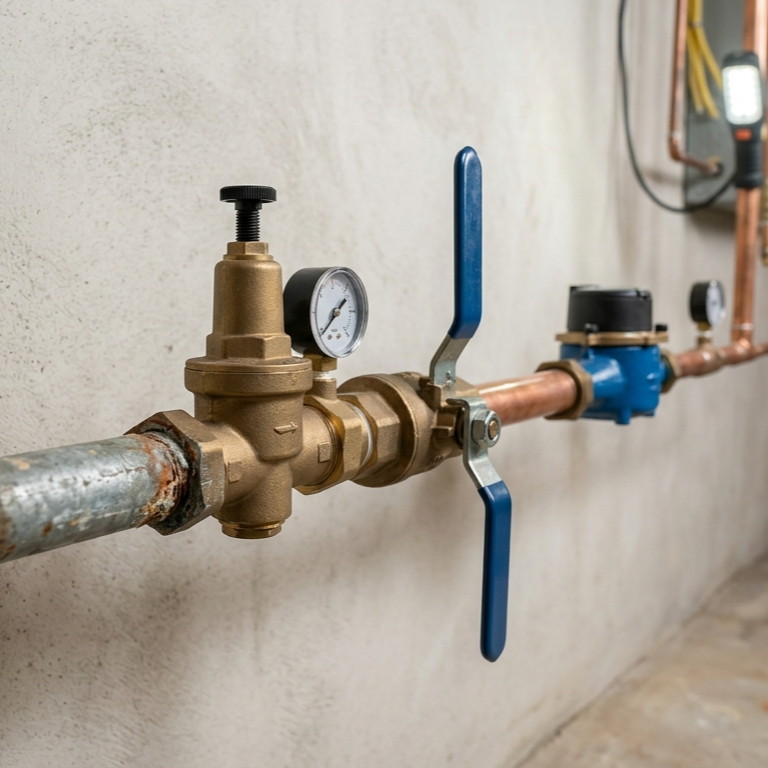
Quick Answer: When low water pressure affects the entire house — not just one faucet — the cause is usually upstream of your fixtures. The common culprits are a failing pressure regulator, a partially closed main or meter valve, mineral buildup narrowing older galvanized pipes, a hidden leak bleeding off pressure, or a problem with the municipal supply or a shared issue at the meter. Pinpointing it means working from the source inward: confirm the supply, check the main shutoff and regulator, then look at the pipes. Whole-house low pressure is solvable once you find which link in the chain is restricting the flow.
When a single faucet trickles, the problem is usually that fixture. But when the pressure is weak everywhere — the shower, the kitchen sink, the washing machine all underwhelming — the cause is somewhere upstream, affecting the water before it ever reaches your fixtures. Tracking it down is a matter of working from the supply inward.
Start at the Source
Whole-house low pressure means looking at everything the water passes through before it splits off to individual fixtures: the municipal supply, the meter, the main shutoff valve, the pressure regulator, and the main pipes. A problem at any of these affects the whole house at once, which is actually a helpful clue — it narrows the search to the shared parts of the system.
The first question is whether the issue is yours or the supplier's. If a neighbor on the same line also has weak pressure, the issue may be municipal. If it's just your house, the cause is on your side of the meter.
Cause One: A Failing Pressure Regulator
Most homes have a pressure-reducing valve — a regulator — where the main line enters, which keeps incoming municipal pressure at a safe level for your plumbing. When that regulator fails, it can drift in either direction. A regulator that fails low chokes pressure to the whole house. Because it sits at the entry point, its effects reach every fixture equally, which makes a failing regulator one of the first things to suspect with whole-house low pressure. Regulators wear out over the years and are a known failure point.
Cause Two: A Valve That's Not Fully Open
It sounds too simple, but a main shutoff valve or meter valve that isn't fully open is a frequent cause, especially after recent plumbing work. If a valve was partially closed during a repair and never reopened all the way, it restricts flow to the entire house. Checking that the main shutoff and the valve at the meter are fully open is a quick, no-cost first step that sometimes solves the whole problem.
Cause Three: Mineral Buildup in Aging Pipes
In older homes with galvanized steel pipes, decades of corrosion and mineral scale build up on the inside walls of the pipe, narrowing the channel through which water can flow. As the effective diameter shrinks, pressure and flow drop throughout the house. This happens gradually, so the decline can be easy to miss until it's significant. Hard water accelerates it. When clogged old piping is the cause, the long-term fix is usually repiping, since you can't clear scale out of the full length of a corroded system.
| Cause | Tell-tale sign | Direction of fix |
|---|---|---|
| Failing pressure regulator | Pressure low at every fixture | Replace the regulator |
| Valve not fully open | Started after recent work | Open main/meter valve |
| Scaled galvanized pipes | Old home, gradual decline | Repipe affected lines |
| Hidden leak | Low pressure plus high bill | Locate and repair leak |
| Municipal supply issue | Neighbors affected too | Contact the utility |
Cause Four: A Hidden Leak
A significant leak somewhere in the system bleeds off pressure before it reaches your fixtures. If low pressure shows up alongside a higher water bill, the sound of running water, or damp spots, a hidden leak — including a slab leak under the foundation — moves up the list. The leak diverts water and pressure away from where you want it. Finding and repairing it restores both the pressure and the wasted water.
Cause Five: The Municipal Supply
Sometimes the problem isn't in your house at all. Water main work, a utility-side issue, or simply lower pressure in your area can reduce what arrives at your meter. If your neighbors notice the same thing, or if it coincides with known work in the area, the supply is the likely source. In that case, a call to the water utility is the right step, and a booster system is an option if your area's pressure is chronically low.
Before assuming the worst, check the simplest things first. Make sure the main shutoff and meter valves are fully open, and ask a neighbor if their pressure is normal. Those two checks take minutes and can save you from chasing a problem that's either trivial or not on your property.
How a Pro Tracks It Down
A plumber diagnoses whole-house low pressure methodically: testing the actual pressure with a gauge at an outdoor spigot to measure what's coming in, checking the regulator's output, inspecting valves, and looking for leaks. That measured approach separates a failed regulator from clogged pipes from a supply issue, which matters because the fix for each is completely different. Guessing can mean replacing parts that were never the problem.
Frequently Asked Questions
Because something upstream of your fixtures is restricting the water — most often a failing pressure regulator, a main or meter valve that isn't fully open, mineral buildup in old galvanized pipes, a hidden leak, or a municipal supply issue. Since these sit before the water splits to individual fixtures, they lower pressure everywhere at once.
A failing regulator usually drops pressure evenly across every fixture in the house, and it's a common wear item. A plumber can confirm it by measuring the pressure before and after the regulator with a gauge. If the output is well below what's coming in from the street, the regulator is likely the problem and is typically replaced.
It can. A significant leak diverts water and pressure away from your fixtures. If the low pressure comes with a higher-than-normal water bill, the sound of running water, or damp areas, a hidden leak — possibly under the slab — is worth investigating. Fixing it restores both pressure and the water being lost.
In older homes with galvanized steel pipes, internal corrosion and scale slowly narrow the pipes until the flow noticeably drops. It usually develops gradually rather than suddenly, but it can reach a tipping point where it becomes obvious. Hard water speeds it up. Repiping is the lasting fix when scaled pipes are the cause.
Yes. Water main work, utility-side problems, or generally low pressure in your area can all reduce what reaches your home. A good clue is whether neighbors on the same supply have the same issue. If so, contacting the water utility is the right move, and a pressure-boosting system can help where supply pressure is chronically low.
The simplest things: confirm your main shutoff and meter valves are fully open, since a partly closed valve after recent work is a common and free fix. Then check whether neighbors are affected, which tells you if the problem is yours or the supplier's. Those quick checks often point you in the right direction before anything is replaced.
Find the Restriction, Restore the Flow
Whole-house low pressure points to a shared part of your system — the regulator, a valve, the main pipes, a leak, or the supply itself. Because it affects everything at once, the search starts at the source and works inward. Once the restricting link is found, the fix is usually clear, and full pressure returns to every tap in the house.
Weak water pressure throughout the house — Get the regulator, valves, and pipes tested to find the real restriction and fix it. American Discount Plumbing serves Phoenix and the Valley. ROC #150707. Call (602) 883-2787.