

Water Bill Sky-High With No Visible Leak? The Likely Culprit
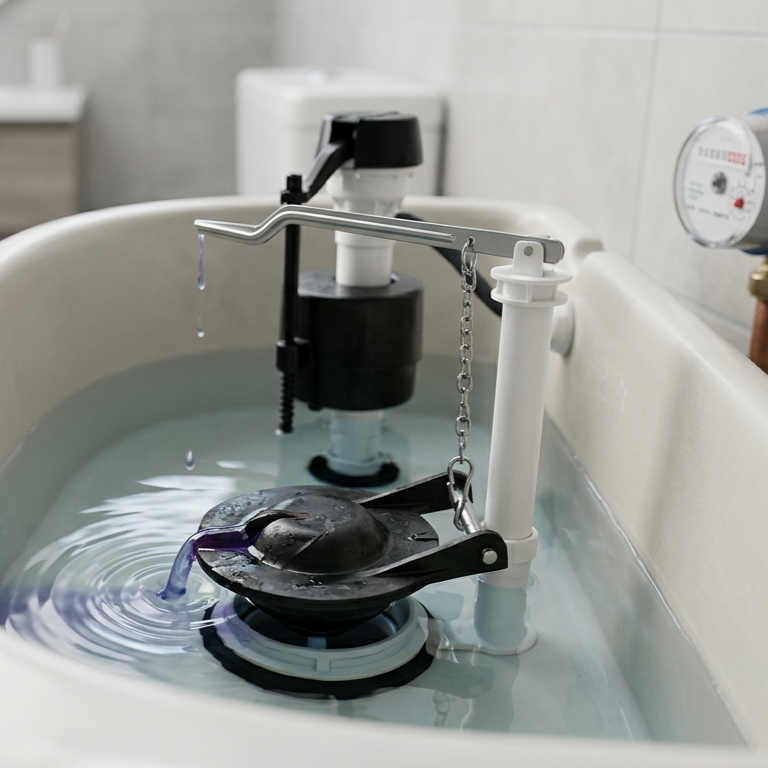
Quick Answer: The usual culprit is a leak you can't see — most often a running toilet, which can quietly waste around 200 gallons a day. After that come slab leaks, irrigation leaks, a water softener stuck in its cycle, and dripping fixtures. Two simple tests find them: drop food coloring in the toilet tank and watch for color in the bowl, and read your water meter's low-flow indicator with everything off. In the desert, a summer spike is often just irrigation, not a leak at all.
You open the water bill, and it's twice what it usually is, so you walk through the house looking for the puddle that explains it — and there isn't one. That's the frustrating part about a high water bill: the biggest wasters are almost always invisible, running silently inside a toilet, under the slab, or out in the irrigation system. Here's how to track it down without guessing.
Start With the Toilet — It's Usually the Toilet
If water is disappearing with nothing visible, the first suspect is a running toilet, and it's the suspect more often than all the others combined. A worn flapper — the rubber seal at the bottom of the tank — lets water trickle from the tank into the bowl around the clock, and because it drains straight down the drain, you never see a drop on the floor. The EPA estimates that an average leaking toilet wastes about 200 gallons a day. That's the kind of silent loss that doubles a bill while looking like nothing is wrong.
The test takes two minutes. Put a few drops of food coloring in the tank, wait about 10 minutes without flushing, and check the bowl. If color shows up in the bowl, water is leaking past the flapper, and the toilet needs a new one. (Flush afterward so the dye doesn't stain.) It's the single highest-value check you can run, and the fix is usually cheap.
The Water Meter Tells You the Truth
Your meter is a leak detector you already own. Turn off every water-using fixture and appliance in the house and outside — sinks, ice maker, irrigation, everything — then find the meter and look at its low-flow indicator, the small dial or triangle that spins on even a tiny flow. If it's moving with everything off, water is going somewhere.
From there, you can narrow it down. Close the main shutoff valve to the house: if the indicator stops, the leak is inside (most likely that toilet). If it keeps moving, shut off the irrigation; if it stops, then the leak is in the irrigation system. And if it still moves with both the house and irrigation off, the leak is in the underground service line between the meter and the house — a job for a plumber. One catch worth knowing: a flapper that leaks on and off may not show on a single meter reading, which is why the dye test and the meter test work best together.
| Where you're losing water | How it hides | How to catch it |
|---|---|---|
| Running toilet (flapper) | Drains into the bowl silently | Dye test in the tank |
| Underground/slab line | No surface water at all | Meter moves with everything off |
| Irrigation/drip system | Underground, runs on a timer | Meter stops when irrigation is off |
| Water softener cycling | Drains during a stuck regeneration | Check for constant draining |
| Dripping faucets/fixtures | Slow, easy to ignore | Listen and inspect; a 1-drip/sec faucet wastes 3,000+ gal/yr |
The Hidden Causes Beyond the Toilet
When the toilet's clear, a few other things waste water without a visible puddle. A slab leak — a break in the water line running under the concrete foundation — shows up as a warm spot on the floor, the faint sound of running water when everything is off, and a climbing bill, with no surface water because it's all under the slab. Most Phoenix-area homes sit on slab foundations, which makes this a real local possibility.
A water softener stuck in its regeneration cycle can run continuously to the drain, quietly wasting thousands of gallons a month without you ever seeing it. Irrigation and drip lines crack underground and run on a timer, so they waste water at 5 a.m. when no one's watching — the EPA notes a small irrigation leak that can waste roughly 6,300 gallons a month. And ordinary dripping faucets add up faster than they look: a faucet dripping once per second wastes more than 3,000 gallons a year.
Sometimes It's Not a Leak at All
Before you tear into the plumbing, rule out the simplest explanation: you used more water. In the desert, outdoor use can run 60 to 70 percent of a home's total, almost all of it irrigation, so the first hot month of summer routinely spikes a bill without anything being broken. A new yard, more frequent watering, guests in town, or filling a pool all show up on the bill as a jump that looks alarming but is just usage.
There's also a slower, sneakier factor here: hard water. Phoenix-area water runs hard, and over time, scale builds inside pipes, water heaters, and fixtures. That scale doesn't waste water on its own, but it stresses fixtures and contributes to the drips and failures that do. High household water pressure works the same way — pressure above 80 psi (the point at which plumbing code requires a pressure-reducing valve) strains every connection and increases both consumption and the risk of a leak.
Frequently Asked Questions
A running toilet, by a wide margin. A worn flapper lets water trickle from the tank into the bowl continuously, draining away without ever reaching the floor — the EPA puts the average at about 200 gallons a day. Test it by putting food coloring in the tank and checking whether the color appears in the bowl after about 10 minutes without flushing.
Turn off all water inside and outside, then watch the meter's low-flow indicator — the small dial or triangle that spins on tiny flows. If it moves with everything off, you have a leak. Close the main shutoff to tell whether it's inside or outside, and shut off irrigation to separate that from the underground service line.
Yes. If a softener gets stuck in its regeneration cycle, it can run continuously to the drain, wasting thousands of gallons a month with nothing visible in the house. If your bill jumped and you have a softener, check whether it's draining constantly or cycling far more often than it should — that points to a stuck valve or control.
The classic trio is a warm spot on the floor (often from a hot water line), the sound of running water when every fixture is off, and an unexplained jump in the bill, all with no visible water because the leak is under the concrete. Slab leaks need electronic leak detection to pinpoint, so they're not a DIY find — but the meter test will confirm water is being lost.
Because in the desert, most of a home's water goes outdoors — often 60 to 70 percent — and almost all of that is irrigation. The first stretch of hot weather, a new yard, or more frequent watering will spike the bill without anything being broken. Rule out usage and irrigation before assuming there's a hidden leak.
Not directly, but it contributes. Hard-water scale builds up in pipes, fixtures, and the water heater over time, stressing them and leading to drips, failing valves, and water waste. Hard water and high pressure together accelerate the small failures that quietly raise a bill.
Find the Silent One, Fix the Bill
A high bill with no puddle isn't a mystery once you know where to look. Run the dye test on the toilets, read the meter with everything off, and walk the irrigation and the softener. Most of the time, you'll find a flapper or a buried line doing the damage — and if the meter's still spinning with everything shut down, that's the moment to bring in a plumber to chase it down before another month's bill lands.
Bill jumped with no leak in sight? — Get the toilets, meter, slab lines, and softener checked, and the silent waster found and fixed. American Discount Plumbing serves Phoenix and the Valley. ROC #150707. Call (602) 883-2787.